
'Larry Clark's "Kids"' - Harper's Bazaar August 1995
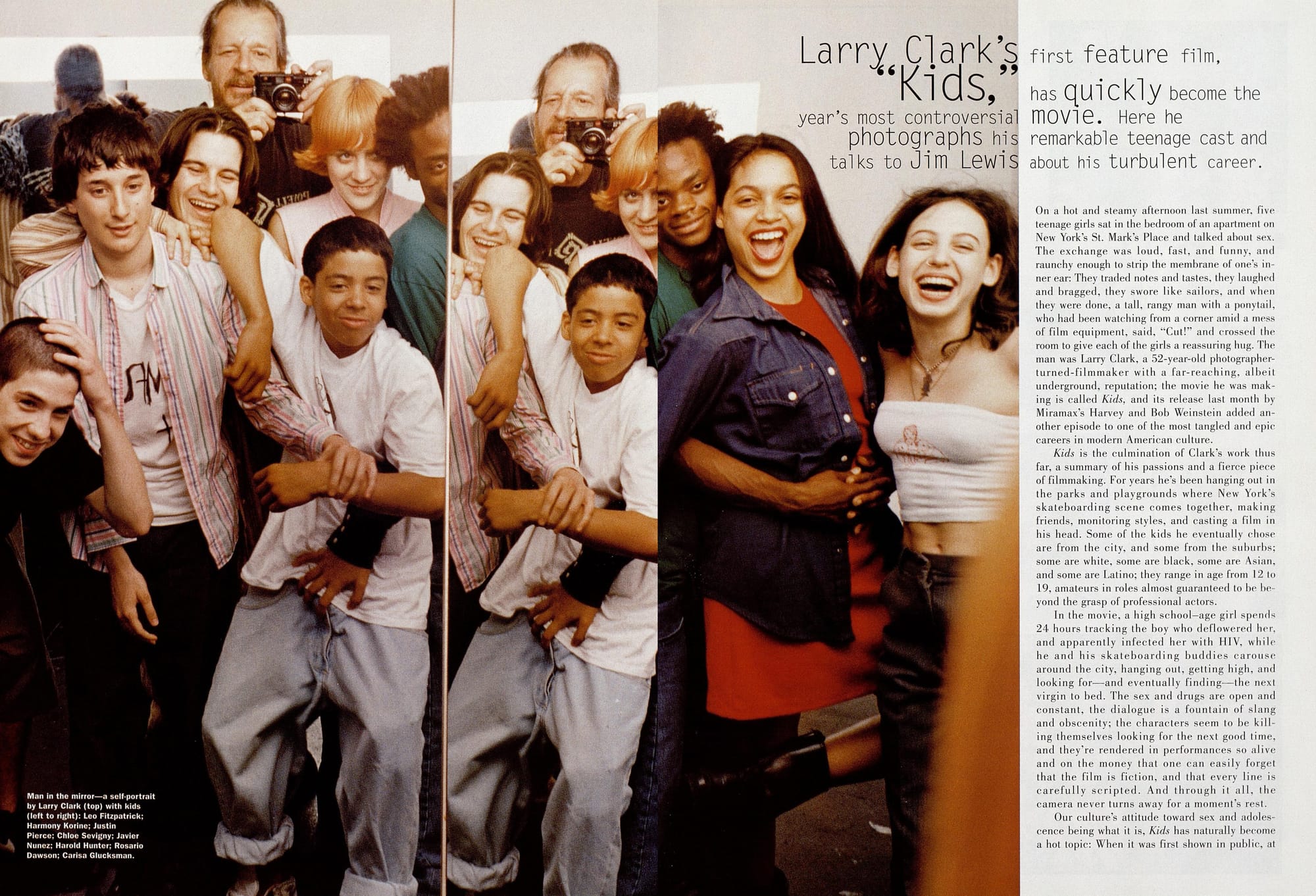
Larry Clark’s first feature film “Kids,” has quickly become the year's most controversial movie. Here he photographs his remarkable teenage cast and talks to Jim Lewis about his turbulent career.
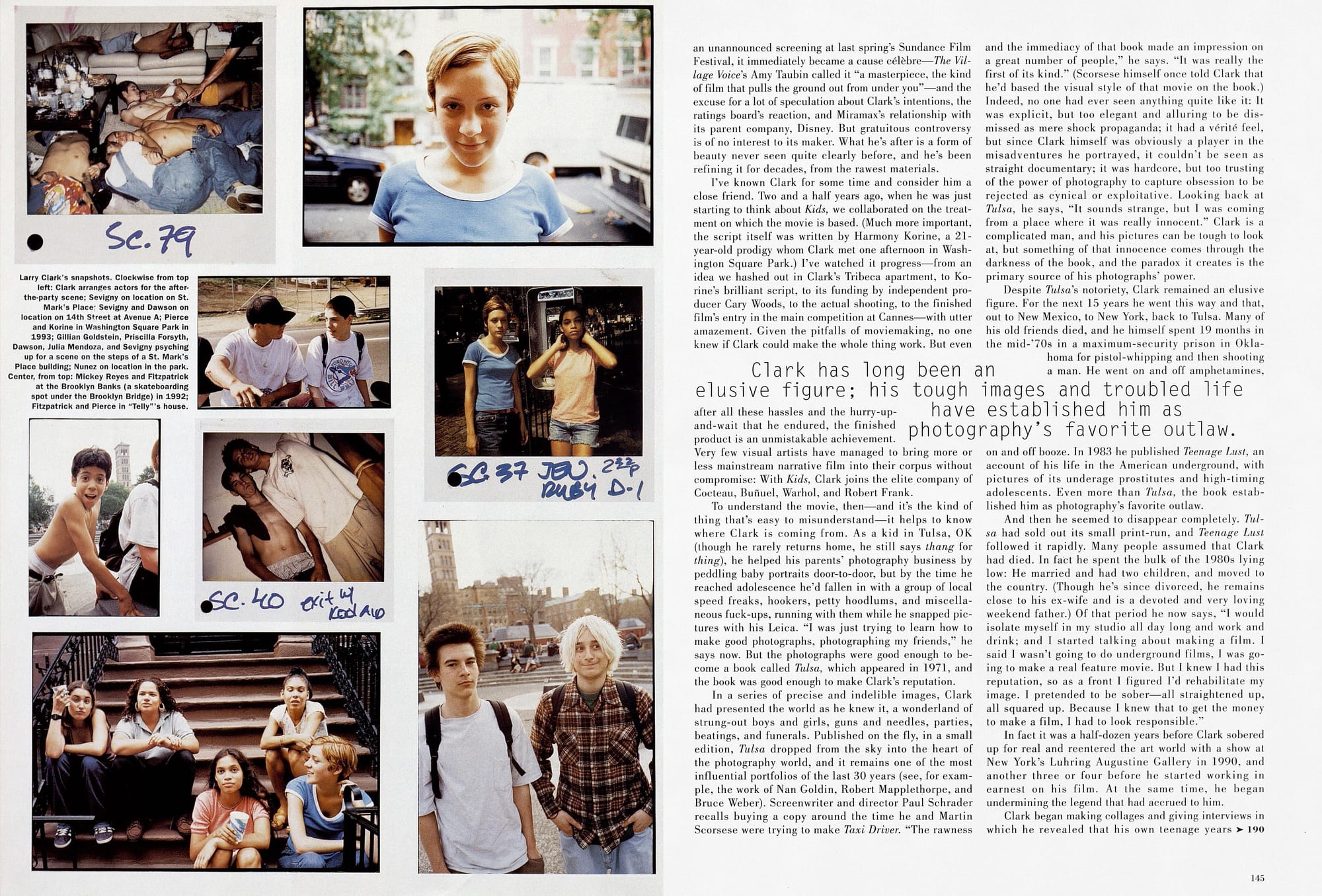
On a hot and steamy afternoon last summer, five teenage girls sat in the bedroom of an apartment on New York's St. Mark's Place and talked about sex. The exchange was loud, fast, and funny, and raunchy enough to strip the membrane of one's inner ear: They traded notes and tastes, they laughed and bragged, they swore like sailors, and when they were done, a tall, rangy man with a ponytail, who had been watching from a corner amid a mess of film equipment, said, "Cut!" and crossed the room to give each of the girls a reassuring hug. The man was Larry Clark, a 52-year-old photographer-turned-filmmaker with a far-reaching, albeit underground, reputation; the movie he was making is called Kids, and its release last month by Miramax's Harvey and Bob Weinstein added another episode to one of the most tangled and epic careers in modern American culture.
Kids is the culmination of Clark's work thus far, a summary of his passions and a fierce piece of filmmaking. For years he's been hanging out in the parks and playgrounds where New York's skateboarding scene comes together, making friends, monitoring styles, and casting a film in his head. Some of the kids he eventually chose are from the city, and some from the suburbs; some are white, some are black, some are Asian, and some are Latino; they range in age from 12 to 19, amateurs in roles almost guaranteed to be beyond the grasp of professional actors.
In the movie, a high school-age girl spends 24 hours tracking the boy who deflowered her, and apparently infected her with HIV, while he and his skateboarding buddies carouse around the city, hanging out, getting high, and looking for-and eventually finding-the next virgin to bed. The sex and drugs are open and constant, the dialogue is a fountain of slang and obscenity; the characters seem to be killing themselves looking for the next good time, and they're rendered in performances so alive and on the money that one can easily forget that the film is fiction, and that every line is carefully scripted. And through it all, the camera never turns away for a moment's rest.
Our culture's attitude toward sex and adolescence being what it is, Kids has naturally become a hot topic: When it was first shown in public, at an unannounced screening at last spring's Sundance Film Festival, it immediately became a cause célèbre—The Village Voice's Amy Taubin called it "a masterpiece, the kind of film that pulls the ground out from under you"-and the excuse for a lot of speculation about Clark's intentions, the ratings board's reaction, and Miramax's relationship with its parent company, Disney. But gratuitous controversy is of no interest to its maker. What he's after is a form of beauty never seen quite clearly before, and he's been refining it for decades, from the rawest materials.
I've known Clark for some time and consider him a close friend. Two and a half years ago, when he was just starting to think about Kids, we collaborated on the treatment on which the movie is based. (Much more important, the script itself was written by Harmony Korine, a 21-year-old prodigy whom Clark met one afternoon in Washington Square Park.) I've watched it progress—from an idea we hashed out in Clark's Tribeca apartment, to Ko-rine's brilliant script, to its funding by independent producer Cary Woods, to the actual shooting, to the finished film's entry in the main competition at Cannes—with utter amazement. Given the pitfalls of moviemaking, no one knew if Clark could make the whole thing work. But even after all these hassles and the hurry-up-and-wait that he endured, the finished product is an unmistakable achievement. Very few visual artists have managed to bring more or less mainstream narrative film into their corpus without compromise: With Kids, Clark joins the elite company of Cocteau, Buñuel, Warhol, and Robert Frank.
To understand the movie, then—and it's the kind of thing that's easy to misunderstand—it helps to know where Clark is coming from. As a kid in Tulsa, OK (though he rarely returns home, he still says thang for thing), he helped his parents' photography business by peddling baby portraits door-to-door, but by the time he reached adolescence he'd fallen in with a group of local speed freaks, hookers, petty hoodlums, and miscellaneous fuck-ups, running with them while he snapped pictures with his Leica. "I was just trying to learn how to make good photographs, photographing my friends," he says now. But the photographs were good enough to become a book called Tulsa, which appeared in 1971, and the book was good enough to make Clark's reputation.
In a series of precise and indelible images, Clark had presented the world as he knew it, a wonderland of strung-out boys and girls, guns and needles, parties, beatings, and funerals. Published on the fly, in a small edition, Tulsa dropped from the sky into the heart of the photography world, and it remains one of the most influential portfolios of the last 30 years (see, for exam-ple, the work of Nan Goldin, Robert Mapplethorpe, and Bruce Weber). Screenwriter and director Paul Schrader recalls buying a copy around the time he and Martin Scorsese were trying to make Taxi Driver. "The rawness and the immediacy of that book made an impression on a great number of people," he says. "It was really the first of its kind." (Scorsese himself once told Clark that he'd based the visual style of that movie on the book.)
Indeed, no one had ever seen anything quite like it: It was explicit, but too elegant and alluring to be dismissed as mere shock propaganda; it had a vérité feel, but since Clark himself was obviously a player in the misadventures he portrayed, it couldn't be seen as straight documentary; it was hardcore, but too trusting of the power of photography to capture obsession to be rejected as cynical or exploitative. Looking back at Tulsa, he says, "It sounds strange, but I was coming from a place where it was really innocent." Clark is a complicated man, and his pictures can be tough to look at, but something of that innocence comes through the darkness of the book, and the paradox it creates is the primary source of his photographs' power.
Despite Tulsa's notoriety, Clark remained an elusive figure. For the next 15 years he went this way and that, out to New Mexico, to New York, back to Tulsa. Many of his old friends died, and he himself spent 19 months in the mid-"70s in a maximum-security prison in Okla-homa for pistol-whipping and then shooting a man. He went on and off amphetamines, on and off booze. In 1983 he published Teenage Lust, an account of his life in the American underground, with pictures of its underage prostitutes and high-timing adolescents. Even more than Tulsa, the book established him as photography's favorite outlaw.
And then he seemed to disappear completely. Tulsa had sold out its small print-run, and Teenage Lust followed it rapidly. Many people assumed that Clark had died. In fact he spent the bulk of the 1980s lying low: He married and had two children, and moved to the country. (Though he's since divorced, he remains close to his ex-wife and is a devoted and very loving weekend father.) Of that period he now says, "I would isolate myself in my studio all day long and work and drink; and I started talking about making a film. I said I wasn't going to do underground films, I was going to make a real feature movie. But I knew I had this reputation, so as a front I figured I'd rehabilitate my image. I pretended to be sober-all straightened up, all squared up. Because I knew that to get the money to make a film, I had to look responsible."
In fact it was a half-dozen years before Clark sobered up for real and re-entered the art world with a show at New York's Luhring Augustine Gallery in 1990, and another three or four before he started working in earnest on his film. At the same time, he began undermining the legend that had accrued to him.
Clark began making collages and giving interviews in which he revealed that his own teenage years hadn't been quite so romantically lawless as his audience had as-sumed. A late puberty left him with a sense of not belonging or measuring up; to make matters worse, his father more or less disowned him. As he entered adulthood, then, he became obsessed with the few extraordinary years of adolescence, with all their uncontrollable awkwardness, horror, and excitement; in that regard, Kids is just a continuation of Tulsa by other means. It is all part of a surprisingly personal exorcism, an attempt to capture all the glories of youth that he felt he missed the first time out, by turning each picture into an attempt to create an idealized self-portrait-as-a-teenage-boy.
To admit as much was enormously difficult for Clark, but it had the advantage of killing a substantial myth, one that had forced him into a role as the art world's pet savage, and that had made the viewing of his work more vicarious than it should have been. Clark is neither a loose cannon nor a naif; his work is not meant to be a cheap thrill. Like most successful artists, he's a workaholic with extraordinary control over his medium and an addiction to daring himself. But he's ambivalent about the revision he made to his life story.
"I guess it worked," he says. "I don't know.... I don't know why I did it. I'm not particularly glad I did it. It's better not to tell on yourself. Don't plead guilty. That's the old convict thing, you know. The old outlaw thing. Never plead guilty."
Guilty or no, it's his profound identification with the kids he photographs that saves Clark's work from being prurient, and he gets angry at the very question of the fitness of his relationship with them. "When I'm photographing people I have my priorities together," he says.
"I would not hurt these kids, or harm these kids, or exploit these kids in any way at all. No way. And I would never make anybody look bad. There's a bond there." Indeed, I've spent time with him while he was hanging out with his teenage friends, and the respect and appreciation they have for each other is something to see. "I realize I'm 52 years old," he says, "but I just become them, and they treat me as one of the guys." Korine, who first introduced Clark to the kids who comprise his cast, agrees: "Larry has this power, this ability— more than anything it's his genius—to ingratiate himself." That had to change just a little as the movie was being shot. The set, as one might expect, could get a little bit out of control; one actor, for example, got picked up by the police for running wild on the night before the last, crucial day of filming. Clark let him cool off in a cell overnight, and then went down the next morning and bailed him out. "When I made the film I was still their friend, but I was also an authority figure," he says. "They were working, I was the boss; I was a dictator, I could be mean and yell at them, threaten them. It got pretty rough." Still, you can tell from the openness of the performances that the kids trust him completely, and you can tell from the film itself that they have no reason not to: All he wants is to show the disturbing beauty of their lives.
By now Clark has been propelled into a fame, if not an infamy, beyond anything he's experienced before; it's a long way from an Oklahoma jail cell to a press conter-ence on the French Riviera-which may be why he seems to be so unimpressed with all the hoopla, saving his most unprintable scorn for the circus of celebrity.
He'd still rather hang out with the kids than go Hollywood. And he's getting ready to film them again, for a new movie, also written by Korine, called Ken Park. The frenzy around Kids hasn't fazed him at all. "It was crazy," he says with a kind of perverse pride. "It was crazy, crazy, crazy. But I pulled it off."