Frank151 Book Japan Chapter 3 'Interviews' Translated
Full scans of Frank 151 Book Japan Chapter 3
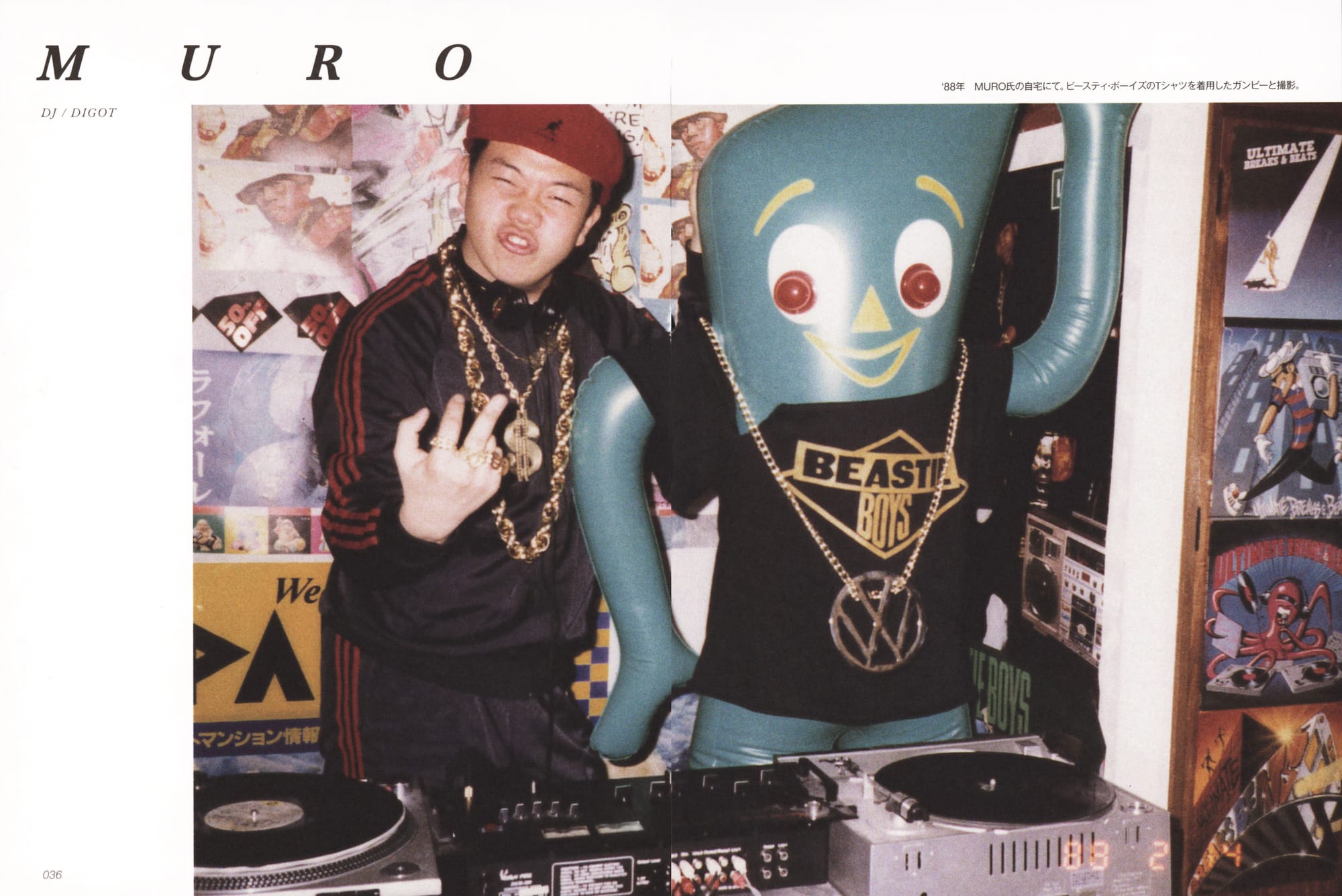
DJ Muro - DJ / DIGOT
Bio: Born in Saitama Prefecture. Through his activities in KRUSH POSSE and MICROPHONE PAGER, he shocked the Japanese-language rap scene. As both an MC and DJ, he reigns as one of the pioneers of today’s Japanese hip-hop scene. His signature title, “King of Diggin’,” has made his name known around the world.
After working with the select shop SAVAGE!, he now also produces DIGOT.
Frank151: What was your path into music?
MURO: When I was a kid, my parents ran a gas station, and I used to play beside it. Cars were constantly coming in fast, and it was dangerous, so when I was in the lower grades of elementary school, they bought me a small portable player. Back then, when you bought books, they came with sonosheets, and I started collecting those. They were things like theme songs from manga. I guess I’ve always had a collector’s instinct. I liked music and anime theme songs.
Then I started junior high, and even though I wanted to go to discos, I couldn’t get in. So a friend’s father took us to a roller-skating rink instead. But there was a DJ there, and the environment wasn’t that different from a disco. At the time, there was a culture of “rental record shops,” so I would rent the records I had checked out at the roller rink and record them onto cassette tapes.
For my generation, heavy metal was at its peak, so almost every week my friends dragged me along to live shows. I ended up seeing all kinds of things, and I think the fact that I wasn’t picky or dismissive back then is connected to what I do now.
Frank151: From there, after graduating high school, did you move from disco into Black music?
MURO: Yes. I’d never really liked doing or thinking the same things as other people. There were overwhelmingly few people listening to Black music. In high school, I don’t think there were even a handful. Around then, there was something called a modular stereo, a component system with a double cassette deck. One day, by chance, I pressed play on both decks at the same time and the sounds mixed together. I thought, “Oh! I can mix with this!” So at the school festival, I brought that stereo, stacked up cassette tapes on both sides, and did something like DJing. Though there were times when nobody was there at all… That was probably my first attempt, or my first impulse toward wanting to become a DJ and play music nonstop.
Frank151: Had you already encountered DJ culture at that point?
MURO: Yes. I had seen DJs at roller-skating rinks and secretly at discos, so I thought, “That’s cool.” I liked dancing to music, but then I started wanting to be on the other side — to make people dance. As I gradually became able to get into discos, I’d go straight to the booth and keep checking what records the DJ was playing.
On the way home, there was a record shop in Shinjuku called Winners that stayed open quite late. There was a period when I’d buy the records I’d checked at the disco, even though they were expensive.
Frank151: So before rap, you had already encountered DJing.
MURO: Yes. A friend told me, “There are guys doing the kind of thing you do at the pedestrian paradise in Harajuku.” I went, and Akira — CRAZY-A — KRUSH, BEL and others were there. I thought, “Wow. Japanese people are doing this too.” I went for two or three weeks in a row. At the time I was much bigger physically, so apparently I really stood out, and KRUSH came up and asked, “Do you like this?” Then he took me to his home in Ōizumi.
I would carry records for him, and since nobody around them happened to have a driver’s license, I’d drive people back and forth while learning all kinds of things. Around the time I started buying records, Run-D.M.C. had come out, the number of DJs was increasing, and sets of two turntables were being sold for the first time. KRUSH said, “There are going to be a lot more DJs, so you should rap!” and suddenly started writing lyrics. He was like, “Try singing this.” I guess that was the beginning of rap for me. KRUSH was the person who taught me that there’s no point in doing the same thing as everyone else, so I’m still very grateful to him.
Frank151: How old were you then?
MURO: It was 1989, so I was around eighteen or nineteen. I had graduated high school and was spending a year as a rōnin, going to prep school. Around then I got my driver’s license, so I’d punch in on something like the prep school timecard, then skip out and hang around the CISCO parking lot by Shinjuku Alta.
Frank151: What kind of fashion were you into then?
MURO: I was pretty outrageous. I’d carry a huge boombox, pull the emblem off a Volkswagen, attach it to a chain, and ride the Keihin-Tōhoku Line like that. When I made a demo tape, Watanabe Mi-kun was working at Celluloid in Laforet, so I’d go there and say, “I made a demo, listen to it,” and play it on the boombox. I must have been a huge nuisance.
Frank151: At that time, how was it with KRUSH and “KRUSH POSSE”?
MURO: Back then, they were still active as B-FRESH. They’d say, “You’re big, so stand beside us,” and let me do security.
Frank151: Were you originally in B-FRESH too?
MURO: Yes.
Frank151: Really?!
MURO: Well, I was just doing security or standing there holding the boombox. To be honest, the jobs BEL brought in were not normal. For example, an opening event at Chūjitsu-ya in Narimasu — totally unrelated things like that. So backstage, there’d be people practicing pantomime, people practicing magic tricks, and we’d be there talking about “What should the second song be?” KRUSH was probably getting stressed in that environment too.
At the time, apart from that, there were really only contests and gong shows. The Inkstick gong shows started, and I think they became a chance for various people to get to know us.
Frank151: Since Inkstick came up, what were your impressions of Tokyo, clubs, and parties around 1988–89?
MURO: I really remember Club D in Harajuku, where we did a lot of contests. Back then, discos and clubs were clearly separated, and the crowds were completely different. I loved both. When Droopy Drawers was opening in Roppongi, KRUSH was scouted to DJ there. I’d first drive KRUSH to Droopy, then go straight to ZOO in Shimokitazawa, go to parties by Mi-kun or Hiroshi Kawanabe, and they’d let me hold the mic. Then I’d go back to Droopy, and beside DJ Honda scratching, KRUSH and I would get to hold the mic again. Those were huge experiences for me.
Frank151: Interestingly, the same clubs come up in everyone’s stories. Droopy Drawers always comes up, and Bobby also went there.
MURO: Back then, there was the culture of Roppongi Circus, or Picasso, Monkberry, 328, Red Shoes — club culture was really divided. Because I went to both sides, I came to understand how both were fun, and I thought, “What would happen if I did the opposite?” One day at ZOO in Shimokitazawa, Hiroshi Egaitsu asked me, “Do you want to DJ?” I played New Jack Swing, the kind of thing they played in Roppongi, at ZOO. And at Droopy Drawers, I played earthy reggae instead. I think that worked. People started noticing, like, “Something about this guy is different,” or “He’s weird.”
Frank151: By the time Droopy comes up, KRUSH POSSE was already taking shape, right?
MURO: Yes. It was already formed.
Frank151: Who were the first members?
MURO: There was KRUSH and KRUSH’s younger brother BANG, with two DJs and me. Later, a DJ named GO replaced BANG, and the three of us performed together.
Frank151: What led from KRUSH POSSE breaking up to forming MICROPHONE PAGER?
MURO: During the KRUSH POSSE period, TWIGY and Hazu invited us to Nagoya. I thought there was nobody in Tokyo with their kind of uniqueness, so we hit it off. TWIGY and I exchanged contact information and said, “When you come to Tokyo, let’s keep in touch.” The first time we met was at a contest. At the time, I really wanted Jordan 3s, and TWIGY was wearing the black cements, so I was like, “Where did you buy those? Trade with me!” Well, I guess it was kind of an abduction. Later I kept saying, “Aren’t you going to come to Tokyo?” and eventually he ended up living at my parents’ house.
Frank151: Really?
MURO: Yes. At my parents’ house, my grandmother somehow wrote “Twingy” on his chopsticks. There were chopsticks like that, and when I came home, there’d be little notes like, “Boy-Ken called.” There was that warmth you only get at a family home.
At that time, we were actually really indebted to people from V.I.P. and reggae scenes. There weren’t hip-hop venues, so there were places like Club Jamaica and Afromania, and we often got to join in there.
Frank151: From around then, you formed MICROPHONE PAGER and began focusing on New York. Can you talk about that?
MURO: That story is really about MASAO and TAKE-G. At ZOO in Shimokitazawa, there weren’t many people with dreads or dancers. But every week, two guys with dreads would come. I wondered if it was because there was a select shop called Sparks Beat in Shimokitazawa. They would always come when I played really obscure tracks and ask, “Who is this?” Those two were MASAO and TAKE-G.
At some point, they brought me a VHS tape and said, “We really want you to watch this.” For a while I wouldn’t take it, saying, “I don’t like dancers.” But they came so often that I finally watched it, and it was really hardcore stuff like Kool G Rap and EPMD. I said, “This is surprisingly masculine.” Then they started naming dancers. I knew up to Mop Top, but not much beyond that. They said they had been to New York, and I got really interested in who they were. We started hanging out, getting excited and saying, “It’s New York after all.”
We took the name from a pager that existed back then called Sky Pager and made it MICROPHONE PAGER. The name came together in my room at my parents’ house with the idea: “Let’s increase the number of microphones, the number of MCs. It would be great if a scene like that could exist.”
Frank151: In the early official lineup of Pager, MASAO was there at one point, and TAKE-G appears in photos with you too, right?
MURO: There was also a kid named Gigan for a moment. When we were doing a party called Chain Gang, we’d let people hold the mic. I didn’t like things being too rigid, so there was a sense of “Let’s be a rough collective; freedom is the theme.” Maybe the theme was not making too many rules, so eventually even I didn’t really know who the members were.
But there was me, TWIGY, P.H. FRON who was working under TWIGY, then MASAO and TAKE-G. TAKE-G was also dancing in Fruits of Rhythm, behind Kan Takagi, together with KEN-BO. After that ended, he came over to Pager. I think MASAO was saying things like, “You can do more of what you like over here,” or “How late are you doing this?” At the time, there were factions between discos and different groups, and people absolutely refused to acknowledge each other. A lot of things happened. We were still wild then.
Frank151: Nowadays everyone gets along, but at the time dancers from Shinjuku and Roppongi didn’t get along, and I think there were similar things among rappers and DJs too. From our point of view, it was interesting that people knew of each other by area but weren’t really friendly.
MURO: I see. So you noticed after all.
Frank151: Of course we noticed.
MURO: I was seeing New York directly, so even with clothes, there was Outer Limits, and in that same line there was a shop called Crisp under the elevated tracks between Ueno and Okachimachi. They imported things directly. I would also go to Tokyodo, where Toshimi-kun was, and Celluloid to buy tracksuits. At the time, I was the stylist for KRUSH POSSE. I’d be like, “Please let me choose the jersey colors.” I really liked coordinating uniforms like Stetsasonic. It was fun to make jerseys using fabrics from high brands like MCM or Gucci. I liked putting KRUSH in them and thinking about stage outfits.
Frank151: I interviewed Magara-san too, so Outer Limits came up.
MURO: At the time, I didn’t know Magara-kun’s name, but I knew he was working part-time at Crisp. Vivienne Westwood mountain hats and bondage gear were too expensive for me to buy, but Magara-kun was already wearing them. I remember thinking, “He doesn’t seem that much older than me.” Back then, Magara-kun went to clubs like Monkberry. I was a kid going back and forth between places like Circus and the more uncool Shimokitazawa clubs, so we didn’t really overlap. Recently we’ve started linking up, and that’s really interesting. Things go around and come around.
Frank151: You said you were DJing at Droopy and ZOO. Was KRUSH the reason you started seriously working as a club DJ?
MURO: Yes, KRUSH. I was playing records on Saturdays at Droopy. Then I was offered a Friday regular with YOGGY from EAST END, and that was the first regular slot I got. Around the same time, at ZOO, Egaitsu-san asked, “Do you want to do it with GO?” Until then, I was MURO because of KRUSH, but the places that gave me work as MURO were Droopy Drawers and ZOO in Shimokitazawa. I remember that clearly.
Frank151: I’d also like to ask about GOLD. Do you have memories of GOLD?
MURO: It was a shock. Until then, I thought clubs were something that opened in established neighborhoods like Shinjuku or Roppongi. But when places like Inkstick opened by the bayside and things started getting exciting, I thought, “A whole town is going to form here.” That was thrilling. The scale was huge, the guests and DJs they invited were amazing. As a kid, I thought, “A club with a basketball court on the first floor? That’s incredible.” That was a time when people said to me, “You’re young. Your time is still ahead.”
Frank151: At that time, what were your thoughts about creating a culture around hip-hop?
MURO: First of all, I wanted a place. We really wanted to do our own events. During the Pager period, I drove a Suzuki Jimny — a beat-up one someone had passed on to me. My parents’ house was in Kawaguchi, Saitama, and I’d pick up TWIGY and everyone from there and drive around Tokyo, thinking anywhere was fine as long as there was a place where we could hold a mic. We had a strong desire to do our own events. The manager of ZOO in Shimokitazawa, Yamashita-san, gave us a Monday event. I think that was the beginning.
Frank151: While you were rapping and DJing, what made you start focusing on the “original sources” — soul, funk, and so on — which are now synonymous with you?
MURO: I had been buying records since then. At first, KRUSH told me, “Go to Hunter in Ginza and buy Bob James.” There was a used record shop in Ginza that even ran TV commercials. During KRUSH POSSE, we had a segment on a TV Kanagawa show called Funky Tomato. I hope that never goes up on YouTube.
Frank151: Someone might upload it, saying, “I have that!”
MURO: I’m joking, but until now I’ve bought those tapes from people for 5,000 yen each. There was a segment called “Rap Forest.” We’d go to Yoyogi Park with a blackboard and teach things like how to rhyme. Back then there weren’t many music videos, so they’d say, “MURO-kun, put together the PVs that have come into Japan.” It was the kind of program where we could decide the structure ourselves. We filmed in Ginza every month, so I’d stop by Hunter then. Incidentally, the producer of that show was Tsuyoshi Takashiro. Denki Groove was there too, so things connected in all kinds of ways.
Frank151: And from there you moved into source records?
MURO: I was buying them in parallel, but at the time I didn’t have opportunities to play them. I made a lot of tapes myself, but they were for my own listening. The drive from Ōizumi to Droopy, when I was taking KRUSH there, was the only time I could play my demos for him. So every time I made a different demo, I wanted nothing more than for KRUSH to say, “Who is this?” That’s where it started. That competitive streak probably continues to this day.
In 1993, I was invited to New York for the first time for the Music Seminar. Around then, Stretch Armstrong was doing about ten minutes of quick source-record stuff on the radio. I thought, “Oh! There’s someone doing this! I wasn’t wrong!” From there I started doing it more and more.
I was invited to New York in 1993. At the time, I had started working part-time at a shop on Fire Street called STARRICH, whose manager loved Lionel Richie. I asked, “Is it okay if I go to New York? Can I take time off?” He said, “Then practice signing my card and go buy stock for me.” He handed me his card and said, “If buying stock is part of it, that’s fine.” So I got a week off and went to New York for the first time in 1993.
Frank151: What do you mean by being invited to the Music Seminar?
MURO: An invitation arrived asking MICROPHONE PAGER to perform at the Music Seminar. But they couldn’t pay travel costs for everyone. Since I was working at STARRICH, I thought if I could get travel money from there, we could take one more person. So I went partly to buy stock. At the time, there was no GAP or Timberland in Japan, and XL sizing hadn’t really come in yet. The things I brought back sold immediately. Around then, I bought Kid Capri old-school mixtapes over there, and when I listened to them I thought, “You can play the Jackson 5!” At events that started at places like CAVE in Shibuya, I played Jackson 5 on 7-inch records, and maybe that’s when people started finding it interesting.
Frank151: What led to going to the Music Seminar?
MURO: There was a compilation called Planet Rap from Tommy Boy, and MICROPHONE PAGER’s remix of “Kaisei Kaishi” was going to be included. That’s why we were invited. In the summer of 1993, I went to New York for the first time and performed live.
Frank151: That was your first time in New York?
MURO: For me, yes. MASAO had already been back and forth many times, and he was wearing Polo pieces I had never seen before. I was jealous.
Frank151: I heard TAKE-G’s family ran a dental clinic. He’s become a dentist now, hasn’t he?
MURO: Yes, TAKE-G successfully became a dentist. MASAO had incredible taste. It was almost as if he had Girbaud before Grand Puba wore it. He kept bringing back new things and teaching us about them. I think if MICROPHONE PAGER had an image of being ahead of the curve, it was because of him.
Frank151: What was your first impression of New York?
MURO: It hit me hard. I went thinking of it as America, but the racial mix and everything made me feel, “This isn’t America — New York is its own country.” Even now, whenever I go, it stimulates me and gives me energy. It’s a place I go to recharge. The good thing is that the parts that don’t change stay unchanged.
Frank151: This is probably complete urban legend, but I heard that when you DJed with Q-Tip, at first he was like, “What’s a DJ from Japan going to be like?” But after seeing you DJ, he thought, “This is crazy,” hurried into a taxi, and went home to get records.
MURO: Is that true? But when I got an offer from Q-Tip, someone I admired, at a place called Santos, I was really happy. The urban legend I heard about myself was that I was walking through Center-gai with two huge dogs, big enough that I’d have to be on all fours to match them, and twin children who looked exactly like me on my shoulders, striding through the wind. I was like, “What the hell is that?” And I heard it in two different places while doing regional gigs. How does a rumor like that spread?
Frank151: Going back a little, when you were also buying stock, I have this image of you setting up a stall where today’s Yoshimoto Mugendai Hall is in Shibuya.
MURO: You know about that too?
Frank151: I went there as a kid. My image of you then was that you were unfriendly.
MURO: I was unfriendly.
Frank151: But including that, it was appealing.
MURO: The place that is now American Rag Cie used to be Sazaby, and STARRICH and another company rented two corner rooms on the second floor there. Someone who saw me from the STARRICH balcony scouted me and said, “Don’t you want to do more of what you like?” We were buying stock in that room too. The morning after we came back from a buying trip, I got a call: “MURO! This is serious. Come here right away! For some reason people are lined up all the way to the fire station!” It was a building where of course you weren’t allowed to sell merchandise. You had to ring the intercom to get in. And there we were saying, “Come back in 90 minutes to pick up your dubbed mixtape.” We thought selling clothes there was dangerous, so we rented a tent for 5,000 yen a day and started selling by the Yoshimoto place. After saving a little money, we found a property on the third floor behind Manhattan Records. That became STILL DIGGIN’.
Frank151: From there, the bustle of Udagawachō began. What was the atmosphere of Udagawachō like then?
MURO: CISCO had been there for a long time, but Manhattan Records opening at street level was huge. And CAVE. Those two decisively changed Udagawachō. Day and night. They overwhelmingly brought in B-boys. I think the Friday event at CAVE called Fish was the first time people realized a B-boy event could draw a crowd.
Frank151: There’s definitely an image of everyone hanging out in front of Manhattan Records.
MURO: Yes. I think that was true. Having something like that at street level was huge. It stood out to the general public too.
Frank151: Around then, younger generations started appearing too. GORE-TEX was around you, people connected to Nitro were around. How did you see the younger generation?
MURO: Everyone would come up to me, whether because they found it interesting or were curious, saying, “MURO-kun! MURO-kun!” I’d be like, “Is this interesting? Then what about this?” It was fun, so honestly I don’t remember it clearly. I was absorbed in it. I was doing what I liked, and the people who followed, followed. That became Nitro and others. If someone was interesting, I’d have them work at the shop. Or I’d think, maybe I’ll keep rapping, maybe I’ll try DJing. I feel like the scene expanded from there.
Frank151: Another thing I remember is when Fab 5 Freddy came to Japan and interviewed you for Yo! MTV Raps. In the video, he introduced you by saying, “They can’t speak English, but they’re doing hip-hop in Japan.” That image stayed with me: dancers, King Giddra, everyone. It was really interesting.
MURO: Yes. When I was doing the Friday regular at CAVE, KEN-BO brought ZEEBRA and K-DUB SHINE. We passed the mic around a little, and it was like, “They’re returnees.” We couldn’t speak English, so our theme was, “Even if we can’t speak English, let’s do Japanese rap so cool that someday they’ll imitate us.” But then guys who could speak English appeared, and I sometimes felt like I couldn’t compete. Around then, DJing became so interesting to me that I shifted more and more in that direction. MCs were increasing a lot from that period too.
Frank151: This was before Sanpin Camp, right?
MURO: It was before, but to be honest, around Sanpin I wasn’t that attracted to rap anymore. Rap was something guys who really spoke English could do — returnees had appeared — so I thought, “Maybe I should do something different.” I may have started feeling that way around then.
Frank151: Going back a little, can you explain the process by which MICROPHONE PAGER’s first album came out?
MURO: Around then, we had gradually been making songs we performed live, and FILE Records offered us a deal, so we thought, “Okay, let’s make an album.” But then MASAO got a hernia, and various things happened, and we fell into a serious slump. Everyone was going through hard times and getting stuck. PH wasn’t on it much, and it ended up feeling a bit like a collection of pieces. FILE wanted to release it, but I wasn’t really satisfied and was saying I didn’t quite want to put it out.
At the desk beside me, Taki-shin-kun, who was still at FILE Records before NEIGHBORHOOD, was there. I consulted him, saying, “I want to sample this for the jacket.” So it was something released during a pretty messy period, and that ended up remaining.
Frank151: Did Taki-shin take the jacket you brought and sample it, laying a map behind it?
MURO: Yes. At the time, on Taki-shin’s desk there was a VHS of a biker movie called Hell’s Belles, the one with the miniskirted girl facing away on the cover, which Hysteric Glamour and others sampled. Later that led me to the source record for Ghostface Killah featuring Jadakiss’s “Run,” a hip-hop classic. When I first went to New York, I paid $100 for that record, and Taki-shin had the video. I said, “Please lend it to me. Let me dub it.” There were other small episodes too, but even then I thought, “This guy is ahead.”
Frank151: It’s interesting that you and Taki-shin were working together then.
MURO: Yes. Now it feels presumptuous, but back then I just brought the jacket and said, “Please use this.” Taki-shin-kun remembered it too. He asked me to DJ for a NEIGHBORHOOD anniversary. I’m the same generation as Kubota Takeshi, but Taki-shin still treats me warmly.
Frank151: When people think of Pager, there are things like working with Souls of Mischief. At the time, connecting with overseas artists was amazing.
MURO: Being included on Tommy Boy’s Planet Rap was really huge. It became a proper calling card overseas. For Asians, being released by Tommy Boy was a big deal. When we went overseas, some people knew MICROPHONE PAGER. The day after the Music Seminar in New York, we were even in the newspaper — just a small article, but still. I think those things connected and spread.
Frank151: From there, your attention shifted more toward DJing, and the Diggin’ series began. Was that 1996?
MURO: Diggin’ Ice was 1996, but King of Diggin’ was earlier. At the time, I dubbed an enormous number of cassette tapes to hand out in New York and took them with me. Being able to appear on NYC college radio in 1996 was really big.
Frank151: A school station?
MURO: Yes. There was a DJ named Mayhem, and he asked, “Do you want to appear on the school program’s radio show?” He said, “The guests are Sadat and Akinyele,” so I was really excited. Then I got there and only Relive had come. But when I played there, everyone was banging on the glass and going crazy. I gained a lot of confidence, thinking, “Maybe I can DJ in New York too.” They’d ask, “How do you understand this when you can’t speak English?” and that started to feel good. So then I perversely thought, “I won’t learn English!” I wanted to remain mysterious. That still continues today. But breakbeats are instrumental, so they’re universal. Wherever I went, even London, people found it interesting, and that felt incredibly good.
Frank151: Do you still have all your records?
MURO: No, not at all. At the most, they were divided among four places. Manhattan Records even built me a prefab on the roof and kept the air conditioning on all year, like wine. I also had one room next to the SAVAGE! office, one room in Tomigaya, and one room in Kawaguchi. That was the most. It was stupid. My attitude was, “If you’ve never seen it, buy it!”
Frank151: I think you were the one who transmitted the culture of “digging records” to Japanese kids.
MURO: I’m really happy to hear you say that.
Frank151: We grew up with the idea that you had to dig until your hands turned black, that digging itself was study. But I think that’s disappearing now.
MURO: Now you just hold an iPhone near a song and the title comes up. Once it comes up, of course you look at it, and I think that’s normal now. If I were a kid today, I’d use it too. But back then we didn’t have that, so passion was what moved your whole body. Even now, when I wake up, I go to some Union somewhere, or think, “I need two copies, so I have to find this somewhere.” I still don’t buy online because I’m clumsy. I think, “This record might be at that place,” and call to ask. Maybe that’s why I can still stay in that same passion.
Frank151: Has the number of records you own decreased now?
MURO: Yes, I reduced them. Especially after the earthquake. They collapsed pretty badly. None of the records were ruined, but I reduced them room by room. Now I have about two rooms and a little in the garage. Along the way, I came to understand which records I needed. I had a regular slot at Harlem in Shibuya, and sometimes I found myself matching the customers. I started thinking, “Maybe this isn’t what I’m supposed to be doing.” It was around when DJ HAZIME was about to come in, or had just come in. After that, I left Harlem to HAZIME and stepped away. After 2000, I switched to buying only rap new releases I really liked — things I could still listen to ten years later.
Frank151: Another urban legend: overseas artists who come to Japan don’t go to record shops; they go digging at your place. I heard Just Blaze wanted to go to your home warehouse.
MURO: When I lived in Yoyogi, people came. I knew Just Blaze’s name but didn’t know him personally, yet he knew me well, which felt strange. Another thing — not an urban legend — is that when I was living in a small six-tatami room in Tomigaya, Q-Tip came for a magazine interview and walked straight in with his shoes on. I couldn’t bring myself to tell him not to.
Frank151: A cultural difference.
MURO: From that time, people like Bobby too, but Q-Tip and Grand Puba were incredibly outstanding, both musically and fashion-wise. Bobby would say, “MURO-kun, you’re kind of similar.” Those two were people I admired. They rapped, dug records, produced, DJed — all of that. Lord Finesse too.
Frank151: Do you still have contact with Lord Finesse?
MURO: Yes. Two years ago, at a party called Park Jam in a park in Harlem, I was preparing records when Finesse suddenly ran in and introduced me on the mic. I cried. He said, “When I went to Japan in the ’90s, I heard a cassette tape sampling Burger King. King of Diggin’? Diggin’ is ours! But when I actually listened to the tape, it hit me, and ever since then I’ve recognized MURO.” I was deeply moved and thought, I have no choice but to keep going.
When I sign things, I still write, “Keep on diggin’ 365 days.” I went to New York recently, and ever since the earthquake I had been in a deep slump, wondering, “What have I been trying to communicate all this time?” In a way, I had lost myself. I had produced other people too much and couldn’t produce myself anymore. I couldn’t decide song titles, and I couldn’t enjoy things much.
When I was feeling that lack of confidence, Stezo was at Park Jam this time. I was telling him, “In Japan, dancers and even DMC competitors use ‘It’s My Turn’ for double-copy routines. It’s famous in Japan.” There’s a 1970s group called Skull Snaps whose drum break is used in “It’s My Turn.” Stezo said, “That group is here today. I’m making drums with them now and shooting a documentary to help people understand sampling culture.” I thought that was amazing. Then the camera was pointed at me, and he said, “People say the elements of hip-hop are graffiti, DJing, MCing, and dance, but I think the fifth element should be diggin’.” I thought, “This is it! There was someone here at this moment thinking the same thing.” I was moved and said, “Absolutely.” I thought, “That’s right. I’m diggin’. There’s no doubt that what I’ve been communicating is the act of digging.” That gave me real confidence. This trip to New York wasn’t exactly a return to my roots, but I suddenly saw the whole path of what I had been doing.
Frank151: Every B-boy who was connected to Udagawachō recognizes that. Please have confidence in it. Let me say that as one of the kids from that time.
MURO: Thank you. I think fewer and fewer people are of an age where we can actually talk about these things. Even around me. In the past, when I did interviews like this, the writers had watched me from the beginning. Recently, there are many writers who don’t really understand me at all, so I often have to explain from zero. At those times, I’ve often wondered, “What have I been doing?” But this time, what I’ve done became very clear to me.
Frank151: For that reason, I think there are a lot of parts kids today can’t see. They can’t see the roots, and that’s unavoidable. This issue is a special feature meant to convey that. I also wanted to talk about this: when Tatsuro Yamashita appeared on your Diggin’ Ice ’96, it was a real shock. In terms of feeling “soul,” it showed that it wasn’t only overseas music; you could feel soul in Japanese records too. I understand that now, but at the time nobody in Japan could introduce those things on the same level. If you hadn’t said, “It’s the same, isn’t it?” we never would have noticed. But when that suddenly appeared, I thought, “Ah!” So I still listen to it every summer.
MURO: But you know, I can’t surpass Diggin’ Ice ’96 no matter what I do. It was recorded in one take. If I made a mistake, I had to start again from the beginning. There are rough parts too.
Frank151: But the fact that people still listen nearly twenty years later is amazing.
MURO: I’m happy about that. Also, at Park Jam this time, I played Japanese records. Last time, I played breakbeats with more of the original foundations from over there, hoping people would understand, “This guy knows.” This time I wanted to try playing Japanese records and see what kind of reaction they would get. When I did, the breakdancers kept dancing as if nothing had changed, and even little kids started dancing. There was a great feeling in making people in the birthplace of the music dance to breakbeats from my own country that I had found myself.
Frank151: Thank you. I really wanted to convey the feelings of our generation this time.
MURO: Thank you. But ultimately, it’s about passion, isn’t it? If kids today had something they could feel passionate about, I think they’d probably enjoy things much more.
Frank151: I think they still have the same feeling of loving music. But for better or worse, it has become something completely different from our time. It’s not really about putting in the legwork anymore.
MURO: This is still off the record, but I’m thinking of creating something like an African music lounge in Harajuku. I realized it’s about creating a gathering place, creating a physical place. After coming back from New York this time, I thought we have to create a scene on the ground. There’s no point just complaining that Tokyo doesn’t have good places.
Frank151: We often talk about how important places are too. Back then, you were in the shop, and going to the shop itself mattered. But everyone was very unfriendly.
MURO: It’s hard to imagine now, but I used to click my tongue when customers came in.
Frank151: Still, the atmosphere you could get from a shop — even the smell when you walked into DETENTE — is something I still can’t forget. I always loved the smell of “Black Love,” too.
MURO: Can I say just one more thing? In the ’90s, I liked going around to clothing shops. Back then, the shops carrying those kinds of clothes were DEPT, DETENTE, Tokyodo, and Outer Limits. But not many people went to all four. Everyone was biased toward one place or another.
So I gathered the people from those four shops at a place called Inkstick Suzue and said, “Why don’t we do an event where each shop gets one hour and can do whatever they want?” We only did it once, but for me it was a huge success. I’m really glad we did it.
Frank151: That was in Tokyo, right?
MURO: Yes. People from all over Tokyo gathered, and it was amazing.
Frank151: Because the shops were all separate, people couldn’t really make the rounds, right?
MURO: Exactly. That link between fashion and music was really interesting. I feel like maybe we need to start doing that kind of thing again.
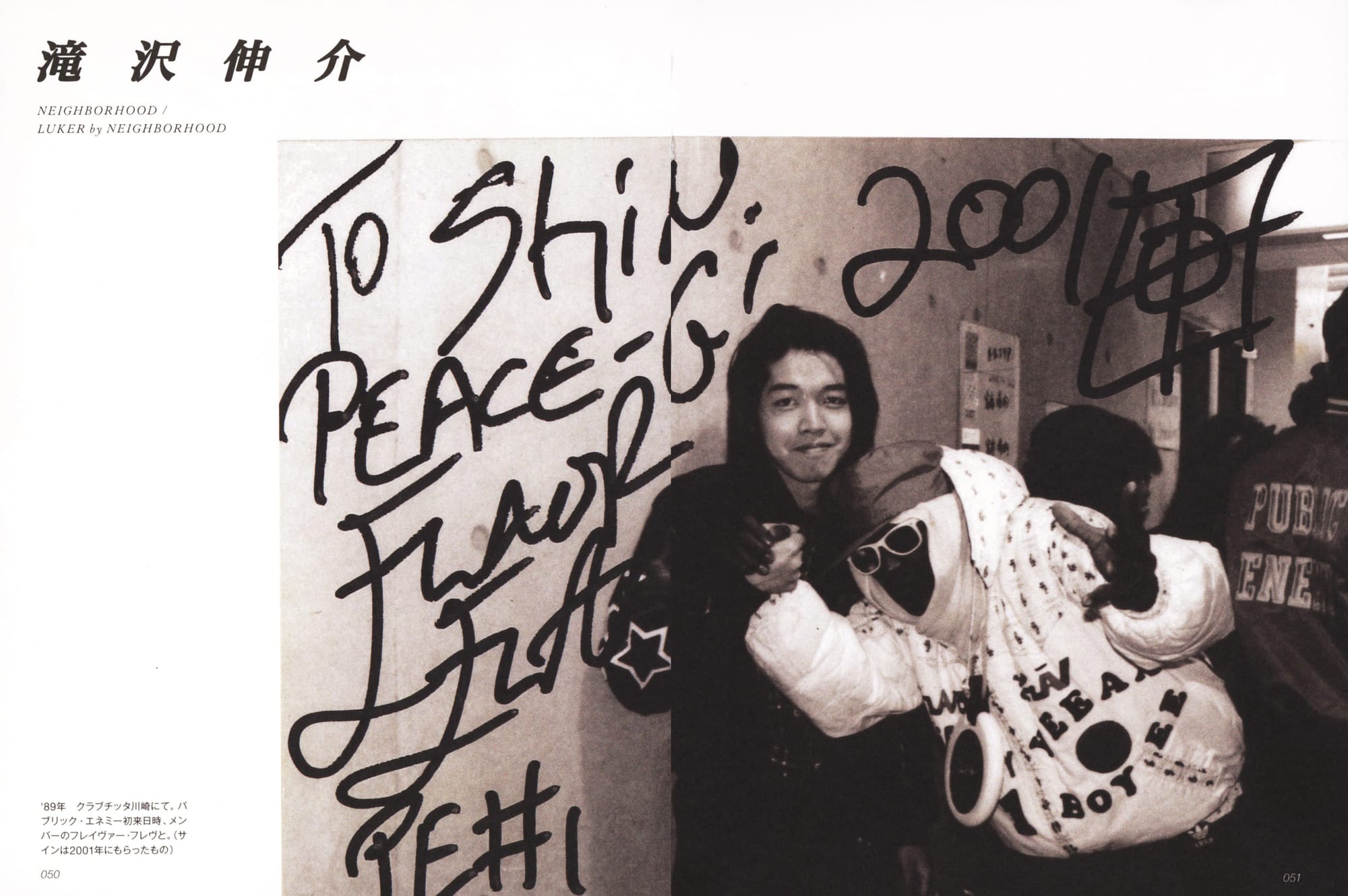
Shinksuke Takizawa - NEIGHBORHOOD
Bio: Born in Nagano Prefecture. After working at the music label Major Force and File Records, he went independent in 1994 and launched the clothing brand NEIGHBORHOOD.
Today, in addition to NEIGHBORHOOD, he also develops LUKER BY NEIGHBORHOOD, SVG BY NEIGHBORHOOD, and the kids’ line NH ONE THIRD.
He has a deep love of motorcycle culture and animals.