
'Chilling And Very Hot' - Sight & Sound November 1995
In-your-face teenage sex is the subject of Larry Clarks 'Kids'. Amy Taubin introduces the film and talks to the director about a project which some want banned in Britain.
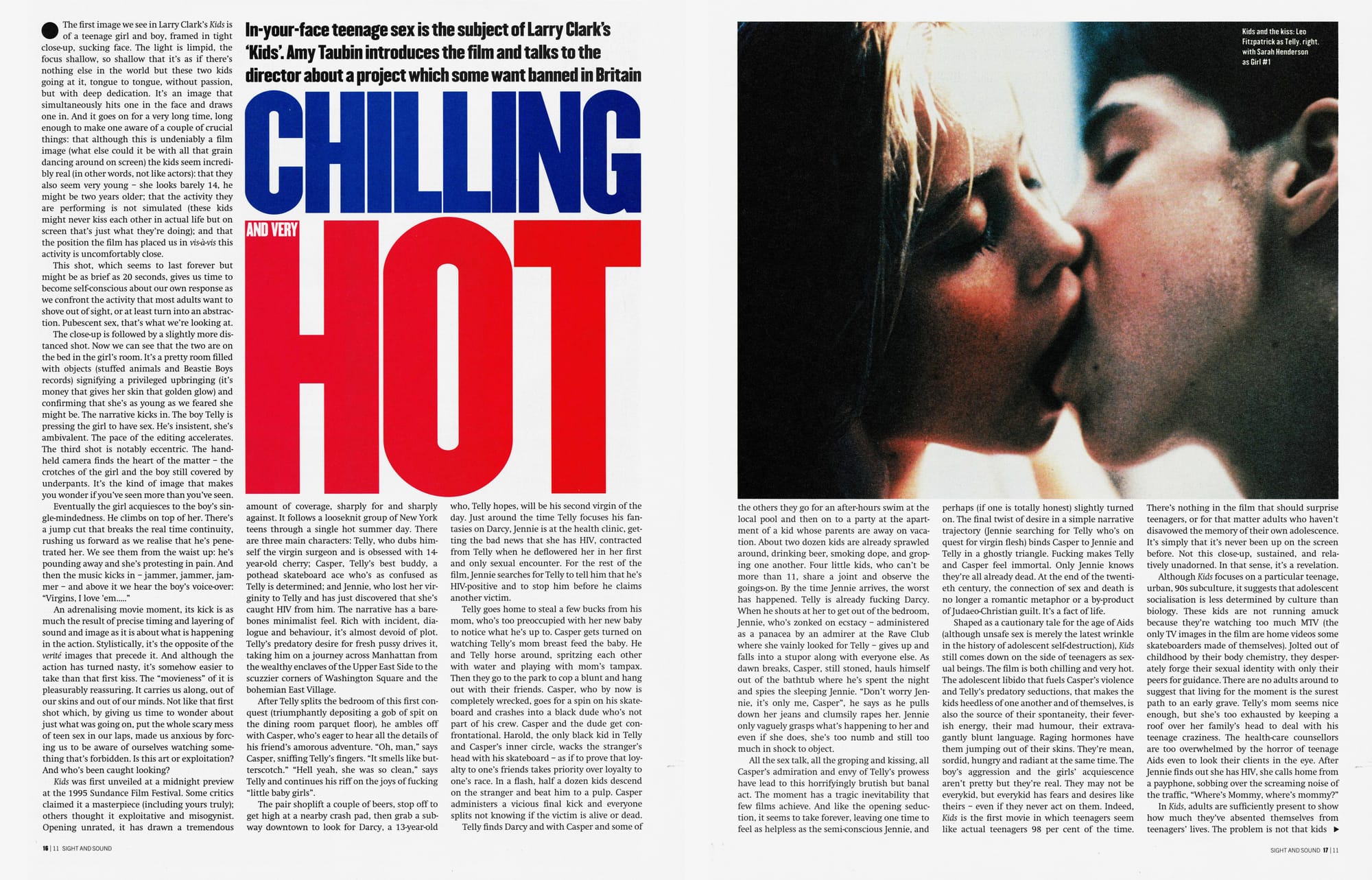
The first image we see in Larry Clark's Kids is of a teenage girl and boy, framed in tight close-up, sucking face. The light is limpid, the focus shallow, so shallow that it's as if there's nothing else in the world but these two kids going at it, tongue to tongue, without passion, but with deep dedication. It's an image that simultaneously hits one in the face and draws one in. And it goes on for a very long time, long enough to make one aware of a couple of crucial things: that although this is undeniably a film image (what else could it be with all that grain dancing around on screen) the kids seem incredibly real (in other words, not like actors): that they also seem very young - she looks barely 14, he might be two years older; that the activity they are performing is not simulated these kids might never kiss each other in actual life but on screen that's just what they're doing); and that the position the film has placed us in vis-a-vis this activity is uncomfortably close.
This shot, which seems to last forever but might be as brief as 20 seconds, gives us time to become self-conscious about our own response as we confront the activity that most adults want to shove out of sight, or at least turn into an abstraction. Pubescent sex, that's what we're looking at.
The close-up is followed by a slightly more distanced shot. Now we can see that the two are on the bed in the girl's room. It's a pretty room filled with objects (stuffed animals and Beastie Boys records) signifying a privileged upbringing (it's money that gives her skin that golden glow) and confirming that she's as young as we feared she might be. The narrative kicks in. The boy Telly is pressing the girl to have sex. He's insistent, she's ambivalent. The pace of the editing accelerates.
The third shot is notably eccentric. The handheld camera finds the heart of the matter - the crotches of the girl and the boy still covered by underpants. It's the kind of image that makes you wonder if you've seen more than you've seen.
Eventually the girl acquiesces to the boy's sin-gle-mindedness. He climbs on top of her. There's a jump cut that breaks the real time continuity, rushing us forward as we realise that he's penetrated her. We see them from the waist up: he's pounding away and she's protesting in pain. And then the music kicks in - jammer, jammer, jammer - and above it we hear the boy's voice-over: "Virgins, I love 'em...."
An adrenalising movie moment, its kick is as much the result of precise timing and layering of sound and image as it is about what is happening in the action. Stylistically, it's the opposite of the verité images that precede it. And although the action has turned nasty, it's somehow easier to take than that first kiss. The "movieness" of it is pleasurably reassuring. It carries us along, out of our skins and out of our minds. Not like that first shot which, by giving us time to wonder about just what was going on, put the whole scary mess of teen sex in our laps, made us anxious by forcing us to be aware of ourselves watching something that's forbidden. Is this art or exploitation? And who's been caught looking?
Kids was first unveiled at a midnight preview at the 1995 Sundance Film Festival. Some critics claimed it a masterpiece (including yours truly); others thought it exploitative and misogynist. Opening unrated, it has drawn a tremendous amount of coverage, sharply for and sharply against. It follows a looseknit group of New York teens through a single hot summer day. There are three main characters: Telly, who dubs himself the virgin surgeon and is obsessed with 14 year-old cherry; Casper, Telly's best buddy, a pothead skateboard ace who's as confused as Telly is determined; and Jennie, who lost her virginity to Telly and has just discovered that she's caught HIV from him. The narrative has a barebones minimalist feel. Rich with incident, dialogue and behaviour, it's almost devoid of plot.
Telly's predatory desire for fresh pussy drives it, taking him on a journey across Manhattan from the wealthy enclaves of the Upper East Side to the scuzzier corners of Washington Square and the bohemian East Village.
After Telly splits the bedroom of this first conquest (triumphantly depositing a gob of spit on the dining room parquet floor), he ambles off with Casper, who's eager to hear all the details of his friend's amorous adventure. "Oh, man," says Casper, sniffing Telly's fingers. "It smells like but-terscotch." "Hell yeah, she was so clean," says Telly and continues his riff on the joys of fucking "little baby girls".
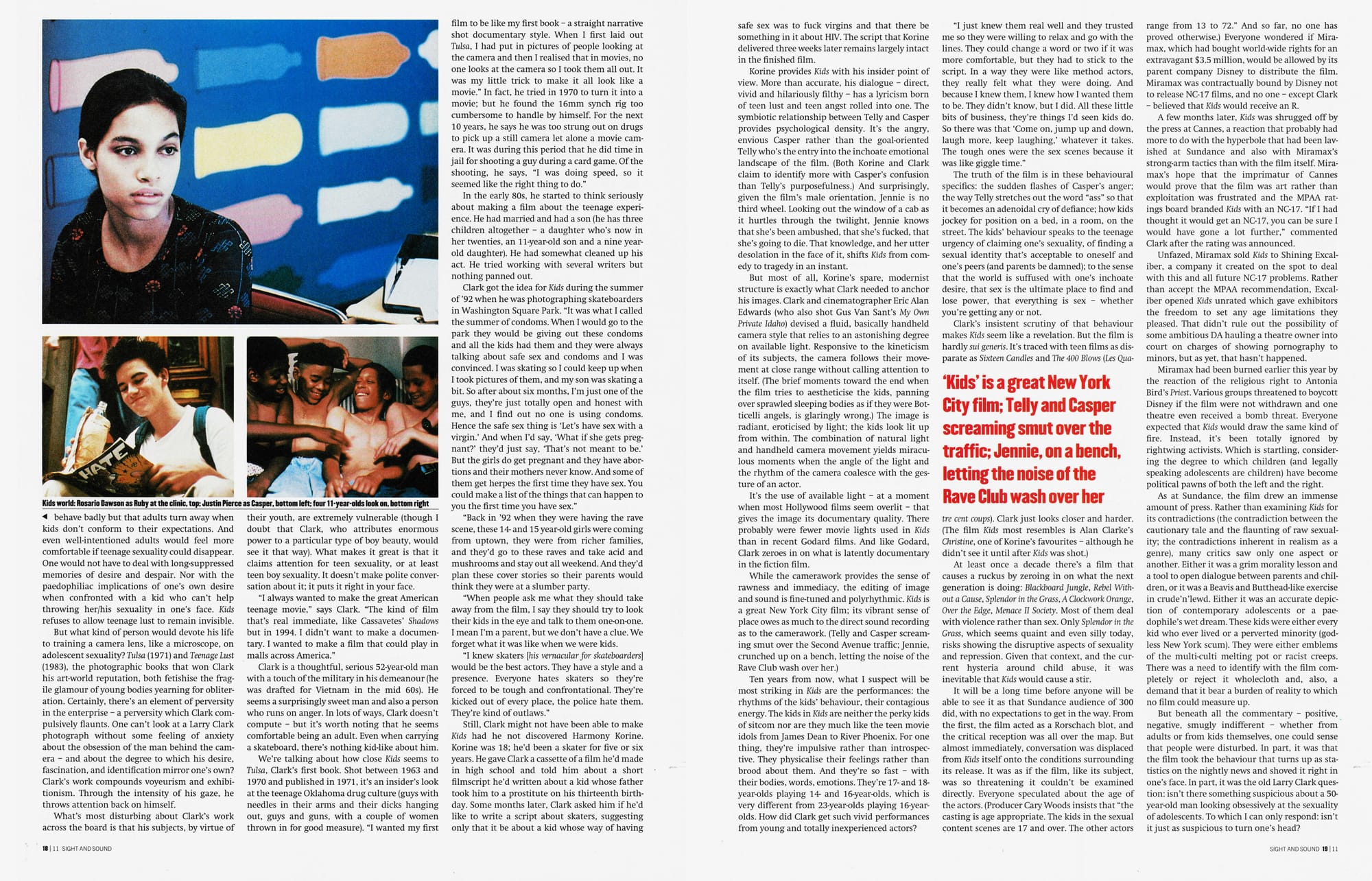
The pair shoplift a couple of beers, stop off to get high at a nearby crash pad, then grab a subway downtown to look for Darcy, a 13-year-old who, Telly hopes, will be his second virgin of the day. Just around the time Telly focuses his fantasies on Darcy, Jennie is at the health clinic, getting the bad news that she has HIV, contracted from Telly when he deflowered her in her first and only sexual encounter. For the rest of the film, Jennie searches for Telly to tell him that he's HIV-positive and to stop him before he claims another victim.
Telly goes home to steal a few bucks from his mom, who's too preoccupied with her new baby to notice what he's up to. Casper gets turned on watching Telly's mom breast feed the baby. He and Telly horse around, spritzing each other with water and playing with mom's tampax. Then they go to the park to cop a blunt and hang out with their friends. Casper, who by now is completely wrecked, goes for a spin on his skateboard and crashes into a black dude who's not part of his crew. Casper and the dude get con-frontational. Harold, the only black kid in Telly and Casper's inner circle, wacks the stranger's head with his skateboard - as if to prove that loyalty to one's friends takes priority over loyalty to one's race. In a flash, half a dozen kids descend on the stranger and beat him to a pulp. Casper administers a vicious final kick and everyone splits not knowing if the victim is alive or dead.
Telly finds Darcy and with Casper and some of the others they go for an after-hours swim at the local pool and then on to a party at the apartment of a kid whose parents are away on vaca-tion. About two dozen kids are already sprawled around, drinking beer, smoking dope, and groping one another. Four little kids, who can't be more than 11, share a joint and observe the goings-on. By the time Jennie arrives, the worst has happened. Telly is already fucking Darcy. When he shouts at her to get out of the bedroom, Jennie, who's zonked on ecstacy - administered as a panacea by an admirer at the Rave Club where she vainly looked for Telly - gives up and falls into a stupor along with everyone else. As dawn breaks, Casper, still stoned, hauls himself out of the bathtub where he's spent the night and spies the sleeping Jennie. "Don't worry Jen-nie, it's only me, Casper", he says as he pulls down her jeans and clumsily rapes her. Jennie only vaguely grasps what's happening to her and even if she does, she's too numb and still too much in shock to object.
All the sex talk, all the groping and kissing, all Casper's admiration and envy of Telly's prowess have lead to this horrifyingly brutish but banal act. The moment has a tragic inevitability that few films achieve. And like the opening seduc-tion, it seems to take forever, leaving one time to feel as helpless as the semi-conscious Jennie, and perhaps (if one is totally honest) slightly turned on. The final twist of desire in a simple narrative trajectory (Jennie searching for Telly who's on quest for virgin flesh) binds Casper to Jennie and Telly in a ghostly triangle. Fucking makes Telly and Casper feel immortal. Only Jennie knows they're all already dead. At the end of the twentieth century, the connection of sex and death is no longer a romantic metaphor or a by-product of Judaeo-Christian guilt. It's a fact of life.
Shaped as a cautionary tale for the age of Aids (although unsafe sex is merely the latest wrinkle in the history of adolescent self-destruction), Kids still comes down on the side of teenagers as sexual beings. The film is both chilling and very hot.
The adolescent libido that fuels Casper's violence and Telly's predatory seductions, that makes the kids heedless of one another and of themselves, is also the source of their spontaneity, their feverish energy, their mad humour, their extravagantly blunt language. Raging hormones have them jumping out of their skins. They're mean, sordid, hungry and radiant at the same time. The boy's aggression and the girls' acquiescence aren't pretty but they're real. They may not be everykid, but everykid has fears and desires like theirs - even if they never act on them. Indeed, Kids is the first movie in which teenagers seem like actual teenagers 98 percent of the time. There's nothing in the film that should surprise teenagers, or for that matter adults who haven't disavowed the memory of their own adolescence.
It's simply that it's never been up on the screen before. Not this close-up, sustained, and relatively unadorned. In that sense, it's a revelation.
Although Kids focuses on a particular teenage, urban, 90s subculture, it suggests that adolescent socialisation is less determined by culture than biology. These kids are not running amuck because they're watching too much MTV (the only TV images in the film are home videos some skateboarders made of themselves). Jolted out of childhood by their body chemistry, they desperately forge their sexual identity with only their peers for guidance. There are no adults around to suggest that living for the moment is the surest path to an early grave. Telly's mom seems nice enough, but she's too exhausted by keeping a roof over her family's head to deal with his teenage craziness. The health-care counsellors are too overwhelmed by the horror of teenage Aids even to look their clients in the eye. After Jennie finds out she has HIV, she calls home from a payphone, sobbing over the screaming noise of the traffic, "Where's Mommy, where's mommy?"
In Kids, adults are sufficiently present to show how much they've absented themselves from teenagers' lives. The problem is not that kids behave badly but that adults turn away when kids don't conform to their expectations. And even well-intentioned adults would feel more comfortable if teenage sexuality could disappear. One would not have to deal with long-suppressed memories of desire and despair. Nor with the paedophiliac implications of one's own desire when confronted with a kid who can't help throwing her/his sexuality in one's face. Kids refuses to allow teenage lust to remain invisible.
But what kind of person would devote his life to training a camera lens, like a microscope, on adolescent sexuality? Tulsa (1971) and Teenage Lust
(1983), the photographic books that won Clark his art-world reputation, both fetishise the fragile glamour of young bodies yearning for obliter-ation. Certainly, there's an element of perversity in the enterprise - a perversity which Clark compulsively flaunts. One can't look at a Larry Clark photograph without some feeling of anxiety about the obsession of the man behind the camera - and about the degree to which his desire, fascination, and identification mirror one's own?
Clark's work compounds voyeurism and exhibi-tionism. Through the intensity of his gaze, he throws attention back on himself.
What's most disturbing about Clark's work across the board is that his subjects, by virtue of their youth, are extremely vulnerable (though I doubt that Clark, who attributes enormous power to a particular type of boy beauty, would see it that way). What makes it great is that it claims attention for teen sexuality, or at least teen boy sexuality. It doesn't make polite conversation about it; it puts it right in your face.
"I always wanted to make the great American teenage movie," says Clark. "The kind of film that's real immediate, like Cassavetes' Shadows but in 1994. I didn't want to make a documentary. I wanted to make a film that could play in malls across America."
Clark is a thoughtful, serious 52-year-old man with a touch of the military in his demeanour (he was drafted for Vietnam in the mid 60s). He seems a surprisingly sweet man and also a person who runs on anger. In lots of ways, Clark doesn't compute - but it's worth noting that he seems comfortable being an adult. Even when carrying a skateboard, there's nothing kid-like about him.
We're talking about how close Kids seems to Tulsa, Clark's first book. Shot between 1963 and 1970 and published in 1971, it's an insider's look at the teenage Oklahoma drug culture (guys with needles in their arms and their dicks hanging out, guys and guns, with a couple of women thrown in for good measure). "I wanted my first film to be like my first book - a straight narrative shot documentary style. When I first laid out Tulsa, I had put in pictures of people looking at the camera and then I realised that in movies, no one looks at the camera so I took them all out. It was my little trick to make it all look like a movie." In fact, he tried in 1970 to turn it into a movie; but he found the 16mm synch rig too cumbersome to handle by himself. For the next 10 years, he says he was too strung out on drugs to pick up a still camera let alone a movie cam-era. It was during this period that he did time in jail for shooting a guy during a card game. Of the shooting, he says “I was doing speed, so it seemed like the right thing to do.”
In the early 80s, he started to think seriously about making a film about the teenage experi-ence. He had married and had a son (he has three children altogether - a daughter who's now in her twenties, an 11-year-old son and a nine year-old daughter). He had somewhat cleaned up his act. He tried working with several writers but nothing panned out.
Clark got the idea for Kids during the summer of '92 when he was photographing skateboarders in Washington Square Park. "It was what I called the summer of condoms. When I would go to the park they would be giving out these condoms and all the kids had them and they were always talking about safe sex and condoms and I was convinced. I was skating so 1 could keep up when I took pictures of them, and my son was skating a bit. So after about six months, I'm just one of the guys, they're just totally open and honest with me, and I find out no one is using condoms. Hence the safe sex thing is 'Let's have sex with a virgin.' And when I'd say, 'What if she gets pregnant?' they'd just say, 'That's not meant to be.' But the girls do get pregnant and they have abortions and their mothers never know. And some of them get herpes the first time they have sex. You could make a list of the things that can happen to you the first time you have sex."
"Back in '92 when they were having the rave scene, these 14 and 15 year-old girls were coming from uptown, they were from richer families, and they'd go to these raves and take acid and mushrooms and stay out all weekend. And they'd plan these cover stories so their parents would think they were at a slumber party.
"When people ask me what they should take away from the film, I say they should try to look their kids in the eye and talk to them one-on-one.
I mean I'm a parent, but we don't have a clue. We forget what it was like when we were kids.
"I knew skaters [his vernacular for skateboarders] would be the best actors. They have a style and a presence. Everyone hates skaters so they’re forced to be tough and confrontational. They're kicked out of every place, the police hate them.
They're kind of outlaws."
Still, Clark might not have been able to make Kids had he not discovered Harmony Korine. Korine was 18; he'd been a skater for five or six years. He gave Clark a cassette of a film he'd made in high school and told him about a short
filmscript he'd written about a kid whose father took him to a prostitute on his thirteenth birth-day. Some months later, Clark asked him if he'd like to write a script about skaters, suggesting only that it be about a kid whose way of having safe sex was to fuck virgins and that there be something in it about HIV. The script that Korine delivered three weeks later remains largely intact in the finished film.
Korine provides Kids with his insider point of view. More than accurate, his dialogue - direct, vivid and hilariously filthy - has a lyricism born of teen lust and teen angst rolled into one. The symbiotic relationship between Telly and Casper provides psychological density. It's the angry, envious Casper rather than the goal-oriented Telly who's the entry into the inchoate emotional landscape of the film. (Both Korine and Clark claim to identify more with Casper's confusion than Telly's purposefulness.) And surprisingly, given the film's male orientation, Jennie is no third wheel. Looking out the window of a cab as it hurtles through the twilight, Jennie knows that she's been ambushed, that she's fucked, that she's going to die. That knowledge, and her utter desolation in the face of it, shifts Kids from comedy to tragedy in an instant.
But most of all, Korine's spare, modernist structure is exactly what Clark needed to anchor his images. Clark and cinematographer Eric Alan Edwards (who also shot Gus Van Sant's My Own Private Idaho) devised a fluid, basically handheld camera style that relies to an astonishing degree on available light. Responsive to the kineticism of its subjects, the camera follows their movement at close range without calling attention to itself. (The brief moments toward the end when the film tries to aestheticise the kids, panning over sprawled sleeping bodies as if they were Botticelli angels, is glaringly wrong.) The image is radiant, eroticised by light; the kids look lit up from within. The combination of natural light and handheld camera movement yields miraculous moments when the angle of the light and the rhythm of the camera coalesce with the gesture of an actor.
It's the use of available light - at a moment when most Hollywood films seem overlit - that gives the image its documentary quality. There probably were fewer movie lights used in Kids than in recent Godard films. And like Godard, Clark zeroes in on what is latently documentary in the fiction film.
While the camerawork provides the sense of rawness and immediacy, the editing of image and sound is fine-tuned and polyrhythmic. Kids is a great New York City film; its vibrant sense of place owes as much to the direct sound recording as to the camerawork. (Telly and Casper screaming smut over the Second Avenue traffic; Jennie, crunched up on a bench, letting the noise of the Rave Club wash over her.)
Ten years from now, what I suspect will be most striking in Kids are the performances: the rhythms of the kids' behaviour, their contagious energy. The kids in Kids are neither the perky kids of sitcom nor are they much like the teen movie idols from James Dean to River Phoenix. For one thing, they're impulsive rather than introspec-tive. They physicalise their feelings rather than brood about them. And they're so fast - with their bodies, words, emotions. They're 17-and 18-year-olds playing 14 and 16-year-olds, which is very different from 23-year-olds playing 16-year-olds. How did Clark get such vivid performances from young and totally inexperienced actors?
"I just knew them real well and they trusted me so they were willing to relax and go with the lines. They could change a word or two if it was more comfortable, but they had to stick to the script. In a way they were like method actors, they really felt what they were doing. And because I knew them, I knew how I wanted them to be. They didn't know, but I did. All these little bits of business, they're things I'd seen kids do. So there was that Come on, jump up and down, laugh more, keep laughing, whatever it takes. The tough ones were the sex scenes because it was like giggle time."
The truth of the film is in these behavioural specifics: the sudden flashes of Casper's anger; the way Telly stretches out the word "ass" so that it becomes an adenoidal cry of defiance; how kids jockey for position on a bed, in a room, on the street. The kids' behaviour speaks to the teenage urgency of claiming one's sexuality, of finding a sexual identity that's acceptable to oneself and one's peers (and parents be damned); to the sense that the world is suffused with one's inchoate desire, that sex is the ultimate place to find and lose power, that everything is sex - whether you’re getting any or not.
Clark's insistent scrutiny of that behaviour makes Kids seem like a revelation. But the film is hardly sui generis. It's traced with teen films as disparate as Sixteen Candles and The 400 Blows (Les Quatre cent coups). Clark just looks closer and harder. (The film Kids most resembles is Alan Clarke's Christine, one of Korine's favourites - although he didn't see it until after Kids was shot.)
At least once a decade there's a film that causes a ruckus by zeroing in on what the next generation is doing: Blackboard Jungle, Rebel Without a Cause, Splendor in the Grass, A Clockwork Orange, Over the Edge, Menace II Society. Most of them deal with violence rather than sex. Only Splendor in the Grass, which seems quaint and even silly today, risks showing the disruptive aspects of sexuality and repression. Given that context, and the current hysteria around child abuse, it was inevitable that Kids would cause a stir.
It will be a long time before anyone will be able to see it as that Sundance audience of 300 did, with no expectations to get in the way. From the first, the film acted as a Rorschach blot, and the critical reception was all over the map. But almost immediately, conversation was displaced from Kids itself onto the conditions surrounding its release. It was as if the film, like its subject, was so threatening it couldn't be examined directly. Everyone speculated about the age of the actors. (Producer Cary Woods insists that "the casting is age appropriate. The kids in the sexual content scenes are 17 and over. The other actors range from 13 to 72." And so far, no one has proved otherwise.) Everyone wondered if Mira-max, which had bought world-wide rights for an extravagant $3.5 million, would be allowed by its parent company Disney to distribute the film. Miramax was contractually bound by Disney not to release NC-17 films, and no one - except Clark believed that Kids would receive an R.
A few months later, Kids was shrugged off by the press at Cannes, a reaction that probably had more to do with the hyperbole that had been lavished at Sundance and also with Miramax's strong-arm tactics than with the film itself. Mira-max's hope that the imprimatur of Cannes would prove that the film was art rather than exploitation was frustrated and the MPAA ratings board branded Kids with an NC-17. "If I had thought it would get an NC-17, you can be sure I would have gone a lot further," commented Clark after the rating was announced.
Unfazed, Miramax sold Kids to Shining Excaliber, a company it created on the spot to deal with this and all future NC-17 problems. Rather than accept the MPAA recommendation, Excal-iber opened Kids unrated which gave exhibitors the freedom to set any age limitations they pleased. That didn't rule out the possibility of some ambitious DA hauling a theatre owner into court on charges of showing pornography to minors, but as yet, that hasn't happened.
Miramax had been burned earlier this year by the reaction of the religious right to Antonia Bird's Priest. Various groups threatened to boycott Disney if the film were not withdrawn and one theatre even received a bomb threat. Everyone expected that Kids would draw the same kind of fire. Instead, it's been totally ignored by
rightwing activists. Which is startling, considering the degree to which children (and legally speaking adolescents are children) have become political pawns of both the left and the right.
As at Sundance, the film drew an immense amount of press. Rather than examining Kids for its contradictions (the contradiction between the cautionary tale and the flaunting of raw sexual-ity; the contradictions inherent in realism as a genre), many critics saw only one aspect or another. Either it was a grim morality lesson and a tool to open dialogue between parents and chil-dren, or it was a Beavis and Butthead-like exercise in crude'n'lewd. Either it was an accurate depiction of contemporary adolescents or a pae-dophile's wet dream. These kids were either every kid who ever lived or a perverted minority (god-less New York scum. They were either emblems of the multi-culti melting pot or racist creeps.
There was a need to identify with the film completely or reject it wholecloth and, also, a demand that it bear a burden of reality to which no film could measure up.
But beneath all the commentary - positive, negative, smugly indifferent - whether from adults or from kids themselves, one could sense that people were disturbed. In part, it was that the film took the behaviour that turns up as statistics on the nightly news and shoved it right in one's face. In part, it was the old Larry Clark ques-tion: isn't there something suspicious about a 50-year-old man looking obsessively at the sexuality of adolescents. To which I can only respond: isn't it just as suspicious to turn one's head?