
'The New Guard' Vogue US July 2000
The New Guard - A dozen brilliant individualists are on course to change the face of fashion. Sally Singer rounds up the usual suspects.
Writer: Sally Singer
Photos: Steven Meisel
Hair: Garen of Garen New York
MUA: Pat McGrath
Fashion Editor: Grace Coddington
During the days after they were captured on camera by Steven Meisel, the fashion stars of the new generation were sighted on the streets of New York darting about like exotic migrant birds. But they weren't to be seen at Pastis, where Calvin regularly nests, or at Balthazar (Helmut's hangout), or at any of the other famous habitats of the indigenous fashion flock. Instead, the newcomers mapped out an alternative, newly worldly New York. Véronique Branquinho the quiet, dark-eyed Antwerp designer ran into Junya Watanabe, the even quieter man from Tokyo, at a small organic café named, resonantly enough, Other Foods; they shared a table although he speaks no French or English, she no Japanese. An Vandevorst and Filip Arickx, of the Belgian label A. F. Vandevorst, met with members of the Dutch/American stage cast of Susan Sontag's Alice in Bed, for which the pair had designed costumes. Nicolas Ghesquiere of Balenciaga, the slight Frenchman with rock-star locks. went to Queens to visit the contemporary arts space P.S.1. And everybody tried to take in the Vanessa Beecroft installation on the Intrepid and queued up for the Whitney Biennial.
They didn't travel as a group. Although it is possible to identify a certain cool, urbane esprit de corps among the fourteen talents instead of trunk shows at Bloomingdale's, "clinics" were held at Kirna Zabête this is no fashion Rat Pack. "These guys are all very individual," says Jeffrey Kalinsky, whose New York store of the same name carries nine of the designers' twelve labels. He's dead right. Most had never even met before arriving in New York for their portrait. It's not merely a question of geography the Belgians don't consort with the Belgians, not even in Antwerp. The truth is that these designers (who range in age and experience over two decades) resolutely follow singular creative and professional paths. Even so, their clothes will soon hang together in your closet (if they don't al-ready, fighting for space with incumbent offerings from Marc and Michael and Miuccia.
"These are the power people; they are the future of fashion," says Judy Collinson of Barneys (eleven out of twelve labels carried). "And they are all extremely intense, extremely ambitious, and very modern."
"Modern," though, does not mean unwearable. Gone are the days when conceptual design was an acquired, pretentious taste, like performance art or savory ice cream. This season we will all look absolutely fabulous and utterly appropriate in a Viktor & Rolf tux, a trench from Josephus Thimister or Balenciaga, a little black dress or suit (constructed with jigsaw-puzzle pieces of fabric from Hussein Cha-layan, or something supple and leathery from Olivier Theyskens. Branquinho's tweeds will be worn from Park Avenue penthouses to Princeton lecture halls. The clean, sleek glamour of Lawrence Steele's luxe looks, which has already smitten Hollywood's heavy-hitting sirens, will gussy up our evenings. Roberto Menichetti's nonretro, rethought Burberry will waterproof our wintry days.
"What I love about these designers is that they are not the avant-garde," says Kalinsky: "They are the New Guard."
In a flighty industry, the emergence of the New Guard represents a significant shift. For the past few years, fashion has not been about quirky, outsider visions. We have not been wearing Other Clothes. The triumph of American sportswear, the easy glamour that comes from a perfectly cut pair of jeans and the best cashmere sweater, has come to dominate the market in every fashion capital; and the overseas postings of Tom Ford at Gucci, Marc Ja-cobs at Louis Vuitton, Michael Kors at Celine, Narciso Rodriguez at Loewe, and John Bartlett at Byblos only underline its global reach. But, of course, these men (yes, they are all men) now constitute the fashion establishment. Their work and their ideas (often diluted by the Gap and other mass purveyors of style) outfit every aspect of our lives. The New Guard's new look, which marries couture-inspired techniques to a witty postpunk ferocity, brings high fashion back to its European roots.
"I'm always in between two things-classical taste and something more New Wave," says Branquinho, who, for fall, mixes tweeds and herringbones with Tracy Lord-on-champagne joie de vivre (that's Philadelphia Story: not porn star).
"I really love the energy of something antique; it's part of me," says Menichetti.
"One foot in the past, one foot in the fu-ture." His philosophy finds form in a "two-faced" maxicoat in which "elegance and sportswear are as one": From the front, it looks almost androgynous; but the back is defined by rows and rows of narrow pleats.
Even Junya Watanabe and Hussein Chalayan, the most consistently "conceptual" of the group, infuse their stunningly original creations with the poetry of bygone silhouettes.
Ultimately, what unites these designers is that they are concerned first and foremost with fashion. Over the next decade. you probably won't read much about where they eat dinner or go to the gym; you won't be buying dinner plates or bath towels with their names on them. Licensing is taboo; "life-styling" is frowned upon. Although they realize the value of famous clients Ghesquiere is close to Chloë Sevigny (see Style Fax, page 30); Steele dressed Jennifer Aniston for the Oscars; Madonna has had her Theyskens moments; and Winona is said to own a bit of Branquinho big names and big nights are not the focus. Unsurprisingly. their heroes are the fiercely private Martin Margiela and Rei Kawakubo, Yves Saint Laurent, and Helmut Lang.
It should be acknowledged that these are fortuitous times for the fashion-crazed.
A buoyant economy has transformed the often dreary retail scene of the mid-nineties into a glorious landscape of designer-led minicollections (think about it: Sam-sonite now has two clothing lines), groovy
"curated" boutiques (the Colette clones), naughty and haughty niche publications (e.g., Self Service, Purple, Big, Flaunt), and, more critically, the savviest customers in the history of getting and spending.
There now exists, in every major city, that woman who knows her E! from her V, who has put her accessories on an Atkins diet (Be gone, Baguette! Adieu, Croissant!), and wants to turn heads by investing in something that is one step beyond the much-publicized, much-advertised items of the season. She's already wearing Balenciaga trousers and a djellaba from Hedi Slimane for YSL Rive Gauche Homme (like Madonna and Catherine Deneuve, she's not afraid to buy menswear when the cut's this sharp and skinny). And you'd better believe her name's on the list for some Viktor & Rolf (yes, she knows their surnames).
And, in a sense, they know her, too. What sets this crop of creative wizards apart from so many eccentric talents who have made swift, untimely exits is a keen awareness that clothes are meant to be worn and loved by women. "It's much more interesting to see my clothes out of the show context," says Chalayan. "When clothes appear in daily life, in a totally banal scenario, they either work or not, and you confront the reality of what you've made."
Thanks to the New Guard, the reality of ready-to-wear has never seemed so magical.
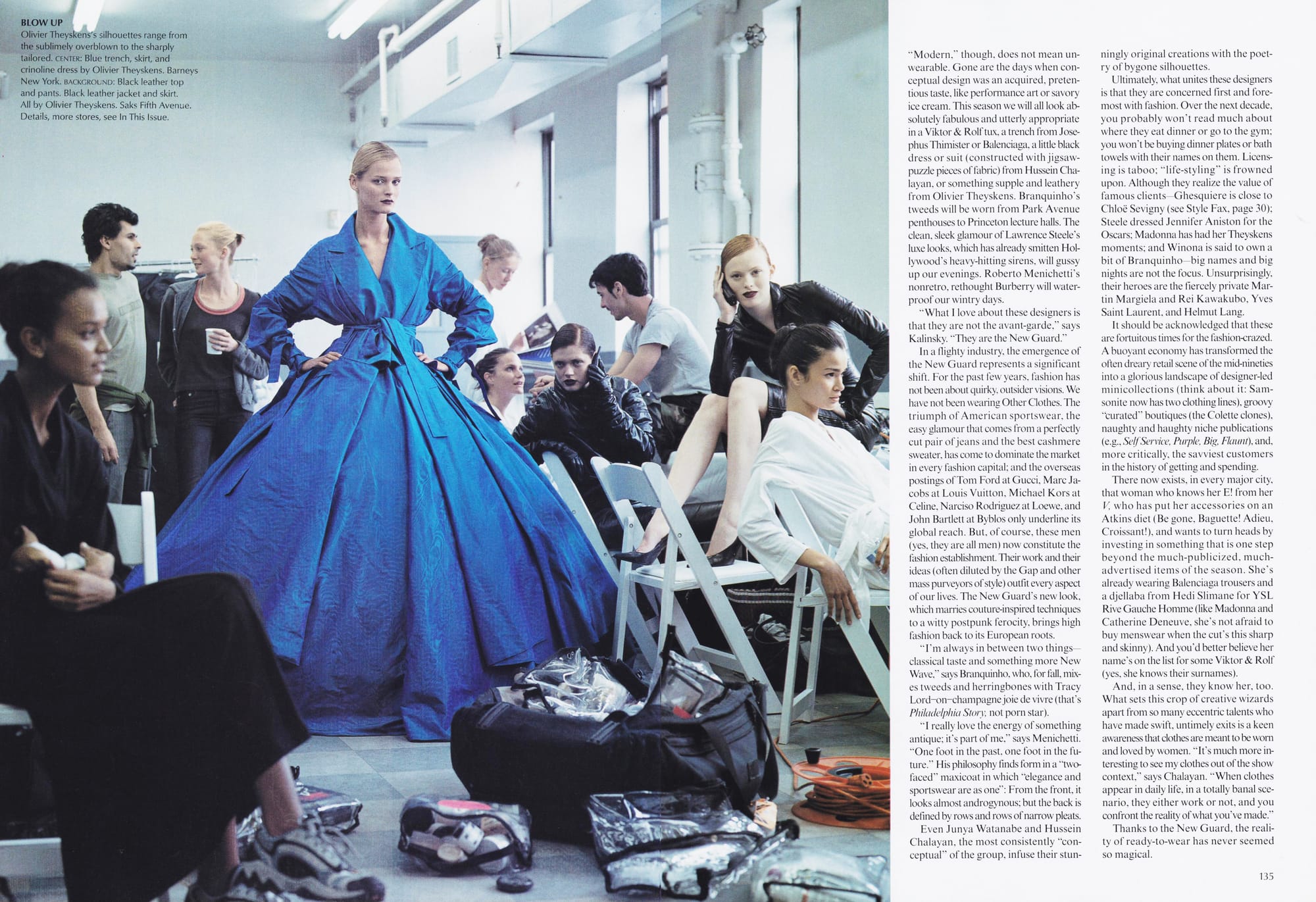
Olivier Theyskens - Olivier Theyskens. the absurdly precocious Brussels designer who makes absurdly enormous dresses and ridiculously tiny leathers, humbly regards his fifth collection as an apprenticeship. "I felt I had to learn about certain things." he says. "I wanted to make long silk dresses that move when you walk. I tried to make the leathers very complicated, with different pockets l'd never seen before, and lots of zips with multiple functions." The results are dramatically wearable trouser suits and motorcycle jackets. and simply dramatic ball gowns. It is extraordinary. considering his burgeoning global reputation. that Theyskens's staff is limited to four. Given his ambition he muses about the possibilities of menswear. perfume. boutiques, and a future move to Paris expect bigger things from this 23-year-old.
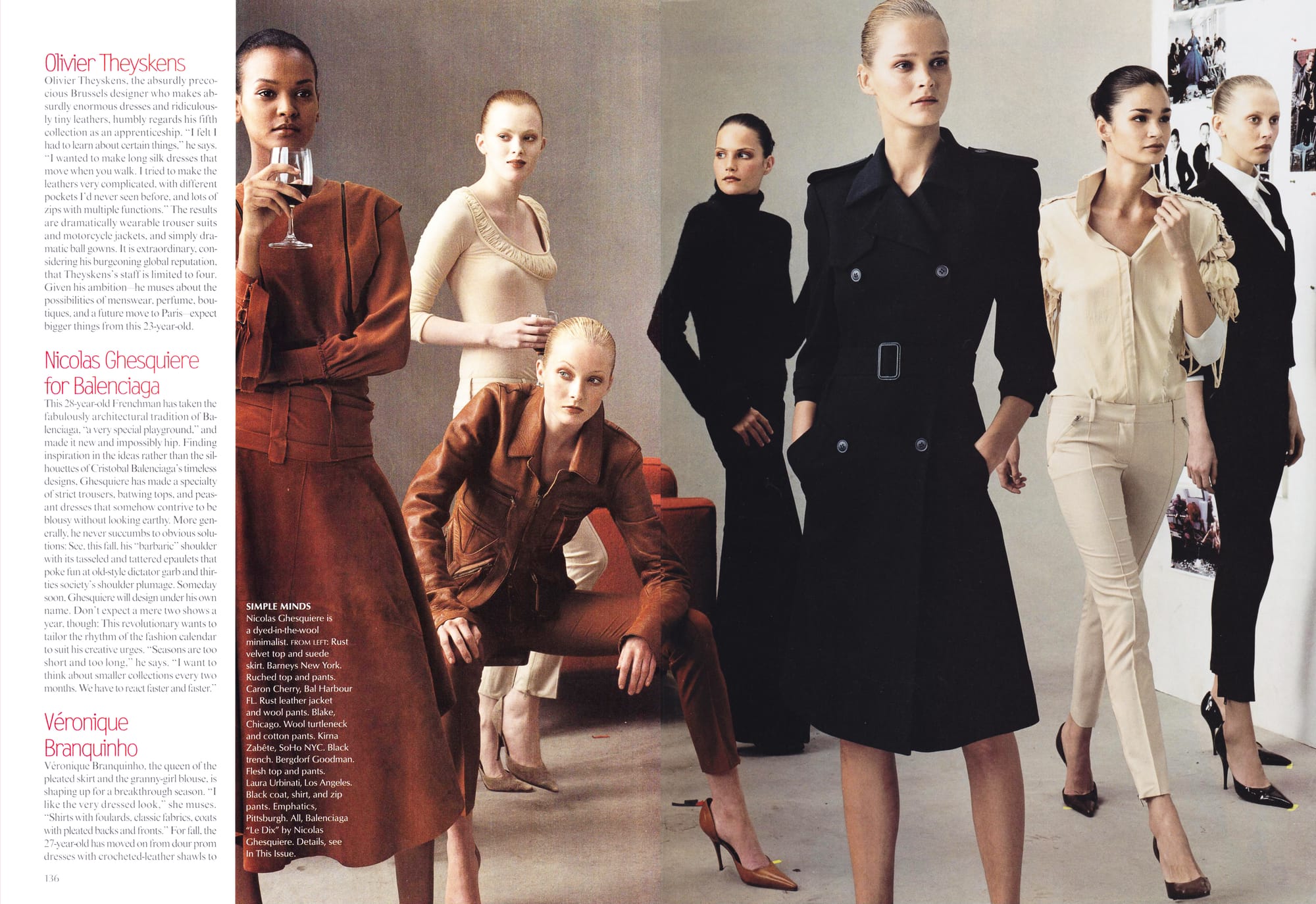
Nicolas Ghesquiere for Balenciaga - This 28-year-old Frenchman has taken the fabulously architectural tradition of Balenciaga, "a very special playground." and made it new and impossibly hip. Finding inspiration in the ideas rather than the silhouettes of Cristobal Balenciaga's timeless designs, Ghesquiere has made a specialty of strict trousers. batwing tops, and peasant dresses that somehow contrive to be blousy without looking earthy. More generally. he never succumbs to obvious solutions: See. this fall, his "barbaric" shoulder with its tasseled and tattered epaulets that poke fun at old-style dictator garb and thirties society's shoulder plumage. Someday soon. Ghesquiere will design under his own name. Don't expect a mere two shows a year, though: This revolutionary wants to tailor the rhythm of the fashion calendar to suit his creative urges. "Seasons are too short and too long." he says. "I want to think about smaller collections every two months. We have to react faster and faster."
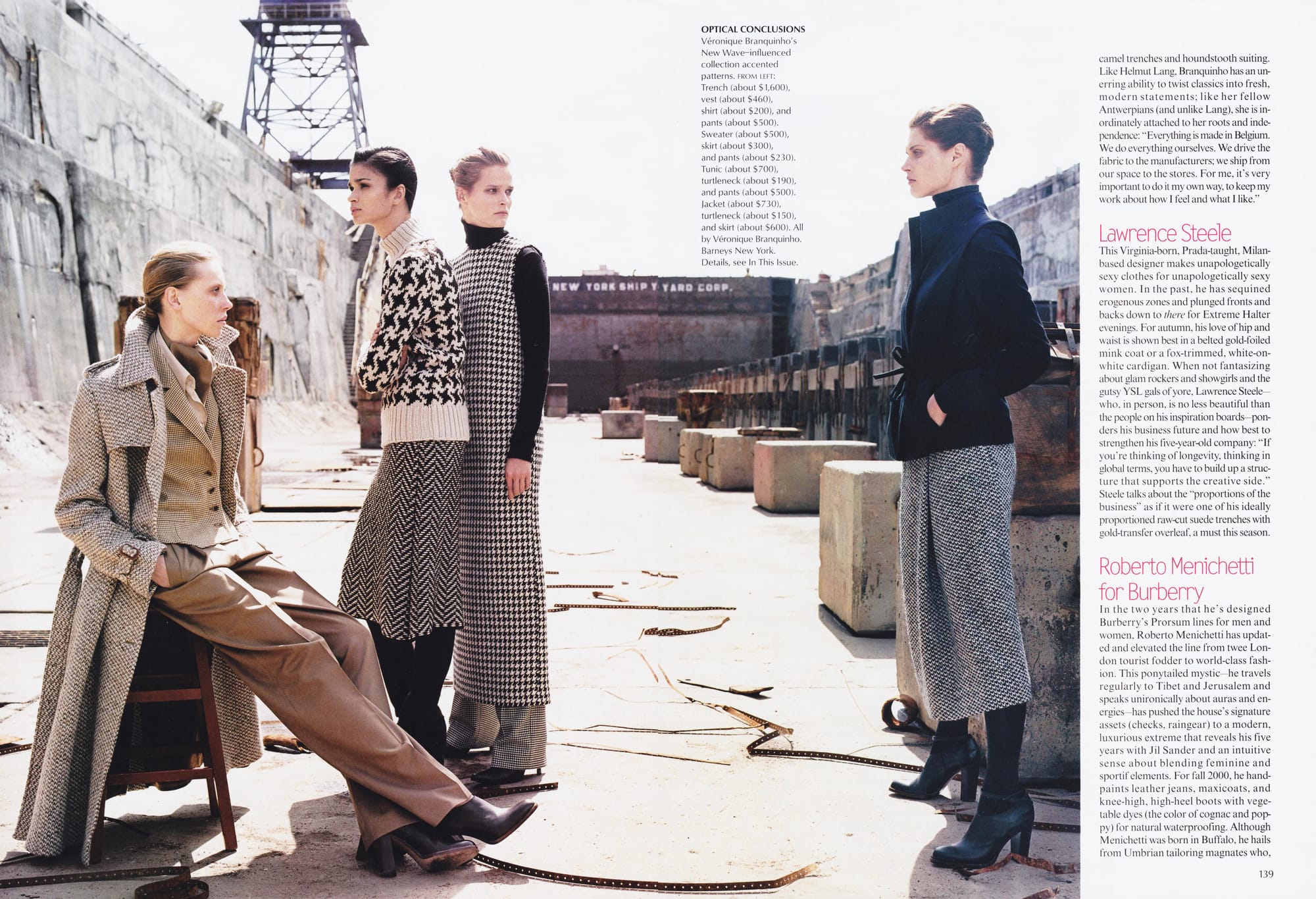
Véronique Branquinho - The queen of the pleated skirt and the granny-girl blouse, is shaping up for a breakthrough season. "I like the very dressed look." she muses. "Shirts with foulards, classic fabrics. coats with pleated backs and fronts." For fall, the 27-year-old has moved on from dour prom dresses with crocheted leather shawls to camel trenches and houndstooth suiting. Like Helmut Lang, Branquinho has an unerring ability to twist classics into fresh, modern statements; like her fellow Antwerpians (and unlike Lang), she is inordinately attached to her roots and independence: "Everything is made in Belgium. We do everything ourselves. We drive the fabric to the manufacturers; we ship from our space to the stores. For me, it's very important to do it my own way, to keep my work about how I feel and what I like."
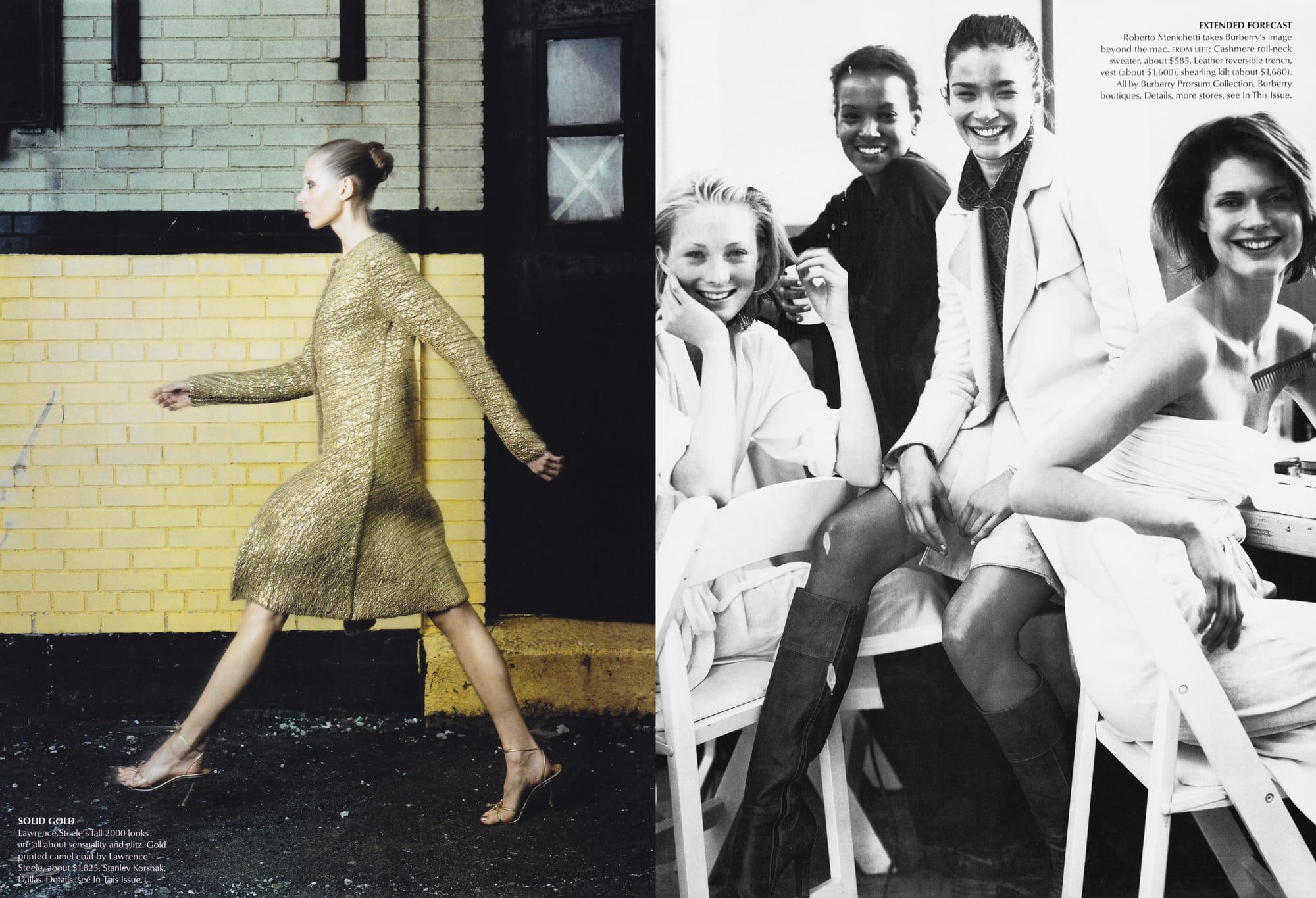
Lawrence Steele - This Virginia-born, Prada-taught, Milan-based designer makes unapologetically sexy clothes for unapologetically sexy women. In the past, he has sequined erogenous zones and plunged fronts and backs down to there for Extreme Halter evenings. For autumn, his love of hip and waist is shown best in a belted gold-foiled mink coat or a fox-trimmed, white-on-white cardigan. When not fantasizing about glam rockers and showgirls and the gutsy YSL gals of yore, Lawrence Steele-who, in person, is no less beautiful than the people on his inspiration boards ponders his business future and how best to strengthen his five-year-old company: "If you're thinking of longevity, thinking in global terms, you have to build up a structure that supports the creative side." Steele talks about the "proportions of the business" as if it were one of his ideally proportioned raw-cut suede trenches with gold-transfer overleaf, a must this season.
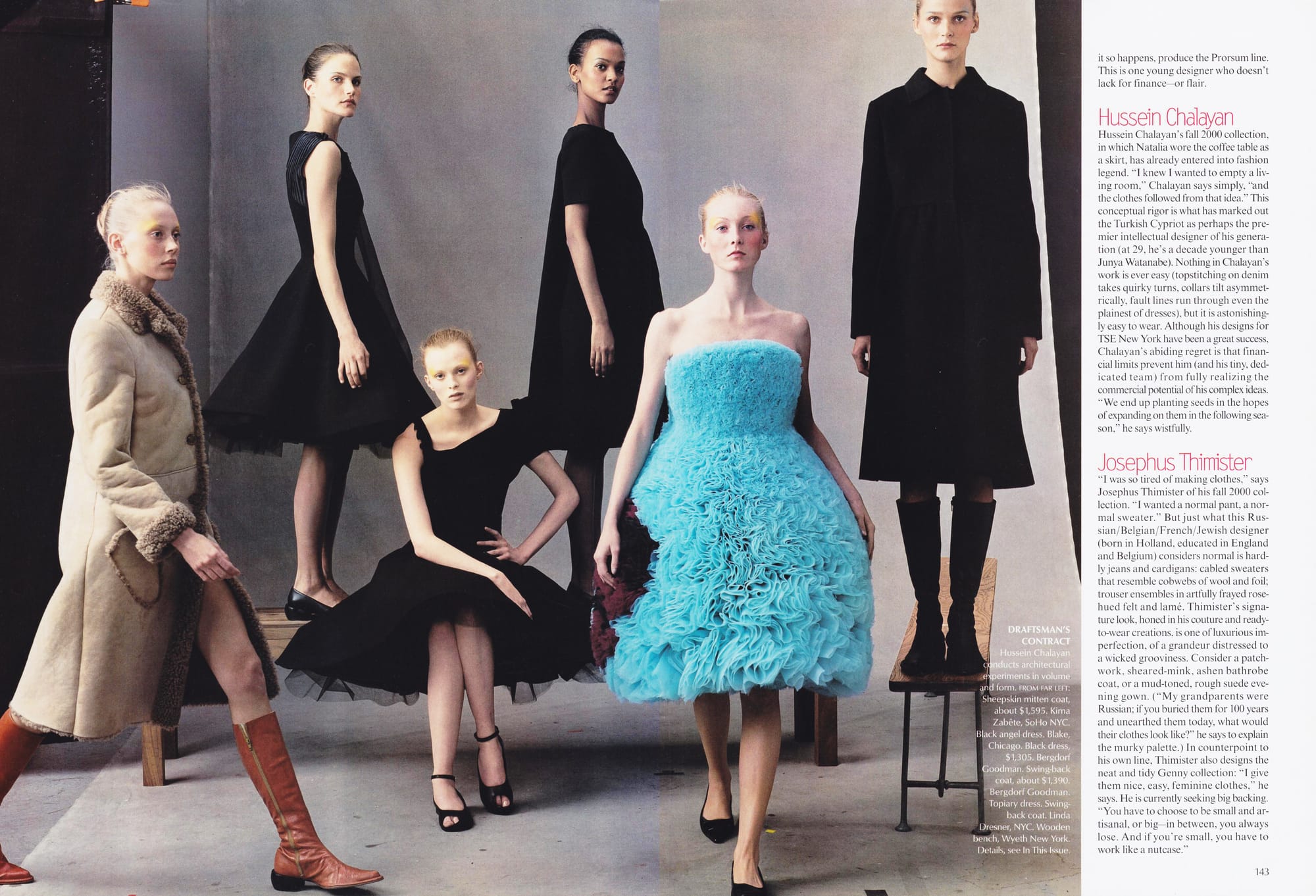
Roberto Menichetti for Burberry - In the two years that he's designed Burberry's Prorsum lines for men and women, Roberto Menichetti has updated and elevated the line from twee London tourist fodder to world-class fashion. This ponytailed mystic he travels regularly to Tibet and Jerusalem and speaks unironically about auras and energies has pushed the house's signature assets (checks, raingear) to a modern, luxurious extreme that reveals his five years with Jil Sander and an intuitive sense about blending feminine and sportif elements. For fall 2000, he hand-paints leather jeans, maxicoats, and knee-high, high-heel boots with vegetable dyes (the color of cognac and poppy) for natural waterproofing. Although Menichetti was born in Buffalo, he hails from Umbrian tailoring magnates who, it so happens, produce the Prosum line. This is one young designer who doesn't lack for finance or flair.
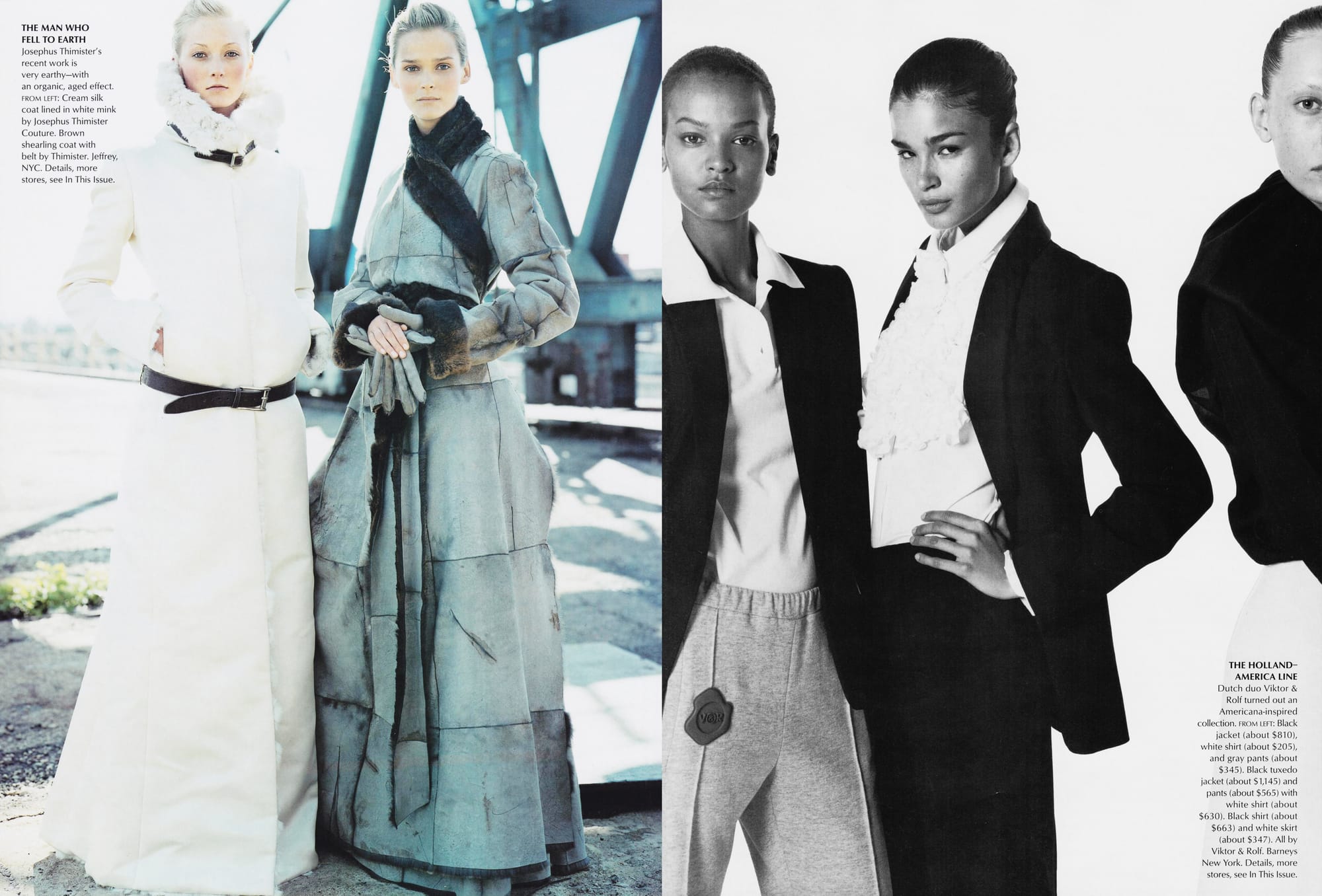
Hussein Chalayan - Hussein Chalayan's fall 2000 collection, in which Natalia wore the coffee table as a skirt, has already entered into fashion legend. "I knew I wanted to empty a living room," Chalayan says simply, "and the clothes followed from that idea." This conceptual rigor is what has marked out the Turkish Cypriot as perhaps the premier intellectual designer of his generation (at 29, he's a decade younger than Junya Watanabe. Nothing in Chalayan's work is ever easy (topstitching on denim takes quirky turns, collars tilt asymmetrically, fault lines run through even the plainest of dresses), but it is astonishingly easy to wear. Although his designs for TSE New York have been a great success, Chalayan's abiding regret is that financial limits prevent him (and his tiny, dedicated team from fully realizing the commercial potential of his complex ideas. "We end up planting seeds in the hopes of expanding on them in the following season," he says wistfully.
Josephus Thimister - "I was so tired of making clothes," says Josephus Thimister of his fall 2000 collection. "I wanted a normal pant, a normal sweater." But just what this Russian/Belgian/French/Jewish designer (born in Holland, educated in England and Belgium) considers normal is hardly jeans and cardigans: cabled sweaters that resemble cobwebs of wool and foil; trouser ensembles in artfully frayed rose-hued felt and lamé. Thimister's signature look, honed in his couture and ready-to-wear creations, is one of luxurious im-perfection, of a grandeur distressed to a wicked grooviness. Consider a patch-work, sheared-mink, ashen bathrobe coat, or a mud-toned, rough suede evening gown. ("My grandparents were Russian; if you buried them for 100 years and unearthed them today, what would their clothes look like?" he says to explain the murky palette.) In counterpoint to his own line, Thimister also designs the neat and tidy Genny collection: "I give them nice, easy, feminine clothes," he says. He is currently seeking big backing. "You have to choose to be small and artisanal, or big in between, you always lose. And if you're small, you have to work like a nutcase."
Viktor & Rolf - Viktor Horsting and Rolf Snoeren, dry-witted Dutchmen with shoe-polish hair and geeky specs, turned haute couture on its tête in the late nineties with their Pierrot-collared ensembles and layered Swarovski-crystal gowns. Now they've reinvented ready-to-wear by offering, in their debut collection, the most carefully edited capsule wardrobe a stylish gal could ever hope for: one graphic print, one tuxedo, one suit, one coat, a little denim, a stripy shirt, some sports gear, a simple dress or two. "For the couture," explains Viktor, "we don't really think about the customer. The clothing is like an autonomous thing." Which is why this design team's primary client to date has been a museum in Groningen, and why the new line is so unexpectedly delightful.
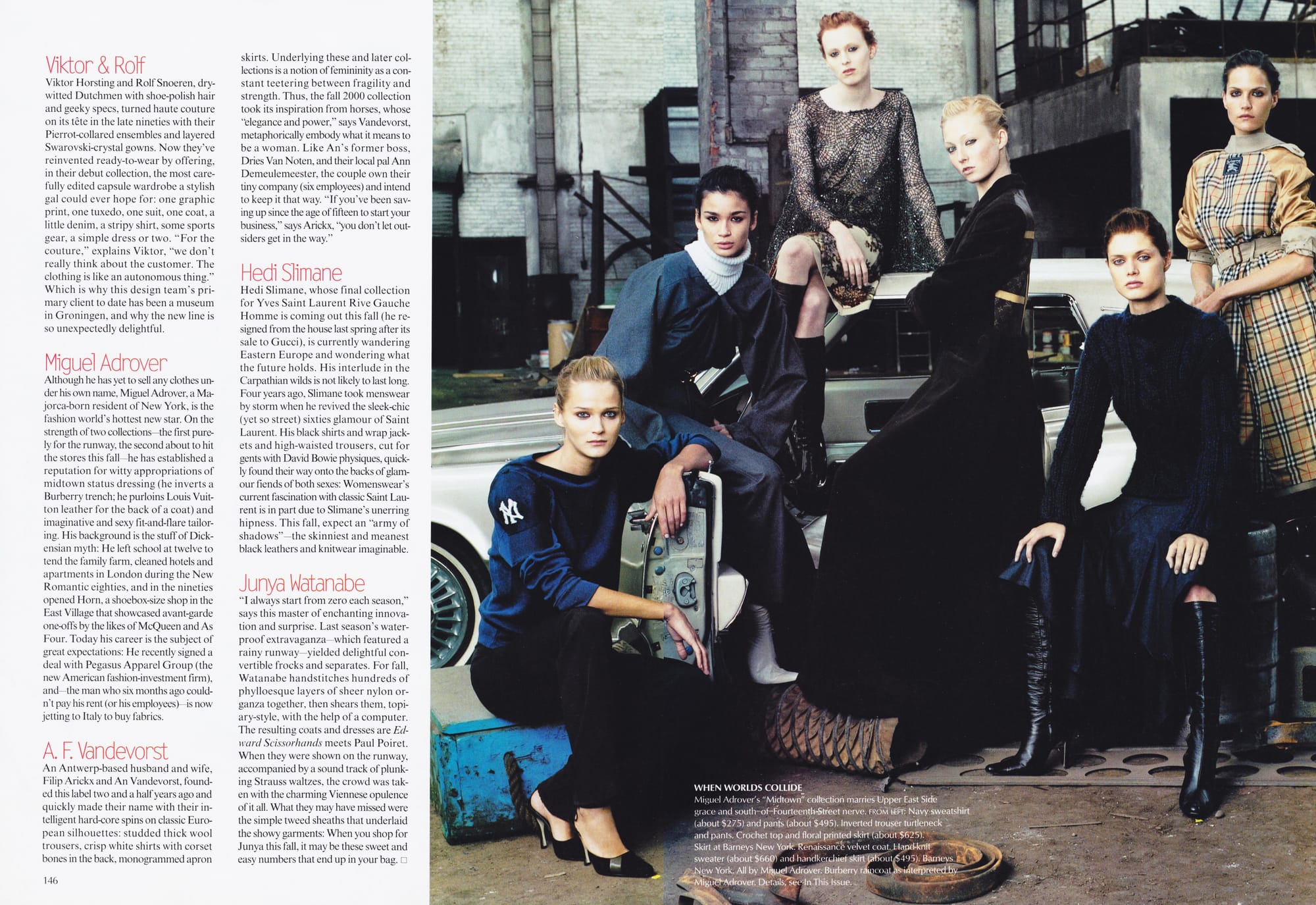
Miguel Adrover - Although he has yet to sell any clothes under his own name, Miguel Adrover, a Majorca-born resident of New York. is the fashion world's hottest new star. On the strength of two collectionsthe first purely for the runway, the second about to hit the stores this fall he has established a reputation for witty appropriations of midtown status dressing (he inverts a Burberry trench; he purloins Louis Vuitton leather for the back of a coat) and imaginative and sexy fit-and-flare tailor-ing. His background is the stuff of Dickensian myth: He left school at twelve to tend the family farm, cleaned hotels and apartments in London during the New Romantic eighties, and in the nineties opened Horn, a shoebox-size shop in the East Village that showcased avant-garde one-offs by the likes of McQueen and As Four. Today his career is the subject of great expectations: He recently signed a deal with Pegasus Apparel Group (the new American fashion-investment firm). and the man who six months ago couldn't pay his rent (or his employees) is now jetting to Italy to buy fabrics.
A. F. Vandevorst - An Antwerp-based husband and wife. Filip Arickx and An Vandevorst. founded this label two and a half years ago and quickly made their name with their intelligent hard-core spins on classic European silhouettes: studded thick wool trousers. crisp white shirts with corset bones in the back, monogrammed apron skirts. Underlying these and later collections is a notion of femininity as a constant teetering between fragility and strength. Thus, the fall 2000 collection took its inspiration from horses, whose
"elegance and power," says Vandevorst, metaphorically embody what it means to be a woman. Like An's former boss, Dries Van Noten, and their local pal Ann Demeulemester, the couple own their tiny company (six employees) and intend to keep it that way. "If you've been saving up since the age of fifteen to start your business." says Arickx, "you don't let outsiders get in the way."
Hedi Slimane - Hedi Slimane, whose final collection for Yves Saint Laurent Rive Gauche Homme is coming out this fall (he resigned from the house last spring after its sale to Gucci), is currently wandering Eastern Europe and wondering what the future holds. His interlude in the Carpathian wilds is not likely to last long.
Four years ago, Slimane took menswear by storm when he revived the sleek-chic (yet so street) sixties glamour of Saint Laurent. His black shirts and wrap jackets and high-waisted trousers, cut for gents with David Bowie physiques, quickly found their way onto the backs of glamour fiends of both sexes: Womenswear's current fascination with classic Saint Laurent is in part due to Slimane's unerring hipness. This fall, expect an "army of shadows"-the skinniest and meanest black leathers and knitwear imaginable.
Junya Watanabe - "I always start from zero each season," says this master of enchanting innovation and surprise. Last season's waterproof extravaganza-which featured a rainy runway yielded delightful convertible frocks and separates. For fall, Watanabe hand-stitches hundreds of phylloesque layers of sheer nylon organza together, then shears them, topiary-style, with the help of a computer.
The resulting coats and dresses are Edward Scissorhands meets Paul Poiret.
When they were shown on the runway. accompanied by a sound track of plunking Strauss waltzes, the crowd was taken with the charming Viennese opulence of it all. What they may have missed were the simple tweed sheaths that underlaid the showy garments: When you shop for Junya this fall, it may be these sweet and easy numbers that end up in your bag.
Image Captions (by appearance)
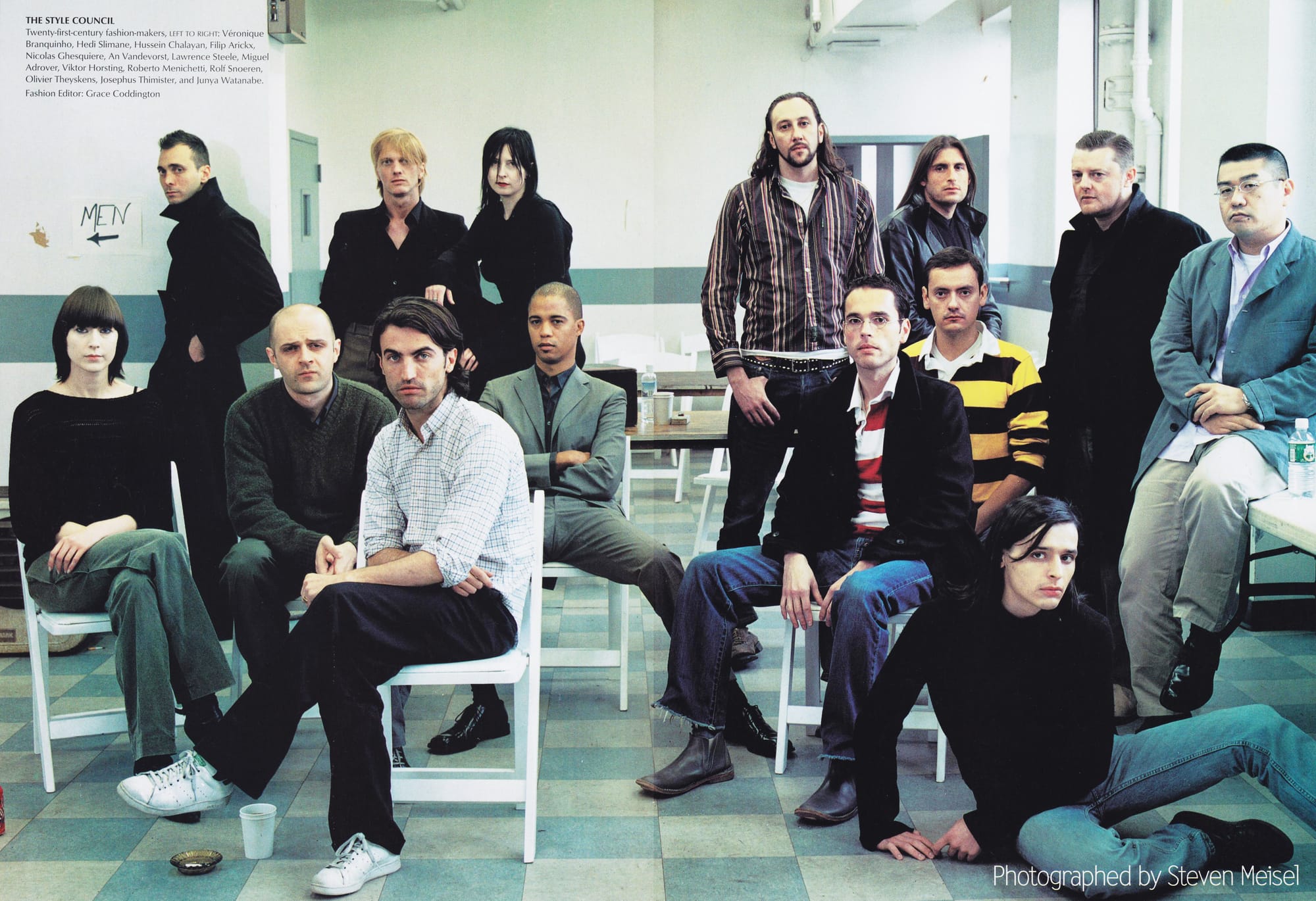
THE STYLE COUNCIL - Twenty-first-century fashion-makers, LEFT TO RIGHT: Véronique Branquinho, Hedi Slimane, Hussein Chalayan, Filip Arickx, Nicolas Ghesquiere, An Vandevorst, Lawrence Steele, Miguel Adrover, Viktor Horsting, Roberto Menichetti, Rolf Snoeren, Olivier Theyskens, Josephus Thimister, and Junya Watanabe.
BLOWN UP - Olivier Theyskens's silhouettes range from the sublimely overblown to the sharply tailored. CENTER: Blue trench, skirt, and crinoline dress by Olivier Theyskens. Barneys New York. BACKGROUND: Black leather top and pants. Black leather jacket and skirt. All by Olivier Theyskens. Saks Fifth Avenue.
SIMPLE MINDS - Nicolas Ghesquiere is a dyed-in-the-wool minimalist. FROM LEFT: Rust velvet top and suede skirt. Barneys New York. Ruched top and pants. Caron Cherry, Bal Harbour FL. Rust leather jacket and wool pants. Blake, Chicago. Wool turtleneck and cotton pants. Kirna Zabête, SoHo NYC. Black trench. Bergdorf Goodman. Flesh top and pants. Laura Urbinati, Los Angeles. Black coat, shirt, and zip pants. Emphatics, Pittsburgh. All, Balenciaga "Le Dix" by Nicolas Ghesquiere.
OPTICAL CONCLUSIONS - Véronique Branquinho's New Wave influenced collection accented patterns. FROM LEFT: Trench (about $1,600), vest (about $460), shirt (about $200), and pants (about $500). Sweater (about $500), skirt (about $300), and pants (about $230). Tunic (about $700), turtleneck (about $190), and pants (about $500). Jacket (about $730), turtleneck (about $150), and skirt (about $600). All by Véronique Branquinho. Barneys New York.
SOLID GOLD - Lawrence Steele’s Fall 2000 looks are all about sensuality and glitz. Gold printed camel coat by Lawrence Steele, about $1825. Stanley Korshak; Dallas.
EXTENDED FORECAST - Roberto Menichetti takes Burberry's image beyond the mac. FROM LEFT: Cashmere roll-neck sweater, about $585. Leather reversible trench, vest (about $1,600), shearling kilt (about $1,680). All by Burberry Prorsum Collection. Burberry boutiques.
DRAFTSMAN'S CONTRACT - Hussein Chalayan ducts architectural experiments in volume. and form. FROM FAR LEFT: Sheepskin mitten coat, about $1,595. Kirna Zabête, SoHo NYC. Black angel dress. Blake, Chicago. Black dress, $1,305. Bergdorf Goodman. Swing-back coat, about $1,390. Bergdorf Goodman. Topiary dress. Swing-back coat. Linda Dresner, NYC. Wooden bench, Wyeth New York.
THE MAN WHO FELL TO EARTH - Josephus Thimister's recent work Is very earthy with an organic, aged effect. FROM LEFT. Cream Silk coat lined in white mink by Josephus Thimister Couture. Brown shearling coat with belt by Thimister. Jeffrey, NYC.
THE HOLLAND-AMERICA LINE - Dutch duo Viktor & Rolf turned out an
Americana-inspired collection. FROM LEFT: Black jacket (about $810), white shirt (about $205), and grey pants (about $345). Black tuxedo jacket (about $1145) and pants (about $565) with white shirt (about $630). Black shirt (about $663) and white skirt (about $347). All by Viktor & Rolf. Barney’s New York.
WHEN WORLDS COLLIDE - Miguel Adrover's "Midtown" collection marries Upper East Side grace and south-of-Fourteenth Street nerve, FROM LEFT: Navy sweatshirt (about $275) and pants (about $495). Inverted trouser turtleneck and pants. Crochet top and floral printed skirt (about $625).
Skirt at Barneys New York Renaissance velvet coat. Handkni sweater (about $660) and handkerchief skirt (about $495). Barneys New York. All by Miguel Adrover. Burberry raincoat as interpreted by Miguel Adrover.
TOWN & COUNTRY - A. F. Vandevorst's English equestrian silhouettes are given a rough, urban edge. FROM LEFT: Leather coat (about $1,754), corduroy jacket (about $588), and pants (about $190). Leather and wool sweater (about $507) and wool skirt (about $456). Army coat (about $1,010), turtleneck (about $226), and skirt (about $271). All by A. F. Vandevorst. Barneys New York.
BACK TO BLACK - Hedi Slimane has made the Yves Saint Laurent Rive Gauche menswear line a cult favorite of hip Parisiennes. FROM LEFT: Black cashmere turtleneck (about $895) and wool pants (about $410). Black cashmere and wool turtleneck (about $200) and wool pants (about $685). All by Yves Saint Laurent Rive Gauche Homme.
RAINBOW COALITION - Cyberage technique meets traditional craftsmanship in Junya Watanabe's confetti-bright cocktail dresses. FROM LEFT: Purple top and dress. Fuchsia top and dress. Red top and dress. Floral-print inverted ruffle coat. Floral jacket and skirt. Beige multilayered dress. Turquoise accordion coat. Beige bubble dress. All by Junya Watanabe. Comme des Garçons Boutique, NYC.

Become a paid subscriber today for unlimited access!