'Spraycan School' - Print January 1982
Another art movement hits New York! Its influential practitioners are the once-scorned graffiti artists who first struck the subways 10 years ago. Today, they’re taken very seriously in the world of commerce and pop culture.
By William Greenfield
“A lot of people don’t like it, man, but like it or not, we’ve made the biggest art movement ever to hit New York City.” Super Cool, one of New York’s early “kings” of subway self-promo, minced no words in observing the scene in 1973. Almost a decade later, his clipped quip of street wisdom is sounding less grandiose and more like an overlooked augury of yet another New York School of Painting.
Not everyone, of course, agrees. Anti-graffiti sentiments still run high in some quarters, with psychological theorists intoning that rebels against authority are hellbent on defiling public property, and politicians campaigning to win the “war” against “spray can vandalism.” Despite these “official” attitudes, a growing number of art-conscious observers are beginning to take notice of the quality and quantity of graffiti-based artwork.
It is true that graffiti appreciation courses have not yet arrived at The New School or at similar culturally trendy citadels of learning. This may partly be because the 1980s have not been the best of times for viewing clandestine creations. The city has waged a continuing defoliation campaign of chemical solvents and more recently escalated police efforts to deter the graffiti sprawl.
In the past year alone, at the persistent urging of Mayor Koch, the Metropolitan Transportation Authority installed cyclone fencing around the train yards and even put in German shepherds as guard dogs. As a result, not much of the actual art, beyond photographs, is left. For this photographic record, we can be grateful to enthusiasts such as Martha Cooper and Henry Chalfant, two independent-minded New Yorkers who recognized the importance and vitality of the work and who dauntlessly persisted in recording its development. While New York City’s Police Department has, perhaps, the largest documentation, these two photographers’ meticulous work is of by far the best quality.
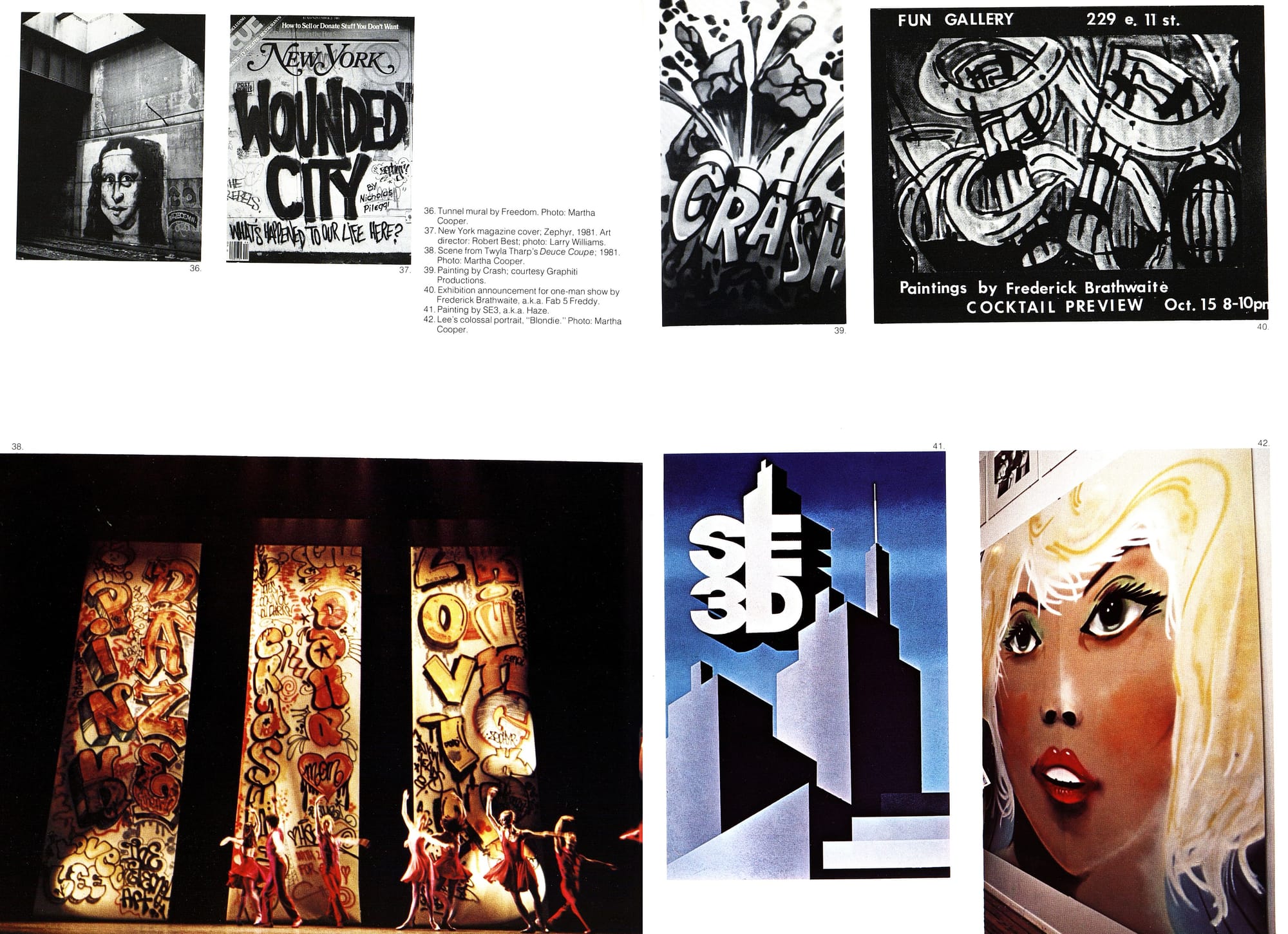
The highly diverse aerosol action painters, latter-day Futurists, “fake” Fauves, and push-button pop artists who comprise New York’s graffiti underground are by now known to countless straphangers simply by their first names: Dondi, Lee, Blade, Zephyr, Futura, Haze, Crash, Daze, Lady Pink, Fred, Ali, Wasp, Duro, Mitch, Doze, Noc, and countless other real and unreal calligraphic identities. These streetwise veterans of “the wolves of war” (Mayor Koch wryly refers to the guard dogs as “wolves”) have emerged from the city’s cancerous rumbling underbelly into a new “yard” — the world of art, publicity, and commerce.
As Fab 5 Freddy, a.k.a. Frederick Brathwaite, succinctly puts it, in a verbal form that Gertrude Stein would appreciate: “Now the object is the objects of graffiti.” From the track-lit white space of art galleries to the recording studios of major record companies, “graffiti” is becoming distinctly salable.
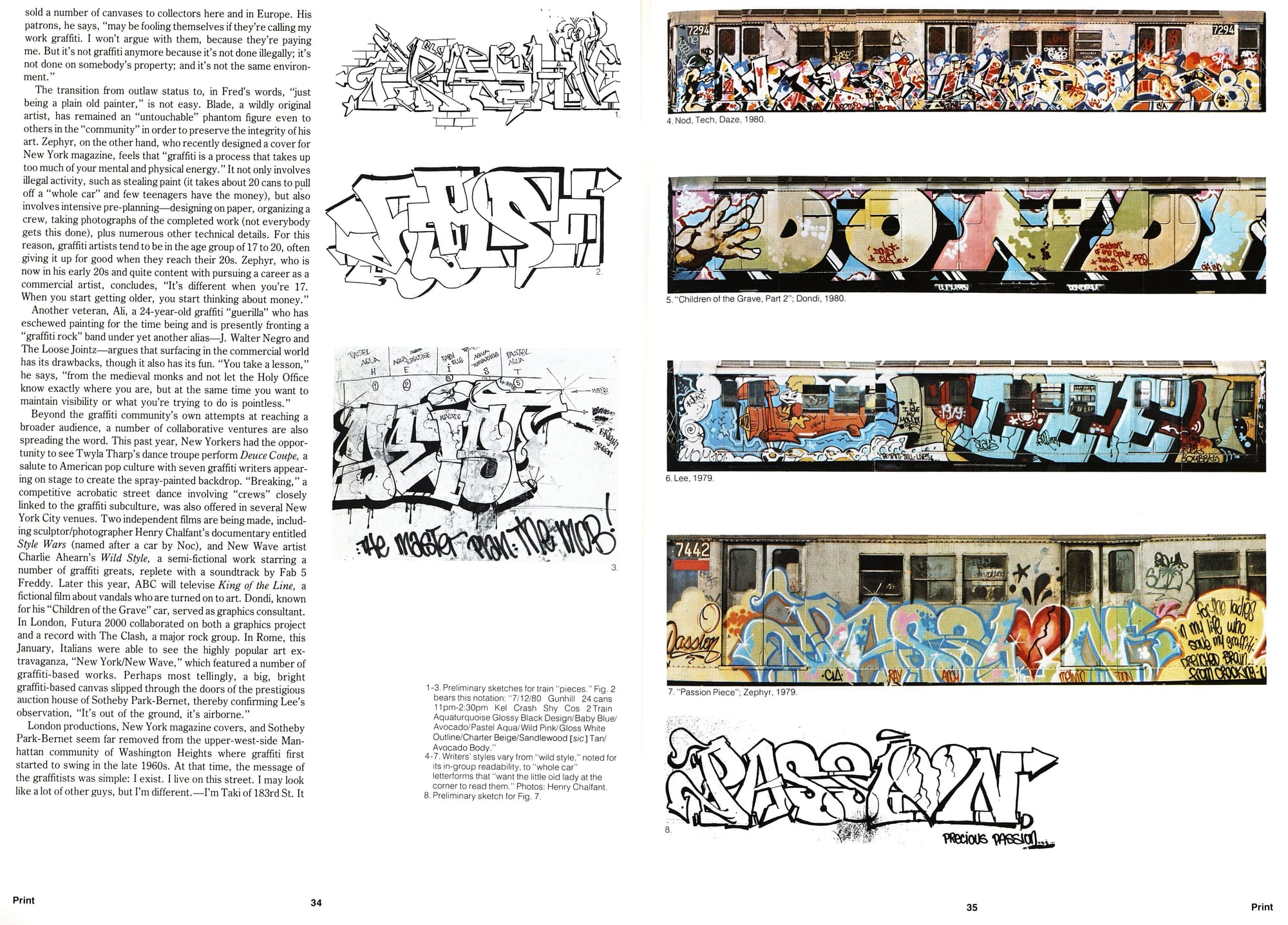
Futura, a graffiti pioneer who abandoned representation for a more abstractly designed “whole car” (see his “Break” car), has sold a number of canvases to collectors here and in Europe. His patrons, he says, “may be fooling themselves if they’re calling my work graffiti. I won’t argue with them, because they’re paying me. But it’s not graffiti anymore because it’s not done illegally; it’s not done on somebody’s property; and it’s not the same environment.”
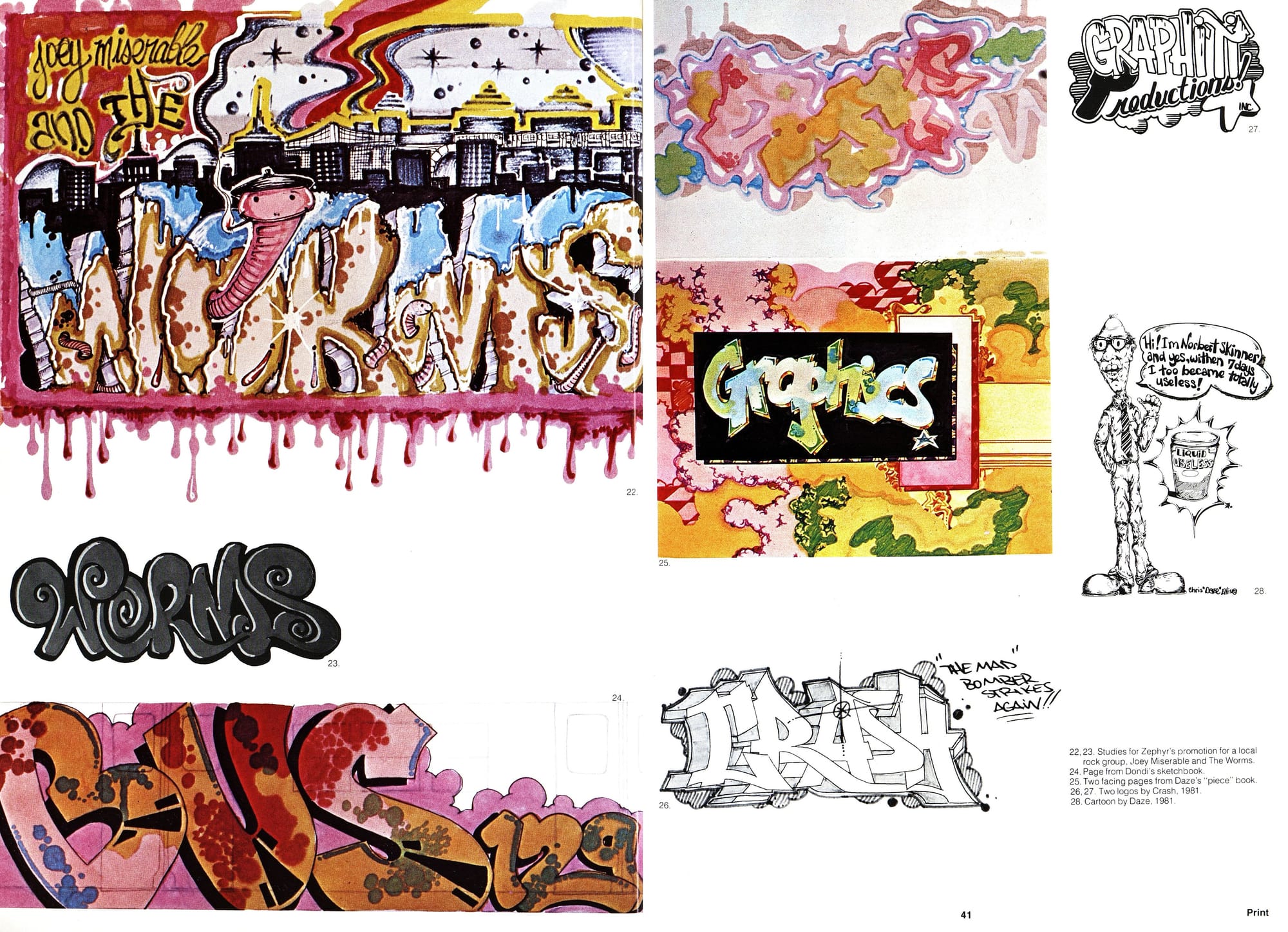
The transition from outlaw status to, in Fred’s words, “just being a plain old painter,” is not easy. Blade, a wildly original artist, has remained an “untouchable” phantom figure even to others in the “community” in order to preserve the integrity of his art. Zephyr, on the other hand, who recently designed a cover for New York magazine, feels that “graffiti is a process that takes up too much of your mental and physical energy.” It not only involves illegal activity, such as stealing paint (it takes about 20 cans to pull off a “whole car” and few teenagers have the money), but also involves intensive pre-planning — designing on paper, organizing a crew, taking photographs of the completed work (not everybody gets this done), plus numerous other technical details. For this reason, graffiti artists tend to be in the age group of 17 to 20, often giving it up for good when they reach their 20s. Zephyr, who is now in his early 20s and quite content with pursuing a career as a commercial artist, concludes, “It’s different when you’re 17. When you start getting older, you start thinking about money.” Another veteran, Ali, a 24-year-old graffiti “guerilla” who has eschewed painting for the time being and is presently fronting a “graffiti rock” band under yet another alias — J. Walter Negro and The Loose Jointz — argues that surfacing in the commercial world has its drawbacks, though it also has its fun. “You take a lesson,” he says, “from the medieval monks and not let the Holy Office know exactly where you are, but at the same time you want to maintain visibility or what you’re trying to do is pointless.”
Beyond the graffiti community’s own attempts at reaching a broader audience, a number of collaborative ventures are also spreading the word. This past year, New Yorkers had the opportunity to see Twyla Tharp’s dance troupe perform Deuce Coupe, a salute to American pop culture with seven graffiti writers appearing on stage to create the spray-painted backdrop. “Breaking,” a competitive acrobatic street dance involving “crews” closely linked to the graffiti subculture, was also offered in several New York City venues. Two independent films are being made, including sculptor/photographer Henry Chalfant’s documentary entitled Style Wars (named after a car by Noc), and New Wave artist Charlie Ahearn’s Wild Style, a semi-fictional work starring a number of graffiti greats, replete with a soundtrack by Fab 5 Freddy. Later this year, ABC will televise King of the Line, a fictional film about vandals who are turned on to art. Dondi, known for his “Children of the Grave” car, served as graphics consultant.
In London, Futura 2000 collaborated on both a graphics project and a record with The Clash, a major rock group. In Rome, this January, Italians were able to see the highly popular art extravaganza, “New York/New Wave,” which featured a number of graffiti-based works. Perhaps most tellingly, a big, bright graffiti-based canvas slipped through the doors of the prestigious auction house of Sotheby Parke-Bernet, thereby confirming Lee’s observation, “It’s out of the ground, it’s airborne.”
London productions, New York magazine covers, and Sotheby Parke-Bernet seem far removed from the upper-west-side Manhattan community of Washington Heights where graffiti first started to swing in the late 1960s. At that time, the message of the graffitists was simple: I exist. I live on this street. I may look like a lot of other guys, but I’m different. I’m Taki of 183rd St. It began as a simple ego-statement or form of self-reassurance. As the people involved matured, the tagging swiftly took a more aggressive direction in order to remain in the fast lane of a hotly competitive fad. The sport of graffiti led ambitious writers to an expanded series of four “plays” or “moves”: 1) putting names everywhere; 2) making them look fancier; 3) using a lot of colors; and 4) putting names in new and daring places so that people would wonder how it was done. Eventually, the basic “tag” turned into a “piece” (as in “masterpiece,” usually involving more than one color). The felt tips gradually gave way to spray cans, and the painting moved from the inside to the outside of trains, as well as onto buses, handball courts, high-visibility walls, and even low-visibility tunnels.
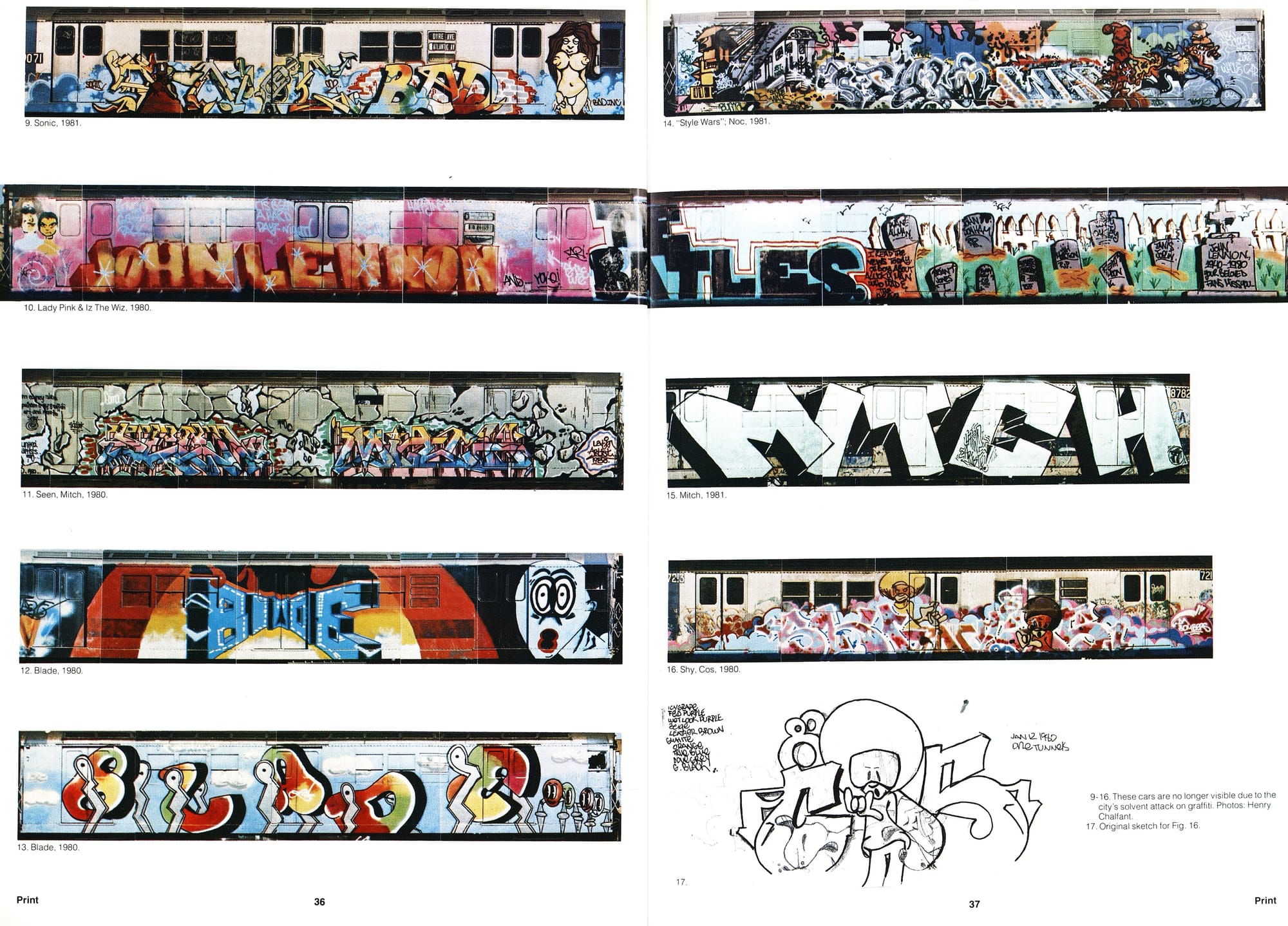
The nature of the communication also evolved, yet it never really lost sight of its very basic roots. Building on their paramount concern of getting a signature across to a captive audience of commuters, graffitists gradually incorporated a number of readily available images into their work. An early ’70s writer like Stay High highlighted his philosophic name-statement with the stick-figure logo from the TV series The Saint. Others embraced similar shards of America’s throwaway pop culture. Purloined images from cartoons — Disney to underground comix — science fiction, custom-car magazines, and the supergraphics of advertising all found their way into the oeuvre. Today a number of serious writers are even beginning to relate their work to the world of Art, with references to painters such as Kandinsky, Edvard Munch, and the Dadaists.
Graffiti, like action painting, became as much a process as a finished product, and writers achieved increasing mastery over the tools of the trade. Learning to control the spray was usually a trial-and-error exercise. It takes a great deal of practice to perfect a “line” and usually requires prior experimentation with other nozzle products such as spray starch, oven cleaners, and pet sprays. Speed is a factor of prime importance, not only because of the danger of interruption by the police, but also in order to create such special effects as a “fade,” which involves a blend of tints and lines while the paint is still wet. Often a good fade means operating two cans simultaneously. Many of the younger writers learned these techniques by hanging out with “the masters.” Dondi, a wickedly adept wild stylist (defined by its illegibility), explains, “When you have style and you’re up on a line, you, like, have dudes coming up to you who want to be your boys. They’ll supply you with all the paint you need just for a wild style outline on paper. Then you go to the yards and help them so that their piece will come off looking cool.” Masters such as Dondi dress in gloves and protective masks as they direct their busy workforce of four or five helpers. Even with a frenzied pace, it may take up to 12 hours to complete a train job.
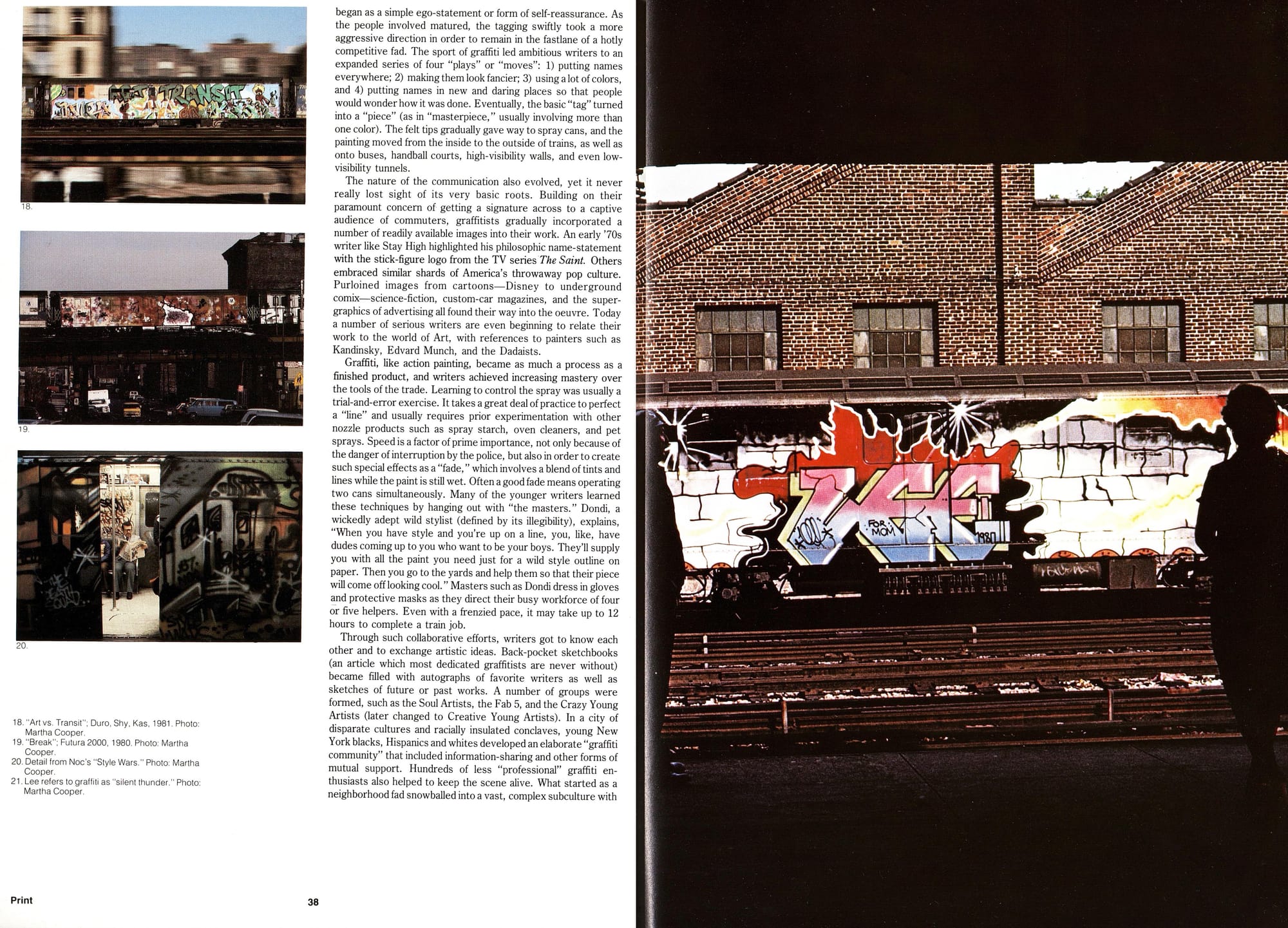
Through such collaborative efforts, writers got to know each other and to exchange artistic ideas. Back-pocket sketchbooks (an article which most dedicated graffitists are never without) became filled with autographs of favorite writers as well as sketches of future or past works. A number of groups were formed, such as the Soul Artists, the Fab 5, and the Crazy Young Artists (later changed to Creative Young Artists). In a city of disparate cultures and racially insulated conclaves, young New York blacks, Hispanics, and whites developed an elaborate “graffiti community” that included information-sharing and other forms of mutual support. Hundreds of less “professional” graffiti enthusiasts also helped to keep the scene alive. What started as a neighborhood fad snowballed into a vast, complex subculture with its hard-won “rites of passage,” aesthetic and social hierarchy, and even community responsibility. “Right now we’re seeing the fourth and fifth generation,” explains Wasp, at 25 an older writer who witnessed, at first hand, the torch of graffiti as it was handed down, and who has seen the progression from “tags” (felt-tipped name-and-street combinations) to the elaborately colorful “whole cars” (train cars painted from top to bottom).
Part of this multiracial, multi-ethnic, and “multi-generational” camaraderie grew out of the very dangers associated with the graffiti life. Stalking the stations in after-school hours and gathering “crews” in the dead of night, an ever-growing number of art-obsessed youths clearly enjoyed the thrill of risking their necks to get their message across. While the fear of getting caught by the police added a sense of excitement, the Transportation Authority’s relentless buffing machines and chemical solvents provided a tragic undertone of romantic futility. For Lee, a 21-year-old Hispanic New Yorker from the crime-plagued Lower East Side who is one of the city’s most prolific push-button muralists and whose most important works were on the trains, it was never the police who were the enemies. “They’re just doing their job, and I respect that. It was ‘the buff.’” With more and more police and buffing, the early 1980s finally witnessed a decline in “whole car” jobs and a resurgence of scribbling, with many writers concentrating on “bombing” the insides.
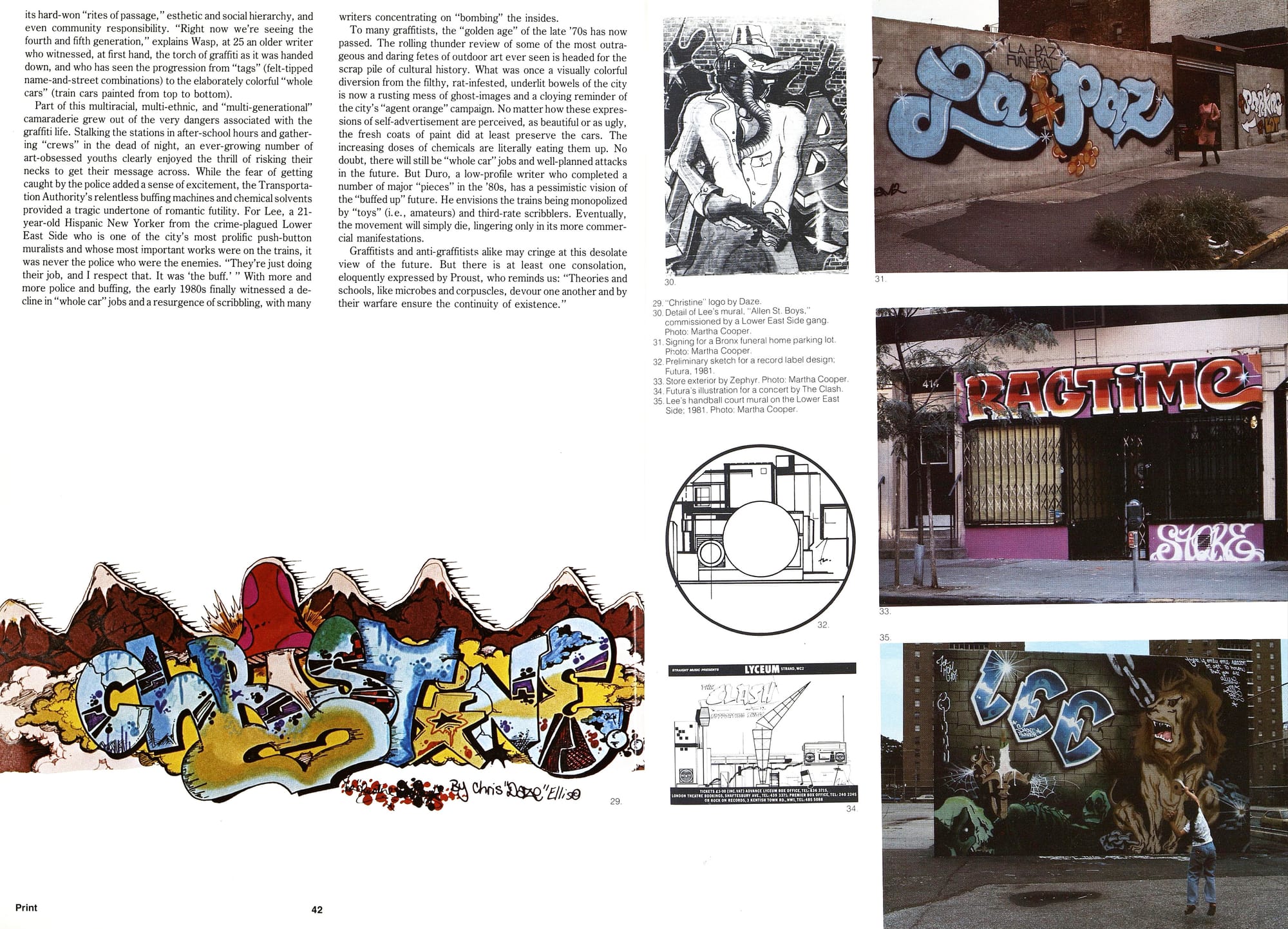
To many graffitists, the “golden age” of the late ’70s has now passed. The rolling thunder review of some of the most outrageous and daring fêtes of outdoor art ever seen is headed for the scrap pile of cultural history. What was once a visually colorful diversion from the filthy, rat-infested, underlit bowels of the city is now a rusting mess of ghost-images and a cloying reminder of the city’s “agent orange” campaign. No matter how these expressions of self-advertisement are perceived, as beautiful or as ugly, the fresh coats of paint did at least preserve the cars. The increasing doses of chemicals are literally eating them up.
No doubt, there will still be “whole car” jobs and well-planned attacks in the future. But Duro, a low-profile writer who completed a number of major “pieces” in the ’80s, has a pessimistic vision of the “buffed up” future. He envisions the trains being monopolized by “toys” (i.e., amateurs) and third-rate scribblers. Eventually, the movement will simply die, lingering only in its more commercial manifestations.
Graffitists and anti-graffitists alike may cringe at this desolate view of the future. But there is at least one consolation, eloquently expressed by Proust, who reminds us: “Theories and schools, like microbes and corpuscles, devour one another and by their warfare ensure the continuity of existence.”