
Sight & Sound April 1992 - 'Revelations - An interview with Wim Wenders'
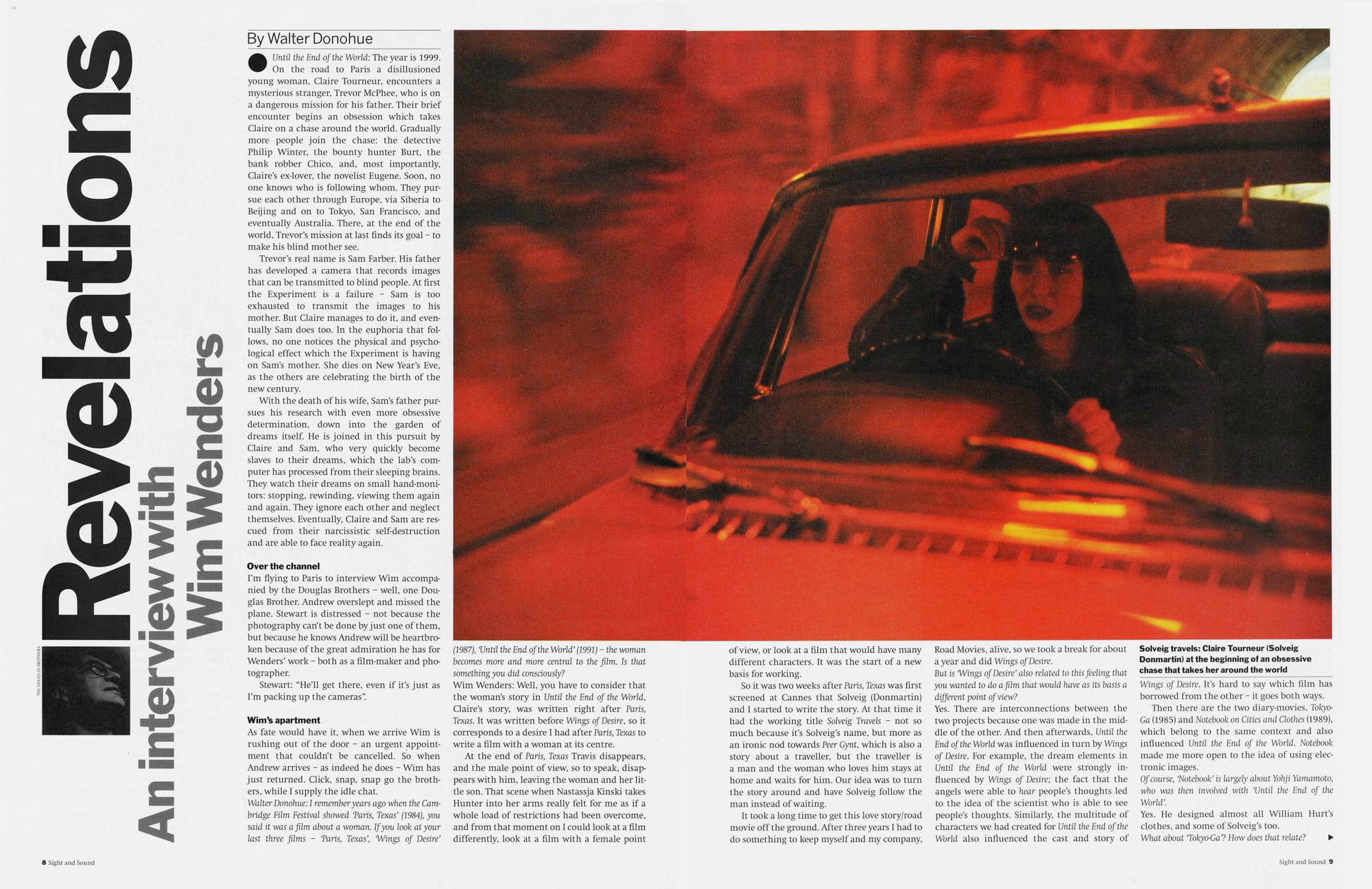
By Walter Donohue
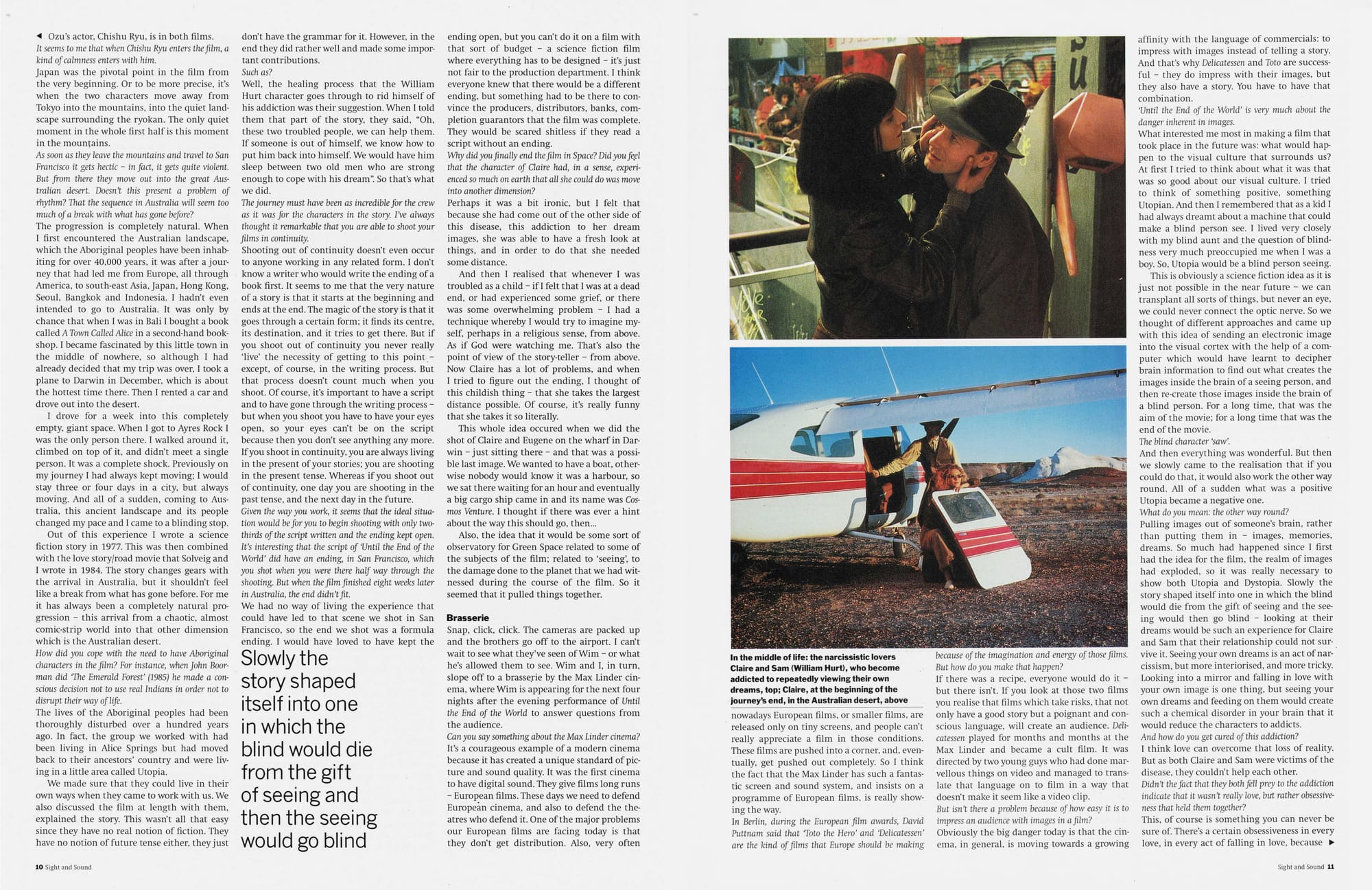
Until the End of the World: The year is 1999. On the road to Paris a disillusioned young woman. Claire Tourneur encounters a mysterious stranger, Trevor McPhee, who is on a dangerous mission for his father. Their brief encounter begins an obsession which takes Claire on a chase around the world. Gradually more people join the chase: the detective Philip Winter, the bounty hunter Burt, the bank robber Chico, and, most importantly, Claire's ex-lover, the novelist Eugene. Soon, no one knows who is following whom. They pursue each other through Europe via Siberia to Beijing and on to Tokyo, San Francisco, and eventually Australia. There at the end of the world. Trevor's mission at last finds its goal - to make his blind mother see.
Trevor's real name is Sam Farber. His father has developed a camera that records images that can be transmitted to blind people. At first the Experiment is a failure - Sam is too exhausted to transmit the images to his mother. But Claire manages to do it, and eventually Sam does too. In the euphoria that fol-lows, no one notices the physical and psychological effect which the Experiment is having on Sam's mother. She dies on New Year's Eve, as the others are celebrating the birth of the new century.
With the death of his wife, Sam's father pursues his research with even more obsessive determination, down into the garden of dreams itself. He is joined in this pursuit by Claire and Sam, who very quickly become slaves to their dreams, which the lab's computer has processed from their sleeping brains They watch their dreams on small hand-moni-tors: stopping, rewinding, viewing them again and again. They ignore each other and neglect themselves. Eventually, Claire and Sam are rescued from their narcissistic self-destruction and are able to face reality again.
Over the channel
I'm flying to Paris to interview Wim accompanied by the Douglas Brothers - well, one Douglas Brother. Andrew overslept and missed the plane. Stewart is distressed - not because the photography can't be done by just one of them, but because he knows Andrew will be heartbroken because of the great admiration he has for Wenders' work - both as a film-maker and photographer. Stewart: "He'll get there, even if it's just as I'm packing up the cameras".
Wim's apartment
As fate would have it, when we arrive Wim is rushing out of the door - an urgent appointment that couldn't be cancelled. So when Andrew arrives - as indeed he does - Wim has just returned. Click, snap, snap go the brothers, while I supply the idle chat.
Walter Donohue: I remember years ago when the Cambridge Film Festival showed ‘Paris, Texas' (1984), You said it was a film about a woman. If you look at your last three films - ‘Paris, Texas', 'Wings of Desire’ (1987), 'Until the End of the World' (1991) - the woman becomes more and more central to the film. Is that something you did consciously?
Wim Wenders: Well, you have to consider that the woman's story in Until the End of the World, Claire's story, was written right after Paris, Texas. It was written before Wings of Desire, so it corresponds to a desire I had after Paris, Texas to write a film with a woman at its centre.
At the end of Paris, Texas Travis disappears, and the male point of view, so to speak, disappears with him. leaving the woman and ner lt-tle son. That scene when Nastassja Kinski takes Hunter into her arms really felt for me as if a whole load of restrictions had been overcome. and from that moment on I could look at a film differently, look at a film with a female point of view, or look at a film that would have many different characters. It was the start of a new basis for working.
So it was two weeks after ‘Paris, Texas’ was first screened at Cannes that Solveig (Donmartin) and I started to write the story. At that time it had the working title Solveig Travels - not so much because it's Solveig's name, but more as an ironic nod towards Peer Gynt, which is also a story about a traveller, but the traveller is a man and the woman who loves him stays at home and waits for him. Our idea was to turn the story around and have Solveig follow the man instead of waiting. It took a long time to get this love story/road movie off the ground. After three years I had to do something to keep myself and my company, Road Movies, alive, so we took a break for about a year and did ‘Wings of Desire.’
WD: But is ‘Wings of Desire' also related to this feeling that you wanted to do a film that would have as its basis a different point of view?
WW: Yes. There are interconnections between the two projects because one was made in the middle of the other. And then afterwards, ‘Until the End of the World’ was influenced in turn by ‘Wings of Desire’. For example, the dream elements in Until the End of the World were strongly influenced by Wings of Desire; the fact that the angels were able to hear people's thoughts led to the idea of the scientist who is able to see people's thoughts. Similarly, the multitude of characters we had created for Until the End of the World also influenced the cast and story of Wings of Desire. It's hard to say which film has borrowed from the other - it goes both ways.
Then there are the two diary-movies, ‘Tokyo-Ga’ (1985) and ‘Notebook on Cities and Clothes’ (1989), which belong to the same context and also influenced ‘Until the End of the World’. Notebook made me more open to the idea of using electronic images.
WD: Of course, ‘Notebook' is largely about Yohji Yamamoto, who was then involved with ‘Until the End of the World'.
WW: Yes. He designed almost all William Hurt's clothes, and some of Solveig's too.
WD: What about ‘Tokyo-Ga?’ How does that relate?
WW: Ozu's actor, Chishu Ryu, is in both films.
WD: It seems to me that when Chishu Ryu enters the film, a kind of calmness enters with him.
WW: Japan was the pivotal point in the film from the very beginning. Or to be more precise, it's when the two characters move away from Tokyo into the mountains, into the quiet landscape surrounding the ryokan. The only quiet moment in the whole first half is this moment in the mountains.
WD: As soon as they leave the mountains and travel to San Francisco it gets hectic - in fact, it gets quite violent. But from there they move out into the great Australian desert. Doesn't this present a problem of rhythm? That the sequence in Australia will seem too much of a break with what has gone before?
WW: The progression is completely natural. When I first encountered the Australian landscape, which the Aboriginal peoples have been inhabiting for over 40,000 years, it was after a journey that had led me from Europe, all through America, to south-east Asia, Japan, Hong Kong, Seoul, Bangkok and Indonesia. I hadn't even intended to go to Australia. It was only by chance that when I was in Bali I bought a book called A Town Called Alice in a second-hand book-shop. I became fascinated by this little town in the middle of nowhere, so although I had already decided that my trip was over, I took a plane to Darwin in December. which is about the hottest time there. Then I rented a car and drove out into the desert.
I drove for a week into this completely empty, giant space. When I got to Ayres Rock I was the only person there. I walked around it, climbed on top of it, and didn't meet a single person. It was a complete shock. Previously on my journey I had always kept moving; I would stay three or four days in a city, but always moving. And all of a sudden, coming to Australia, this ancient landscape and its people changed my pace and I came to a blinding stop.
Out of this experience I wrote a science fiction story in 1977. This was then combined with the love story/road movie that Solveig and I wrote in 1984. The story changes gears with the arrival in Australia, but it shouldn't feel like a break from what has gone before. For me it has always been a completely natural progression - this arrival from a chaotic, almost comic-strip world into that other dimension which is the Australian desert.
WD: How did you cope with the need to have Aboriginal characters in the film? For instance, when John Boorman did 'The Emerald Forest' (1985) he made a conscious decision not to use real Indians in order not to disrupt their way of life.
WW: The lives of the Aboriginal peoples had been thoroughly disturbed over a hundred years ago. In fact, the group we worked with had been living in Alice Springs but had moved back to their ancestors country and were living in a little area called Utopia.
We made sure that they could live in their own ways when they came to work with us. We also discussed the film at length with them, explained the story. This wasn't all that easy since they have no real notion of fiction. They have no notion of future tense either, they just don't have the grammar for it. However, in the end they did rather well and made some important contributions.
WD: Such as?
WW: Well, the healing process that the William Hurt character goes through to rid himself of his addiction was their suggestion. When I told them that part of the story, they said, "Oh, these two troubled people, we can help them. If someone is out of himself, we know how to put him back into himself. We would have him sleep between two old men who are strong enough to cope with his dream". So that's what we did.
WD: The journey must have been as incredible for the crew as it was for the characters in the story. I've always thought it remarkable that you are able to shoot your films in continuity.
WW: Shooting out of continuity doesn't even occur to anyone working in any related form. I don't know a writer who would write the ending of a book first. It seems to me that the very nature of a story is that it starts at the beginning and ends at the end. The magic of the story is that it goes through a certain form; it finds its centre, its destination, and it tries to get there. But if you shoot out of continuity you never really live' the necessity of getting to this point - except, of course, in the writing process. But that process doesn't count much when you shoot. Of course, it's important to have a script and to have gone through the writing process - but when you shoot you have to have your eyes open, so your eyes can't be on the script because then you don't see anything any more. If you shoot in continuity, you are always living in the present of your stories; you are shooting in the present tense. Whereas if you shoot out of continuity, one day you are shooting in the past tense, and the next day in the future.
WD: Given the way you work, it seems that the ideal situation would be for you to begin shooting with only two-thirds of the script written and the ending kept open.
WW: It's interesting that the script of 'Until the End of the World' did have an ending, in San Francisco, which you shot when you were there halfway through the shooting. But when the film finished eight weeks later in Australia, the end didn't fit. We had no way of living the experience that could have led to that scene we shot in San Francisco, so the end we shot was a formula ending. I would have loved to have kept the ending open, but you can't do it on a film with that sort of budget - a science fiction him where everything has to be designed - it's just not fair to the production department. I think everyone knew that there would be a different ending, but something had to be there to convince the producers, distributors, banks, completion guarantors that the film was complete. They would be scared shitless if they read a script without an ending.
Why did you finally end the film in Space? Did you feel that the character of Claire had, in a sense, experienced so much on earth that all she could do was move into another dimension?
Perhaps it was a bit ironic, but I felt that because she had come out of the other side of this disease, this addiction to her dream images, she was able to have a fresh look at things, and in order to do that she needed some distance.
And then I realized that whenever I was troubled as a child - if I felt that I was at a dead end, or had experienced some grief, or there was some overwhelming problem - I had a technique whereby I would try to imagine my-self, perhaps in a religious sense, from above. As if God were watching me. That's also the point of view of the story-teller - from above. Now Claire has a lot of problems, and when I tried to figure out the ending, I thought of this childish thing - that she takes the largest distance possible. Of course, it's really funny that she takes it so literally.
This whole idea occurred when we did the shot of Claire and Eugene on the wharf in Darwin - just sitting there - and that was a possible last image. We wanted to have a boat, otherwise nobody would know it was a harbour, so we sat there waiting for an hour and eventually a big cargo ship came in and its name was Cosmos Venture. I thought if there was ever a hint about the way this should go, then...
Also, the idea that it would be some sort of observatory for Green Space related to some of the subjects of the film; related to seeing to the damage done to the planet that we had witnessed during the course of the film. So it seemed that it pulled things together.
Brasserie
Snap, click, click. The cameras are packed up and the brothers go off to the airport. I can't wait to see what they've seen of Wim - or what he's allowed them to see. Wim and I, in turn, slope off to a brasserie by the Max Linder cinema, where Wim is appearing for the next four nights after the evening performance of ‘Until the End of the World’ to answer questions from the audience.
WD: Can you say something about the Max Linder cinema?
WW: It's a courageous example of a modern cinema because it has created a unique standard of picture and sound quality. It was the first cinema to have digital sound. They give films long runs - European films. These days we need to defend European cinema, and also to defend the theatres who defend it. One of the major problems our European films are facing today is that they don't get distribution. Also, very often nowadays European films, or smaller films, are released only on tiny screens, and people can't really appreciate a film in those conditions. These films are pushed into a corner, and, eventually, get pushed out completely. So I think the fact that the Max Linder has such a fantastic screen and sound system, and insists on a programme of European films, is really showing the way.
WD: In Berlin, during the European film awards, David Puttnam said that ‘Toto the Hero' and ‘Delicatessen' are the kind of films that Europe should be making because of the imagination and energy of those films. But how do you make that happen?
WW: If there was a recipe, everyone would do it - but there isn't. If you look at those two films you realize that films which take risks, that not only have a good story but a poignant and conscious language, will create an audience. Delicatessen played for months and months at the Max Linder and became a cult film. It was directed by two young guys who had done marvelous things on video and managed to translate that language onto film in a way that doesn't make it seem like a video clip.
WD: But isn't there a problem because of how easy it is to impress an audience with images in a film?
WW: Obviously the big danger today is that the cinema, in general, is moving towards a growing affinity with the language of commercials: to impress with images instead of telling a story. And that's why Delicatessen and Toto are successful - they do impress with their images, but they also have a story. You have to have that combination.
WD: 'Until the End of the World' is very much about the danger inherent in images.
WW: What interested me most in making a film that took place in the future was: what would happen to the visual culture that surrounds us? At first I tried to think about what it was that was so good about our visual culture. I tried to think of something positive, something Utopian. And then I remembered that as a kid I had always dreamt about a machine that could make a blind person see. I lived very closely with my blind aunt and the question of blindness very much preoccupied me when I was a boy. So, Utopia would be a blind person seeing.
This is obviously a science fiction idea as it is just not possible in the near future - we can transplant all sorts of things, but never an eye, we could never connect the optic nerve. So we thought up different approaches and came up with this idea of sending an electronic image into the visual cortex with the help of a computer which would have learnt to decipher brain information to find out what creates the images inside the brain of a seeing person, and then re-create those images inside the brain of a blind person. For a long time, that was the aim of the movie; for a long time that was the end of the movie.
WD: The blind character saw.
WW: And then everything was wonderful. But then we slowly came to the realization that if you could do that, it would also work the other way round. All of a sudden what was a positive Utopia became a negative one.
WD: What do you mean: the other way round?
WW: Pulling images out of someone's brain, rather than putting them in - images, memories, dreams. So much had happened since I first had the idea for the film, the realm of images had exploded, so it was really necessary to show both Utopia and Dystopia. Slowly the story shaped itself into one in which the blind would die from the gift of seeing and the seeing would then go blind - looking at their dreams would be such an experience for Claire and Sam that their relationship could not survive it. Seeing your own dreams is an act of narcissism, but more interiorised, and more tricky.
Looking into a mirror and falling in love with your own image is one thing, but seeing your own dreams and feeding on them would create such a chemical disorder in your brain that it would reduce the characters to addicts.
WD: And how do you get cured of this addiction?
WW: I think love can overcome that loss of reality.
But as both Claire and Sam were victims of the disease, they couldn't help each other.
WD: Didn't the fact that they both fell prey to the addiction indicate that it wasn't really love, but rather obsessiveness that held them together?
WW: This, of course, is something you can never be sure of. There's a certain obsessiveness in every love, in every act of falling in love, because falling in love is also a sort of sickness; in love we lose ourselves and our sense of reality. It is also linked to a certain kind of narcissism, because sometimes you realise that what you had fallen in love with was yourself and not the Other. That's what Paris, Texas talks about, that's what Travis realizes. He leaves in the end because he realises that he has never really "seen' the Other, rather he was infatuated with the Other.
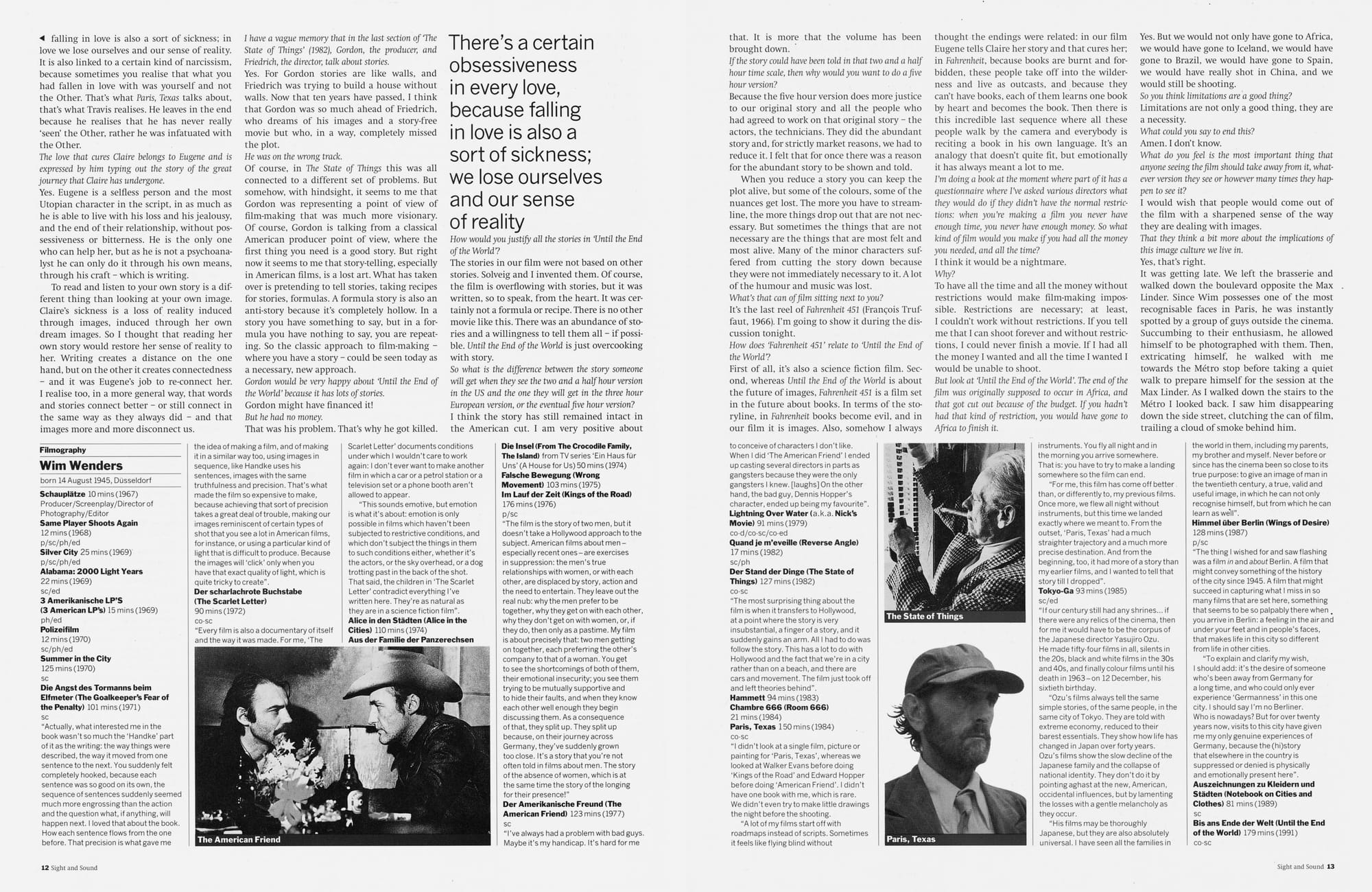
WD: The love that cures Claire belongs to Eugene and is expressed by him typing out the story of the great journey that Claire has undergone.
WW: Yes. Eugene is a selfless person and the most Utopian character in the script, in as much as he is able to live with his loss and his jealousy, and the end of their relationship, without possessiveness or bitterness. He is the only one who can help her, but as he is not a psychoanalyst he can only do it through his own means, through his craft - which is writing.
To read and listen to your own story is a different thing than looking at your own image. Claire's sickness is a loss of reality induced through images, induced through her own dream images. So I thought that reading her own story would restore her sense of reality to her. Writing creates a distance on the one hand, but on the other it creates connectedness - and it was Eugene's job to re-connect her. I realize too, in a more general way, that words and stories connect better - or still connect in the same way as they always did - and that images more and more disconnect us.
WD: I have a vague memory that in the last section of 'The State of Things' (1982), Gordon, the producer, and Friedrich, the director, talk about stories.
WW: Yes. For Gordon stories are like walls, and Friedrich was trying to build a house without walls. Now that ten years have passed, I think that Gordon was so much ahead of Friedrich, who dreams of his images and a story-free movie but who, in a way, completely missed the plot.
WD: He was on the wrong track.
WW: Of course, in ‘The State of Things’ this was all connected to a different set of problems. But somehow, with hindsight, it seems to me that Gordon was representing a point of view of film-making that was much more visionary.
Of course, Gordon is talking from a classical American producer point of view, where the first thing you need is a good story. But right now it seems to me that story-telling, especially in American films, is a lost art. What has taken over is pretending to tell stories, taking recipes for stories, formulas. A formula story is also an anti-story because it's completely hollow. In a story you have something to say, but in a formula you have nothing to say, you are repeat-ing. So the classic approach to film-making - where you have a story - could be seen today as a necessary, new approach.
WD: Gordon would be very happy about 'Until the End of the World' because it has lots of stories.
WW: Gordon might have financed it!
WD: But he had no money.
WW: That was his problem. That's why he got killed.
WD: How would you justify all the stories in 'Until the End of the World?’
WW: The stories in our film were not based on other stories. Solveig and I invented them. Of course, the film is overflowing with stories, but it was written, so to speak, from the heart. It was certainly not a formula or recipe. There is no other movie like this. There was an abundance of stories and a willingness to tell them all - if possi-ble. Until the End of the World is just overcooking with story.
WD: So what is the difference between the story someone will get when they see the two and a half hour version in the US and the one they will get in the three hour European version, or the eventual five hour version?
WW: I think the story has still remained intact in the American cut. I am very positive about that. It is more that the volume has been brought down.
WD: If the story could have been told in that two and a half hour time scale, then why would you want to do a five hour version?
WW: Because the five hour version does more justice to our original story and all the people who had agreed to work on that original story - the actors, the technicians. They did the abundant story and, for strictly market reasons, we had to reduce it. I felt that for once there was a reason for the abundant story to be shown and told.
When you reduce a story you can keep the plot alive, but some of the colours, some of the nuances get lost. The more you have to streamline, the more things drop out that are not necessary. But sometimes the things that are not necessary are the things that are most felt and most alive. Many of the minor characters suffered from cutting the story down because they were not immediately necessary to it. A lot of the humor and music was lost.
WD: What's that can of film sitting next to you?
WW: It's the last reel of Fahrenheit 451 (François Truffaut, 1966). I'm going to show it during the discussion tonight.
WD: How does Fahrenheit 451' relate to 'Until the End of the World?’
WW: First of all, it's also a science fiction film. Second, whereas ‘Until the End of the World’ is about the future of images, Fahrenheit 451 is a film set in the future about books. In terms of the storyline, in Fahrenheit books become evil, and in our film it is images. Also, somehow I always thought the endings were related: in our film Eugene tells Claire her story and that cures her; in Fahrenheit, because books are burnt and forbidden, these people take off into the wilderness and live as outcasts, and because they can't have books, each of them learns one book by heart and becomes the book. Then there is this incredible last sequence where all these people walk by the camera and everybody is reciting a book in his own language. It's an analogy that doesn't quite fit, but emotionally it has always meant a lot to me.
WD: I'm doing a book at the moment where part of it has a questionnaire where I've asked various directors what they would do if they didn't have the normal restrictions: when you're making a film you never have enough time, you never have enough money. So what kind of film would you make if you had all the money you needed, and all the time?
WW: I think it would be a nightmare.
WD: Why?
WW: To have all the time and all the money without restrictions would make film-making impossible. Restrictions are necessary; at least, I couldn't work without restrictions. If you tell me that I can shoot forever and without restrictions, I could never finish a movie. If I had all the money I wanted and all the time I wanted I would be unable to shoot.
WD: But look at ‘Until the End of the World.’ The end of the film was originally supposed to occur in Africa, and that got cut out because of the budget. If you hadn't had that kind of restriction, you would have gone to Africa to finish it.
WW: Yes. But we would not only have gone to Africa, we would have gone to Iceland, we would have gone to Brazil, we would have gone to Spain, we would have really shot in China, and we would still be shooting.
WD: So you think limitations are a good thing?
WW: Limitations are not only a good thing, they are a necessity.
WD: What could you say to end this?
WW: Amen. I don't know.
WD: What do you feel is the most important thing that anyone seeing the film should take away from it, whatever version they see or however many times they happen to see it?
WW: I would wish that people would come out of the film with a sharpened sense of the way they are dealing with images.
WD: That they think a bit more about the implications of this image culture we live in.
WW: Yes, that's right.
It was getting late. We left the brasserie and walked down the boulevard opposite the Max Linder. Since Wim possesses one of the most recognizable faces in Paris, he was instantly spotted by a group of guys outside the cinema. Succumbing to their enthusiasm, he allowed himself to be photographed with them. Then, extricating himself, he walked with me towards the Métro stop before taking a quiet walk to prepare himself for the session at the Max Linder. As I walked down the stairs to the Métro I looked back. I saw him disappearing down the side street, clutching the can of film, trailing a cloud of smoke behind him.
Filmography:
Wim Wenders born 14 August 1945, Düsseldorf
‘Schauplätze’ 10 mins (1967) Producer/Screenplay/Director of Photography/Editor
‘Same Player Shoots Again’ 12 mins (1968) P/SC/PH/ED
‘Silver City’ 25 mins (1969) P/SC/PH/ED
‘Alabama: 2000 Light Years’ 22 mins (1969) SC/ED
‘3 Amerikanische LP'S’ (3 American LP's) 15 mins (1969) PH/ED
‘Polizeifilm’ 12 mins (1970) SC/PH/ED
‘Summer in the City’ 125 mins (1970) SC
‘Die Angst des Tormanns beim Elfmeter’ (The Goalkeeper's Fear of the Penalty) 101 mins (1971) SC - "Actually, what interested me in the book wasn't so much the 'Handke' part of it as the writing: the way things were described, the way it moved from one sentence to the next. You suddenly felt completely hooked, because each sentence was so good on its own, the sequence of sentences suddenly seemed much more engrossing than the action and the question what, if anything, will happen next. I loved that about the book. How each sentence flows from the one before. That precision is what gave me the idea of making a film, and of making it in a similar way too, using images in sequence, like Handke uses his sentences, images with the same truthfulness and precision. That's what made the film so expensive to make, because achieving that sort of precision takes a great deal of trouble, making our images reminiscent of certain types of shot that you see a lot in American films, for instance, or using a particular kind of light that is difficult to produce. Because the images will 'click' only when you have that exact quality of light, which is quite tricky to create"
‘Der scharlachrote Buchstabe’ (The Scarlet Letter) 90 mins (1972) CO-SC
"Every film is also a documentary of itself and the way it was made. For me, 'The Scarlet Letter' documents conditions under which I wouldn't care to work again: I don't ever want to make another film in which a car or a petrol station or a television set or a phone booth aren't allowed to appear.
This sounds emotive, but emotion is what it's about: emotion is only possible in films which haven't been subjected to restrictive conditions, and which don't subject the things in them to such conditions either, whether it's the actors, or the sky overhead, or a dog trotting past in the back of the shot. That said, the children in 'The Scarlet Letter' contradict everything l've written here. They're as natural as they are in a science fiction film."
‘Alice in den Städten’ (Alice in the Cities) 110 mins (1974)
‘Aus der Familie der Panzerechsen Die Insel’ (From The Crocodile Family, The Island) from TV series 'Ein Haus für Uns' (A House for Us) 50 mins (1974)
‘Falsche Bewegung’ (Wrong Movement) 103 mins (1975)
‘Im Lauf der Zeit’ (Kings of the Road) 176 mins (1976) P/SC - "The film is the story of two men, but it doesn't take a Hollywood approach to the subject. American films about men - especially recent ones - are exercises in suppression: the men's true relationships with women, or with each other, are displaced by story, action and the need to entertain. They leave out the real nub: why the men prefer to be together, why they get on with each other, why they don't get on with women, or, if they do, then only as a pastime. My film is about precisely that: two men getting on together, each preferring the other's company to that of a woman. You get to see the shortcomings of both of them, their emotional insecurity; you see them trying to be mutually supportive and to hide their faults, and when they know each other well enough they begin discussing them. As a consequence of that, they split up. They split up because, on their journey across Germany, they've suddenly grown too close. It's a story that you're not often told in films about men. The story of the absence of women, which is at the same time the story of the longing for their presence!"
‘Der Amerikanische Freund’ (The American Friend) 123 mins (1977) SC - "l've always had a problem with bad guys. Maybe it's my handicap. It's hard for me instruments. You fly all night and in the morning you arrive somewhere. That is: you have to try to make a landing somewhere so the film can end.
For me, this film has come off better. than, or differently to, my previous films. Once more, we flew all night without instruments, but this time we landed exactly where we meant to. From the outset, 'Paris, Texas' had a much straighter trajectory and a much more precise destination. And from the beginning, too, it had more of a story than my earlier films, and I wanted to tell that story till I dropped"
‘Tokyo-Ga’ 93 mins (1985) SC/ED - "If our century still had any shrines... if there were any relics of the cinema, then for me it would have to be the corpus of the Japanese director Yasujiro Ozu. He made fifty-four films in all, silents in the 20s, black and white films in the 30s and 40s, and finally colour films until his death in 1963 - on 12 December, his sixtieth birthday.
Ozu's films always tell the same simple stories, of the same people, in the same city of Tokyo. They are told with extreme economy, reduced to their barest essentials. They show how life has changed in Japan over forty years. Ozu's films show the slow decline of the Japanese family and the collapse of national identity. They don't do it by pointing aghast at the new, American, occidental influences, but by lamenting the losses with a gentle melancholy as they occur.
His films may be thoroughly Japanese, but they are also absolutely universal. I have seen all the families in the world in them, including my parents, my brother and myself. Never before or since has the cinema been so close to its true purpose: to give an image of man in the twentieth century, a true, valid and useful image, in which he can not only recognise himself, but from which he can learn as well"
‘Himmel über Berlin’ (Wings of Desire) 128 mins (1987) P/SC - "The thing I wished for and saw flashing was a film in and about Berlin. A film that might convey something of the history of the city since 1945. A film that might succeed in capturing what I miss in so many films that are set here, something that seems to be so palpably there when. you arrive in Berlin: a feeling in the air and under your feet and in people's faces, that makes life in this city so different from life in other cities.
To explain and clarify my wish, I should add: it's the desire of someone who's been away from Germany for a long time, and who could only ever experience 'Germanness' in this one city. I should say I'm no Berliner. Who is nowadays? But for over twenty years now, visits to this city have given me my only genuine experiences of Germany, because the (hi)story that elsewhere in the country is suppressed or denied is physically and emotionally present here"
‘Auszeichnungen zu Kleidern und Städten’ (Notebook on Cities and Clothes) 81 mins (1989) SC
‘Bis ans Ende der Welt’ (Until the End of the World) 179 mins (1991) CO-SC