'Redemption of the hapless Yugo' - Surface January 1996
Writer: Dee Ito
Photos: Tia Maggalon
Cheap, ugly and badly made, the Yugo was introduced to America in 1986 and by 1992 the company was out of business—the flop it deserved to be. Disgruntled owners lacking parts or service junked their Yugos. Were it not for an unlikely champion at the School of Visual Arts in New York City, Yugoslavia's venture into auto capitalism might be forgotten.
But two years after the Yugo's commercial demise, the auto came upon newfound value. Kevin O'Callaghan—a scenic designer and faculty member at the SVA who is also a gifted artist with a reputation for bringing off "big ideas" successfully—gave the Yugo and the former Yugoslavia an opportunity to save face. He saw in the Yugo what no one else saw—a way to use this utterly useless car, to offer it a chance for greatness by making it useful. The Yugo had the potential to become a classic objet d'art, O'Callaghan thought. But if one Yugo could achieve icon status, a big room filled with transformed Yugos could be an exhibition that would knock peopleís proverbial socks off. It was a creative vision that would obsess O'Callaghan. The fact that mounting such a show might be an unrealistic or even difficult project never occurred to him. He ran ads in the local newspapers: "Yugos wanted: Dead or Alive." Thirty-six surfaced, all for a price far below $3900-the original cost of a brand new Yugo.
Once he knew cars were available, O'Callaghan proposed this ambitious idea to Silas Rhodes. Chairman of the Board at the School of Visual Arts as the subject for the annual Media Arts Department 3-D exhibit he oversees. Fortunately for him Visual Arts is open to taking institutional risks and encourages both students and faculty to fulfill creative visions. Their approval was immediate pending O'Callaghan's finding the right space. O'Callaghan approached Jeanne Giordano, director of development for Grand Central Station where the old waiting room—a 20,000 square foot space with high ceilings and polished marble floors—had recently become an exhibition area for highly specialized projects. She loved the concept and a date for a show was set. Designer O'Callaghan had only six weeks to bring off a frankly, almost impossible exhibit. The Yugos would need a miracle of transformation and imagination if they were to become "Art." Richard Wilde—SVA chair of media arts and O'Callaghan's mentor—admits he suffered some anxious days, but he knew that Kevin had always delivered his shows before, and this obsession with Yugo would not be denied realization.
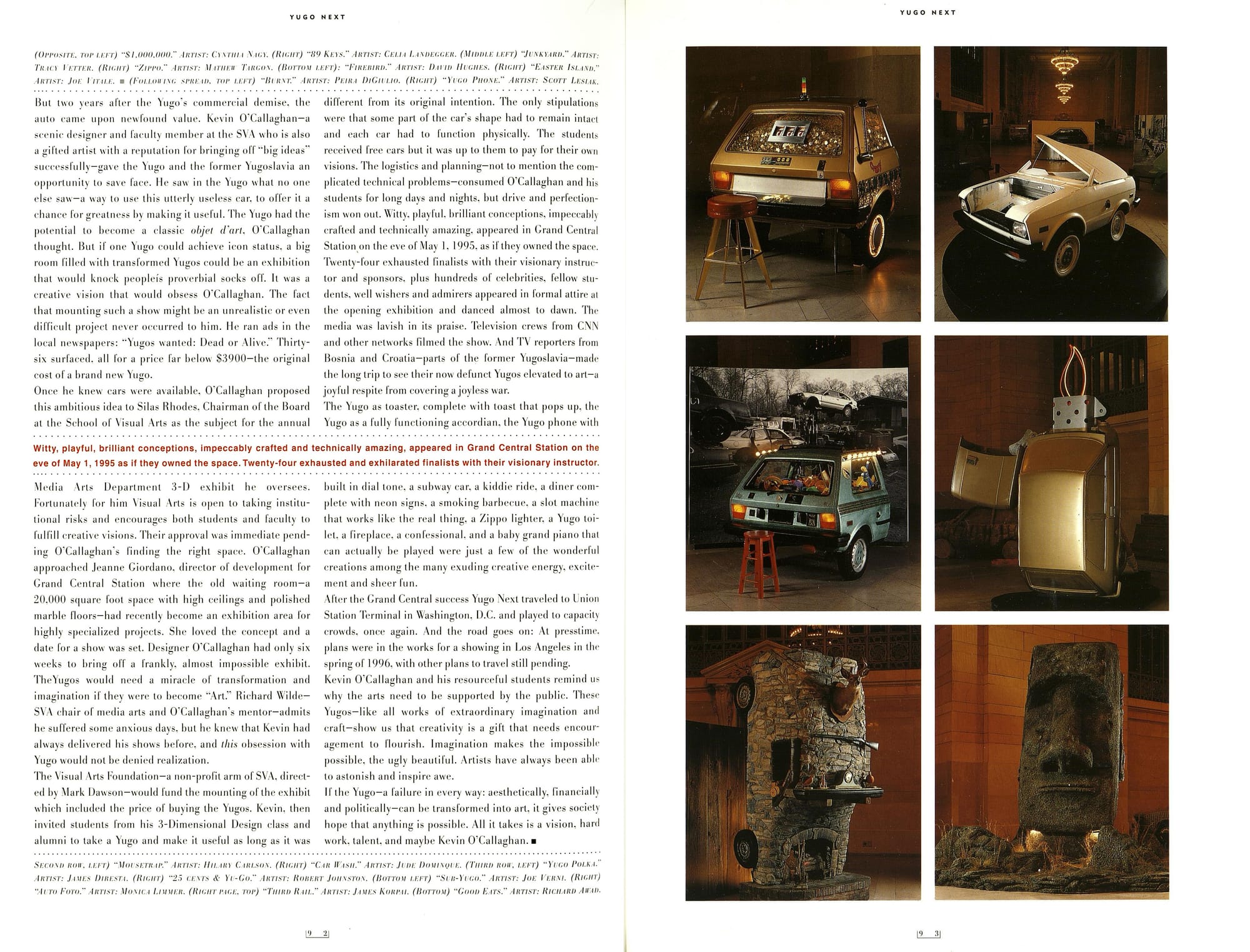
The Visual Arts Foundation-a non-profit arm of SVA, directed by Mark Dawson-would fund the mounting of the exhibit which included the price of buying the Yugos. Kevin, then invited students from his 3-Dimensional Design class and alumni to take a Yugo and make it useful as long as it was different from its original intention. The only stipulations were that some part of the car's shape had to remain intact and each car had to function physically. The students received free cars but it was up to them to pay for their own visions. The logistics and planning-not to mention the complicated technical problems consumed O'Callaghan and his students for long days and nights, but drive and perfectionism won out. Witty, playful, brilliant conceptions, impeccably crafted and technically amazing, appeared in Grand Central Station on the eve of May 1, 1995, as if they owned the space. Twenty-four exhausted finalists with their visionary instructor and sponsors, plus hundreds of celebrities, fellow students, well wishers and admirers appeared in formal attire at the opening exhibition and danced almost to dawn. The media was lavish in its praise. Television crews from CNN and other networks filmed the show. And TV reporters from Bosnia and Croatia—parts of the former Yugoslavia—made the long trip to see their now defunct Yugos elevated to art—a joyful respite from covering a joyless war.
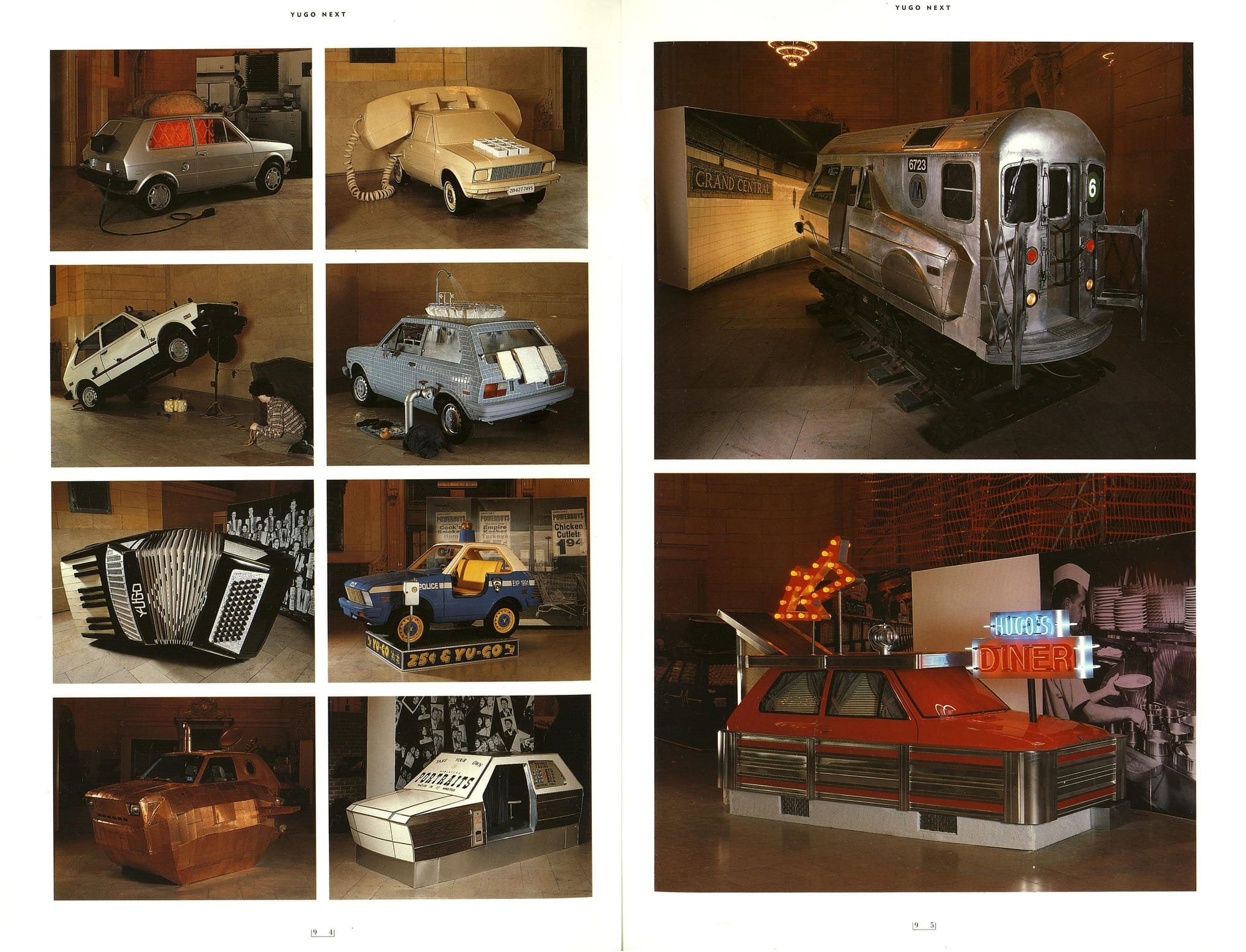
The Yugo as toaster, complete with toast that pops up, the Yugo as a fully functioning accordian, the Yugo phone with built in dial tone, a subway car, a kiddie ride, a diner complete with neon signs, a smoking barbecue, a slot machine that works like the real thing, a Zippo lighter, a Yugo toilet, a fireplace, a confessional, and a baby grand piano that can actually be played were just a few of the wonderful creations among the many exuding creative energy, excitement and sheer fun.
After the Grand Central success Yugo Next traveled to Union Station Terminal in Washington, D.C. and played to capacity crowds, once again. And the road goes on: At presstime. plans were in the works for a showing in Los Angeles in the spring of 1996, with other plans to travel still pending. Kevin O'Callaghan and his resourceful students remind us why the arts need to be supported by the public. These Yugos—like all works of extraordinary imagination and craft-show us that creativity is a gift that needs encouragement to flourish. Imagination makes the impossible possible, the ugly beautiful. Artists have always been able to astonish and inspire awe.
If the Yugo—a failure in every way: aesthetically, financially and politically—can be transformed into art, it gives society hope that anything is possible. All it takes is a vision, hard work, talent, and maybe Kevin O'Callaghan.