
Interview with Paul Mittleman - Educated Community Issue 5 2001
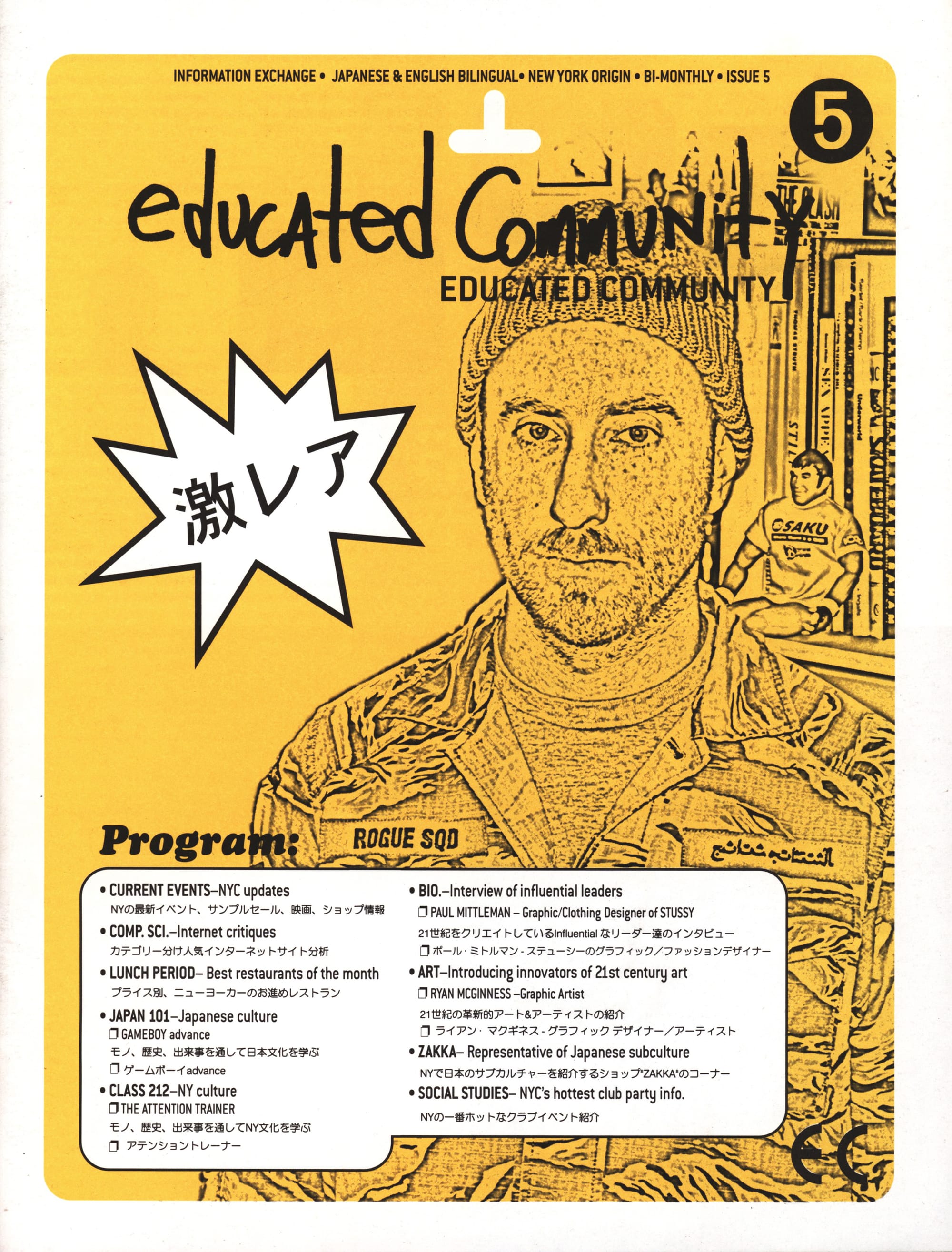
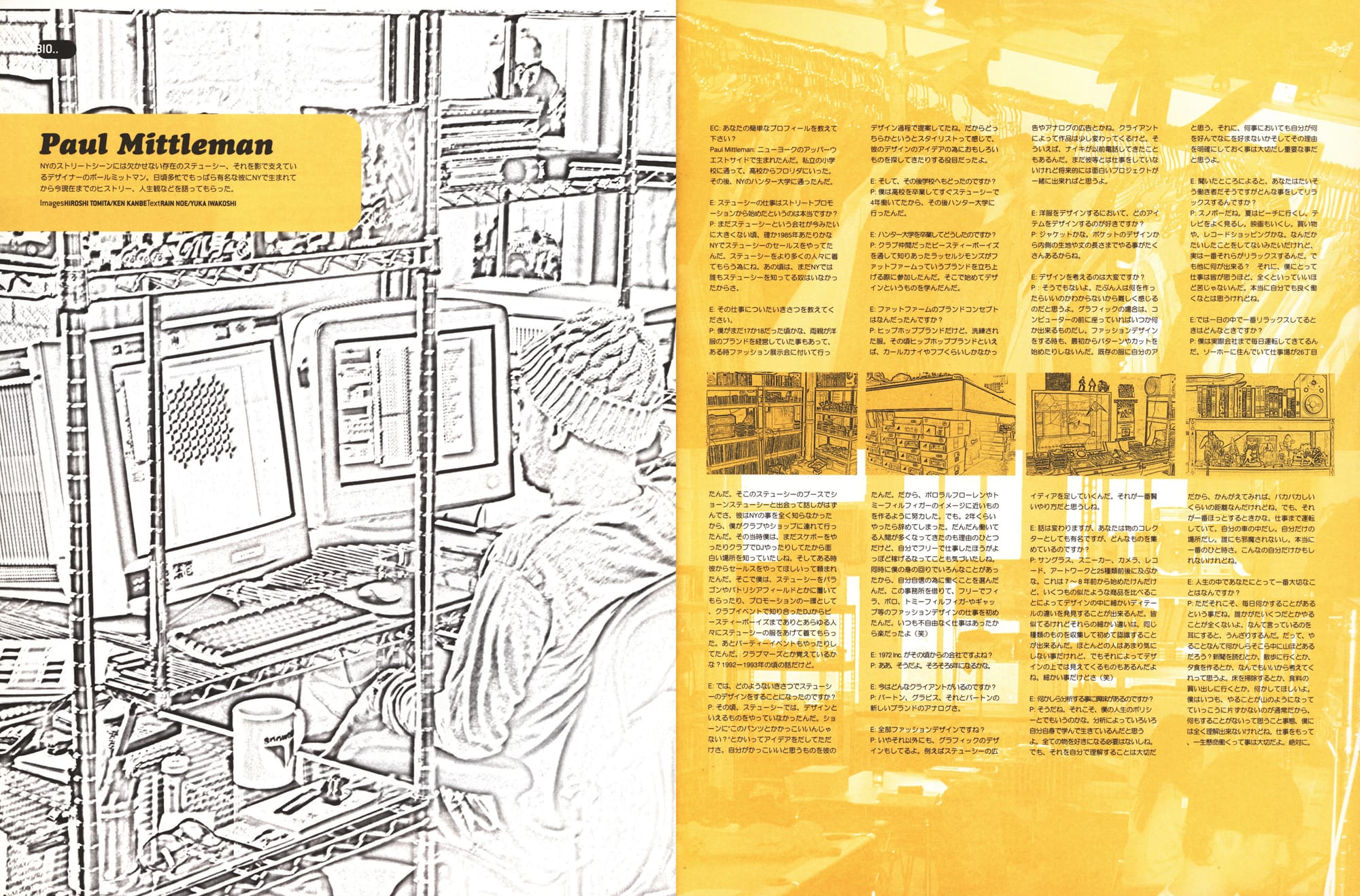
Stussy is an indispensable presence in the New York street scene, and supporting it behind the scenes is designer Paul Mittleman. Known for keeping a low profile despite his reputation, he talks with us about his history—from being born in New York to the present day—as well as his outlook on life.
Images: Hiroshi Tomita / Ken Kanbe
Text: Rain Noe / Yuka Iwakoshi
EC: Where were you born and raised?
PM: I was born on New York’s Upper West Side. I went to a private elementary school, then a public high school in Florida, and eventually Hunter College in New York.
EC: So you started off doing street promotion for Stussy?
PM: Yeah. I was the salesperson in New York when the company was still very small, around 1985—just getting people to wear it, because no one knew about it in New York at that time.
EC: How did you land that gig?
PM: When I was around 17 or 18, I went to a trade show because my parents had a clothing company. I was just walking around and saw the Stussy booth. Shawn and I started talking. I told him I was from New York; he had never really seen any New York clubs, so I took him out to see what was going on. At that point I was really into skateboarding and DJing, and eventually he asked me to be a salesperson for the company.
I started selling the clothes to places like Paragon and Patricia Field—back in the day, those were still cool. At the same time, I was giving a lot of stuff away for street promotion: DJs, the Beastie Boys, people I knew around New York from hanging out.
We sponsored parties too. We threw a bunch of them at places like Mars—remember that club? This was around ’92 or ’93.
EC: How did you start designing for Stussy?
PM: I never really designed for Stussy. I would just show Shawn ideas and say, “Hey, these pants are cooler,” or “These are cool.” I wasn’t really designing—just suggesting things I thought were cool. I was more like a stylist, finding things.
EC: And then you went back to school?
PM: Yeah. I started working at Stussy right after I finished high school. I worked there for about four years, then left to go to Hunter College.
EC: What did you do after graduating from Hunter?
PM: Russell Simmons wanted to start Phat Farm. I knew Russell from clubs and through the Beastie Boys. He was like, “Oh, you know about clothing?” I was like, “Yeah, kind of.” Then he said, “You want to start this thing?”
After Russell asked me to do that, I learned how to design and started designing for them.
EC: What was the concept behind Phat Farm?
PM: To make hip-hop clothing that wasn’t ugly. At that point there was only Karl Kani and FUBU and stuff. We were like, let’s make more Polo- and Tommy Hilfiger–type clothes. That was really the idea.
I did that for about two years, then quit. There were too many people involved, and I realized I could freelance and make way more money. A lot of things were happening, and I just wanted to do my own thing.
I got a studio and started freelancing—doing designs for Fila, Polo, Tommy Hilfiger, and the Gap. Real fashion stuff. The money was pretty good, and there was always a lot of work.
EC: You’ve got your own company now, 1972 Inc.
PM: Yeah, it’s been in business for about five years now.
EC: Who do you have as clients?
PM: Stussy, Burton, Gravis, and Analog.
EC: So it’s mostly clothing design?
PM: No, we design graphics. We do all the Stussy advertising and Analog advertising. We do lots of graphics for Burton, but not their advertising. It really just depends on who calls.
Nike called me to do some stuff, but I haven’t done anything yet. If there’s the right project, I’ll do it.
EC: As far as designing clothes, which items do you like to design the most?
PM: Probably jackets, because you can do the most with them—pockets, layers, different lengths. You can’t do much with shirts.
EC: Is it difficult for you to come up with designs?
PM: It’s not that hard. Most people don’t know what to make, so it’s hard for them.
With graphics, if you’re sitting in front of a computer, eventually something just happens. With clothing, instead of starting from scratch, I find something existing that’s interesting, then change what I don’t like. That’s how all my friends do it, and I think that’s the best way.
EC: I understand you collect a lot of things. What’s up with that, and how many collections do you have?
PM: About 25. I collect sunglasses, shoes, cameras, records. I’m also a big art collector—I started about seven or eight years ago.
If you have a bunch of similar things, you can really see the intricacies of design. They might look the same at first, but when you compare them, you notice the differences and details. Most people don’t really care, but that’s how you start to understand what’s going on. And it’s interesting.
EC: So you’re into analyzing things?
PM: Yeah, that’s kind of my philosophy. That’s how I learn. You don’t have to like everything, but it’s good to understand it. It’s also important to know what you like and don’t like—and why. It’s more constructive.
EC: Rumor has it you’re a crazy hard worker. What do you do to relax?
PM: Snowboarding. In the summer, I go to the beach. I’ll watch TV, go see a movie, and shop for records. It’s kind of a sick habit, but it’s relaxing. What else can you do? I don’t really think work is that stressful, though I do work hard.
EC: What’s the most relaxing part of your daily routine?
PM: I actually drive to work every day, which is kind of ridiculous because I live in SoHo and I’m just driving to 26th Street. But it’s relaxing—being in my car, my space, nobody bothering me. That’s my thing.
EC: In life, what’s most important to you?
PM: Having something to do every day. It really depresses me when people say they’re bored—there’s always something to do. Read the newspaper, take a walk, cook dinner. Sweep the floor, get groceries. Just do something.
I always have stuff that never gets done, so I can’t understand the idea of doing nothing. Just get a job and work hard.