
'Old Skool - Part 2' Hip-Hop Connection October 1994
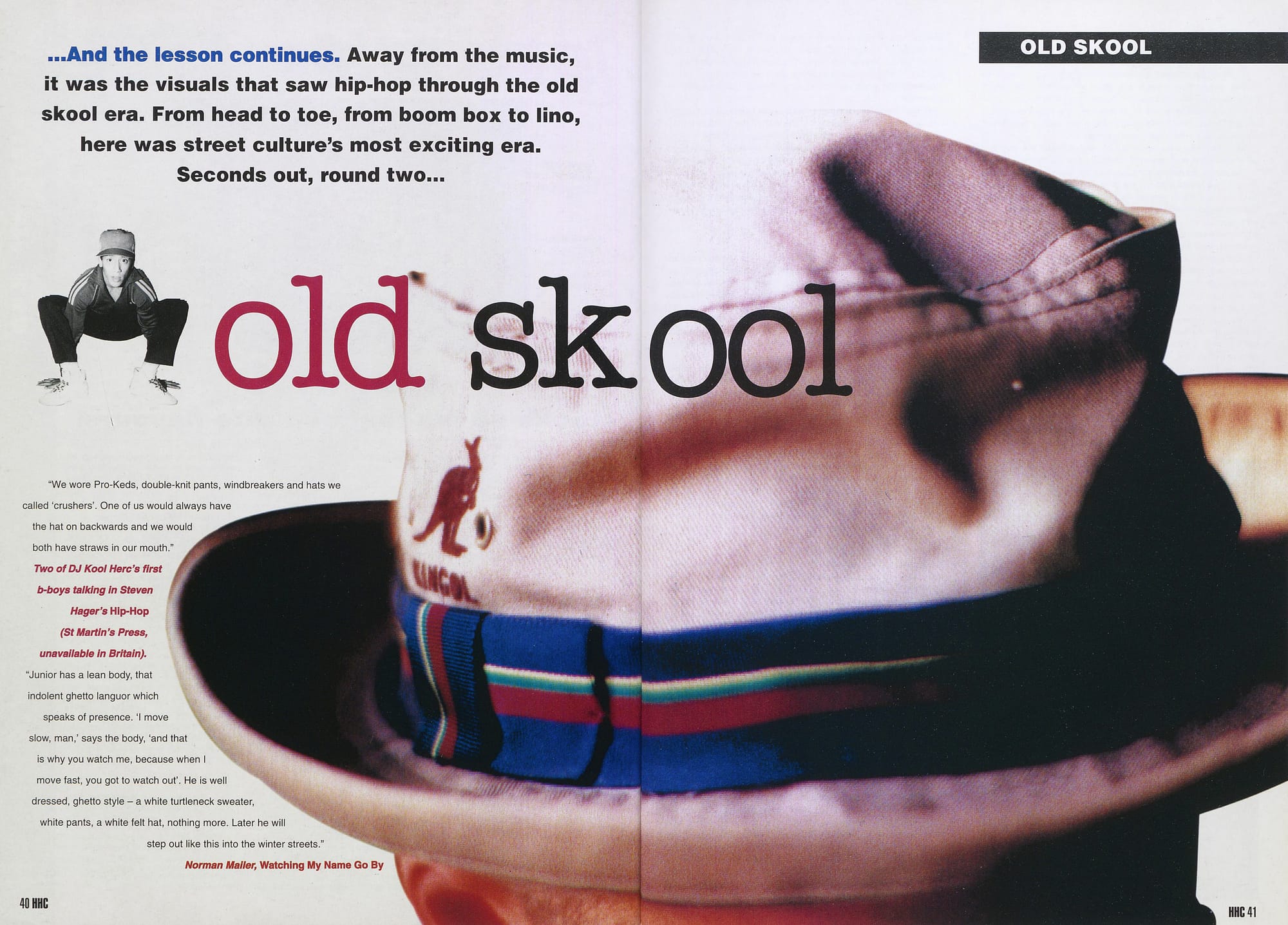
...And the lesson continues. Away from the music, it was the visuals that saw hip-hop through the old skool era. From head to toe, from boom box to lino, here was street culture's most exciting era. Seconds out, round two… Old Skool.
"We wore Pro-Keds, double-knit pants, windbreakers and hats we called 'crushers'. One of us would always have the hat on backwards and we would both have straws in our mouth." - Two of DJ Kool Herc's first b-boys talking in Steven Hager's Hip-Hop (St Martin's Press, unavailable in Britain).
"Junior has a lean body, that indolent ghetto languor which speaks of presence. 'I move slow, man,' says the body, 'and that is why you watch me, because when I move fast, you got to watch out. He is well dressed, ghetto style - a white turtleneck sweater, white pants, a white felt hat, nothing more. Later he will step out like this into the winter streets." - Norman Mailer, Watching My Name Go By
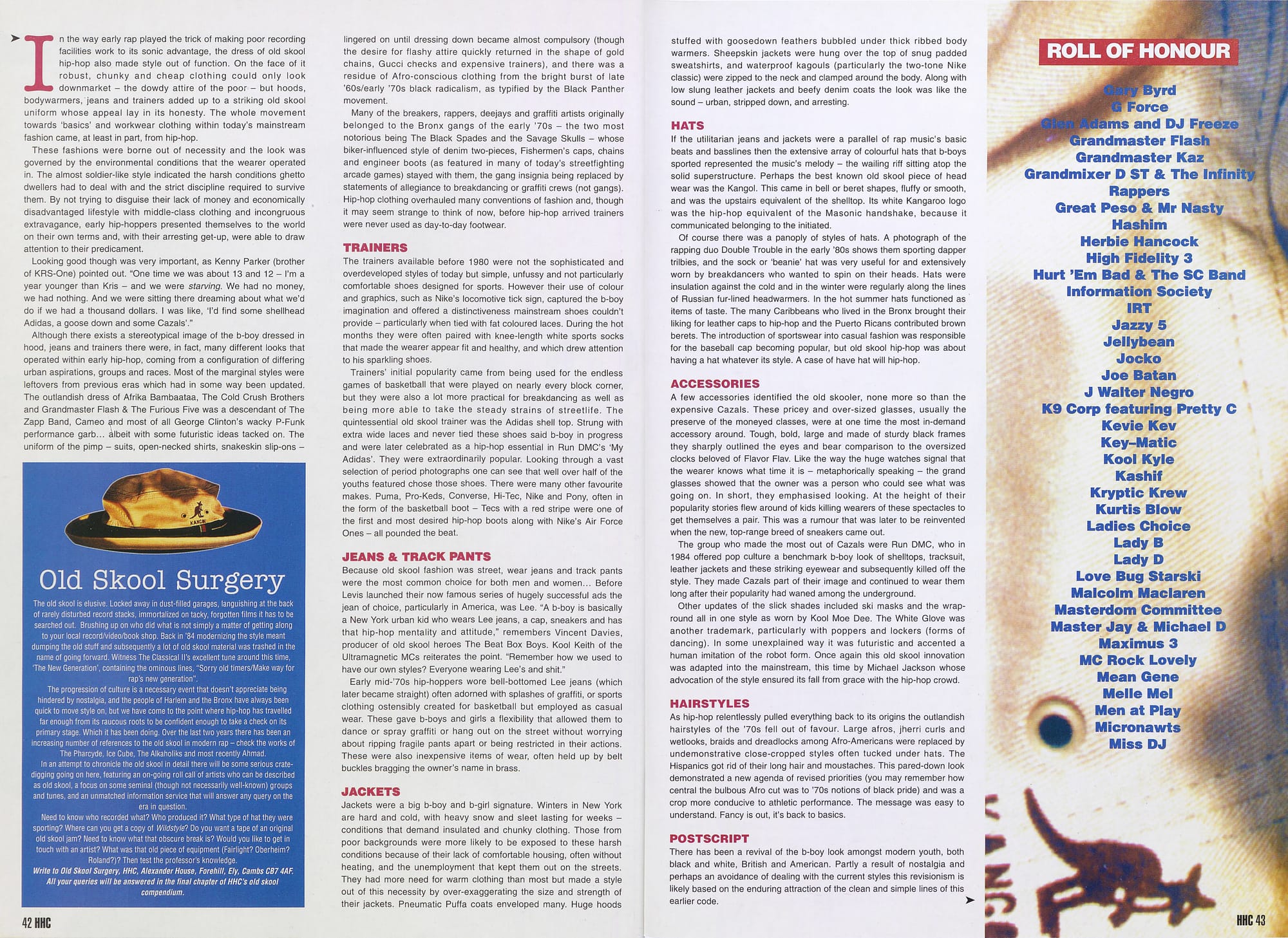
In the way early rap played the trick of making poor recording facilities work to its sonic advantage, the dress of old skool hip-hop also made style out of function. On the face of it robust, chunky and cheap clothing could only look downmarket - the dowdy attire of the poor - but hoods, bodywarmers, jeans and trainers added up to a striking old skool uniform whose appeal lay in its honesty. The whole movement towards basics and workwear clothing within today's mainstream fashion came, at least in part, from hip-hop.
These fashions were borne out of necessity and the look was governed by the environmental conditions that the wearer operated in. The almost soldier-like style indicated the harsh conditions ghetto dwellers had to deal with and the strict discipline required to survive them. By not trying to disguise their lack of money and economically disadvantaged lifestyle with middle-class clothing and incongruous extravagance, early hip-hoppers presented themselves to the world on their own terms and, with their arresting get-up, were able to draw attention to their predicament.
Looking good though was very important, as Kenny Parker (brother of KRS-One) pointed out. "One time we was about 13 and 12 - I'm a year younger than Kris - and we were starving. We had no money, we had nothing. And we were sitting there dreaming about what we'd do if we had a thousand dollars. I was like, I'd find some shellhead Adidas, a goose down and some Cazals'."
Although there exists a stereotypical image of the b-boy dressed in hood, jeans and trainers there were, in fact, many different looks that operated within early hip-hop, coming from a configuration of differing urban aspirations, groups and races. Most of the marginal styles were leftovers from previous eras which had in some way been updated.
The outlandish dress of Afrika Bambaataa, The Cold Crush Brothers and Grandmaster Flash & The Furious Five was a descendant of The Zapp Band, Cameo and most of all George Clinton's wacky P-Funk performance garb. albeit with some futuristic ideas tacked on. The uniform of the pimp - suits, open-necked shirts, snakeskin slip-ons - lingered on until dressing down became almost compulsory (though the desire for flashy attire quickly returned in the shape of gold chains, Gucci checks and expensive trainers), and there was a reside of Afro-conscious clothing from the bright burst of late '60s/early "70s black radicalism, as typified by the Black Panther movement.
Many of the breakers, rappers, deejays and graffiti artists originally belonged to the Bronx gangs of the early '70s - the two most notorious being The Black Spades and the Savage Skulls - whose biker-influenced style of denim two-pieces, Fishermen's caps, chains and engineer boots (as featured in many of today's streetfighting arcade games) stayed with them, the gang insignia being replaced by statements of allegiance to breakdancing or graffiti crews (not gangs).
Hip-hop clothing overhauled many conventions of fashion and, though it may seem strange to think of now, before hip-hop arrived trainers were never used as day-to-day footwear.
TRAINERS - The trainers available before 1980 were not the sophisticated and overdeveloped styles of today but simple, unfussy and not particularly comfortable shoes designed for sports. However their use of colour and graphics, such as Nike's locomotive tick sign, captured the b-boy imagination and offered a distinctiveness mainstream shoes couldn't provide - particularly when tied with fat coloured laces. During the hot months they were often paired with knee-length white sports socks that made the wearer appear fit and healthy, and which drew attention to his sparkling shoes.
Trainers' initial popularity came from being used for the endless games of basketball that were played on nearly every block corner, but they were also a lot more practical for breakdancing as well as being more able to take the steady strains of streetlife. The quintessential old skool trainer was the Adidas shell top. Strung with extra wide laces and never tied these shoes said b-boy in progress and were later celebrated as a hip-hop essential in Run DMC's My Adidas'. They were extraordinarily popular. Looking through a vast selection of period photographs one can see that well over half of the youths featured chose those shoes. There were many other favourite makes. Puma, Pro-Keds, Converse, Hi-Tec, Nike and Pony, often in the form of the basketball boot - Tecs with a red stripe were one of the first and most desired hip-hop boots along with Nike's Air Force Ones - all pounded the beat.
JEANS & TRACK PANTS - Because old skool fashion was street, wear jeans and track pants were the most common choice for both men and women.... Before Levis launched their now famous series of hugely successful ads the jean of choice, particularly in America, was Lee. "A b-boy is basically a New York urban kid who wears Lee jeans, a cap, sneakers and has that hip-hop mentality and attitude," remembers Vincent Davies, producer of old skool heroes The Beat Box Boys. Kool Keith of the Ultramagnetic MCs reiterates the point. "Remember how we used to have our own styles? Everyone wearing Lee's and shit."
Early mid-'70s hip-hoppers wore bell-bottomed Lee jeans (which later became straight) often adorned with splashes of graffiti, or sports clothing ostensibly created for basketball but employed as casual wear. These gave b-boys and girls a flexibility that allowed them to dance or spray graffiti or hang out on the street without worrying about ripping fragile pants apart or being restricted in their actions. These were also inexpensive items of wear, often held up by belt buckles bragging the owner's name in brass.
JACKETS - Jackets were a big b-boy and b-girl signature. Winters in New York are hard and cold, with heavy snow and sleet lasting for weeks - conditions that demand insulated and chunky clothing. Those from poor backgrounds were more likely to be exposed to these harsh conditions because of their lack of comfortable housing, often without heating, and the unemployment that kept them out on the streets.
They had more need for warm clothing than most but made a style out of this necessity by over-exaggerating the size and strength of their jackets. Pneumatic Puffa coats enveloped many. Huge hoods stuffed with goosedown feathers bubbled under thick ribbed body warmers. Sheepskin jackets were hung over the top of snug padded sweatshirts, and waterproof kagouls (particularly the two-tone Nike classic) were zipped to the neck and clamped around the body. Along with low slung leather jackets and beefy denim coats the look was like the sound - urban, stripped down, and arresting.
HATS - If the utilitarian jeans and jackets were a parallel of rap music's basic beats and basslines then the extensive array of colourful hats that b-boys sported represented the music's melody - the wailing riff sitting atop the solid superstructure. Perhaps the best known old skool piece of head wear was the Kangol. This came in bell or beret shapes, fluffy or smooth, and was the upstairs equivalent of the shelltop. Its white Kangaroo logo was the hip-hop equivalent of the Masonic handshake, because it communicated belonging to the initiated.
Of course there was a panoply of styles of hats. A photograph of the rapping duo Double Trouble in the early '80s shows them sporting dapper trilbies, and the sock or beanie' hat was very useful for and extensively worn by breakdancers who wanted to spin on their heads. Hats were insulation against the cold and in the winter were regularly along the lines of Russian fur-lined headwarmers. In the hot summer hats functioned as items of taste. The many Caribbeans who lived in the Bronx brought their liking for leather caps to hip-hop and the Puerto Ricans contributed brown berets. The introduction of sportswear into casual fashion was responsible for the baseball cap becoming popular, but old skool hip-hop was about having a hat whatever its style. A case of have hat will hip-hop.
ACCESSORIES - A few accessories identified the old skooler, none more so than the expensive Cazals. These pricey and over-sized glasses, usually the preserve of the moneyed classes, were at one time the most in-demand accessory around. Tough, bold, large and made of sturdy black frames they sharply outlined the eyes and bear comparison to the oversized clocks beloved of Flavor Flav. Like the way the huge watches signal that the wearer knows what time it is - metaphorically speaking - the grand glasses showed that the owner was a person who could see what was going on. In short, they emphasised looking. At the height of their popularity stories flew around of kids killing wearers of these spectacles to get themselves a pair. This was a rumour that was later to be reinvented when the new, top-range breed of sneakers came out.
The group who made the most out of Cazals were Run DMC, who in 1984 offered pop culture a benchmark b-boy look of shelltops, tracksuit, leather jackets and these striking eyewear and subsequently killed off the style. They made Cazals part of their image and continued to wear them long after their popularity had waned among the underground.
Other updates of the slick shades included ski masks and the wrap-round all in one style as worn by Kool Moe Dee. The White Glove was another trademark, particularly with poppers and lockers (forms of dancing). In some unexplained way it was futuristic and accented a human imitation of the robot form. Once again this old skool innovation was adapted into the mainstream, this time by Michael Jackson whose advocation of the style ensured its fall from grace with the hip-hop crowd.
HAIRSTYLES - As hip-hop relentlessly pulled everything back to its origins the outlandish hairstyles of the '70s fell out of favour. Large afros, jherri curls and wetlooks, braids and dreadlocks among Afro-Americans were replaced by undemonstrative close-cropped styles often tucked under hats. The Hispanics got rid of their long hair and moustaches. This pared-down look demonstrated a new agenda of revised priorities (you may remember how central the bulbous Afro cut was to 70s notions of black pride) and was a crop more conducive to athletic performance. The message was easy to understand. Fancy is out, it's back to basics.
POSTSCRIPT - There has been a revival of the b-boy look amongst modern youth, both black and white, British and American. Partly a result of nostalgia and perhaps an avoidance of dealing with the current styles this revisionism is likely based on the enduring attraction of the clean and simple lines of this earlier code.
Old Skool Surgery: The old skool is elusive. Locked away in dust-filled garages, languishing at the back of rarely disturbed record stacks, immortalized on tacky, forgotten films it has to be searched out. Brushing up on who did what is not simply a matter of getting along to your local record/video/book shop. Back in '84 modernizing the style meant dumping the old stuff and subsequently a lot of old skool material was trashed in the name of going forward. Witness The Classical I's excellent tune around this time,
'The New Generation", containing the ominous lines, "Sorry old timers/Make way for rap's new generation".
The progression of culture is a necessary event that doesn't appreciate being hindered by nostalgia, and the people of Harlem and the Bronx have always been quick to move style on, but we have come to the point where hip-hop has travelled far enough from its raucous roots to be confident enough to take a check on its primary stage. Which it has been doing. Over the last two years there has been an increasing number of references to the old skool in modern rap - check the works of The Pharcyde, Ice Cube, The Alkaholiks and most recently Ahmad. In an attempt to chronicle the old skool in detail there will be some serious crate-digging going on here, featuring an on-going roll call of artists who can be described as old skool, a focus on some seminal (though not necessarily well-known) groups and tunes, and an unmatched information service that will answer any query on the era in question.
Need to know who recorded what? Who produced it? What type of hat they were sporting? Where can you get a copy of Wildstyle? Do you want a tape of an original old skool jam? Need to know what that obscure break is? Would you like to get in touch with an artist? What was that old piece of equipment (Fairlight? Oberheim? Roland?)? Then test the professor's knowledge
Write to Old Skool Surgery, HHC, Alexander House, Forehill, Ely, Cambs CB7 4AF.
All your queries will be answered in the final chapter of HH's old skool compendium.
ROLL OF HONOUR:
Chiy Byrd
a Force
Glen Adams and DJ Freeze
Grandmaster Flash
Grandmaster Kaz
Grandmixer D ST & The Infinity
Rappers
Great Peso & Mr Nasty
Hashi
Herbie Hancock
High Fidelity 3
Hurt 'Em Bad & The SC Band
Information Society
IRT
Jazzy 5
Jellybean
Jocko
Joe Batan
J Walter Negro
K9 Corp featuring Pretty C
Kevie Kev Key-Matic
Kool Kyle
Kashif
Kryptic Krew
Kurtis Blow
Ladies Choice
Lady B
Lady D
Love Bug Starski
Malcolm Maclaren
Masterdom Committee
Master Jay & Michael D
Maximus 3
MC Rock Lovely
Mean Gene
Melle Mel
Men at Play
Micronawts
Miss DJ
Breaking and Popping
> 10.30 pm on a cold Saturday night in January and three b-boys are working their pitch near Times Square, New York City. The spectators have just paid to watch Clint Eastwood blow away a selection of black stick-up men and multi-cultural rapists. They settle down to a few free moments with uptown culture. Eddie is 10 years old. He has been breakdancing and moonwalking on the streets around this block since he was six, using a strip of cardboard as a dancefloor. The two others in the crew are 16, one of them huddled in a sheepskin, the other with the top of his head pushed into a stocking.
So opens David Toop's exploration of early hip-hop (Rap Attack 2, Serpent's Tail £10.99) and within this passage are encoded the dilemmas of this dynamic method of self-expression. Developed in the Bronx but taken to the stage, breakdancing became a victim of its own success.
Breakdancing was nothing new in the 1980s. In the form we know it now it had been around since the early 70s, though the roots of overtly physical dance moves stretch way back to the African-American musics of the early part of the century and beyond back to Africa. Among the African descendants in Brazil there exists a dance called Capoiera which is similar in appearance to breaking and also works as an enactment of physical confrontation.
Breakdancing was practiced by the gangs of New York through the early and mid-70s and incorporated within its timeless structure elements of cinematic kung fu moves, sport actions and popular dances, particularly James Brown's "The Good Foot', but it began to die out with black youth near the end of the decade. However, it remained popular amongst the Bronx's Puerto Rican community who had come to it late and had inherited the style from the blacks. When the success of hip-hop revived interest in breaking and it became an athletic response to the thunderous breaks and beats played by Kool Herc, Flash and Bambaata, blacks and the rest of the ghetto's multi-racial community began practicing it again.
Breakdancing was either performed in the conventional arena of the discotheque or out on the street, sometimes in the shiny corridors of the
subway system. The usual accompaniment was a piece of smooth material with which to spin and slide on and a loud and noisy stereo cassette player, as large and as loud as possible, cranking out the beats. The New York street gangs which had started fading out during the mid-70s reformed around breaking and gave themselves the name of crews, again applying an aesthetic of functionality to new developments, in this case name selection. Many breaking crews grew out of the old street gangs and there is a common perception that their dancing in some way neutralised the inter-neighbourhood violence that had been going on in the area for the previous ten years. This isn't the case. Breaking may have redirected some of the youths' more viscous tendencies, but if things got too heated then it still came down to muscle.
"We won the trophy but the other crew didn't want to admit we won... They wanted to fight," Macho of the Rockwell Breakers explains. "See, breaking is not only breaking. There's a lot of fighting too. You go to a party and burn this guy and he says, You want to battle, man?' and this and that. Then you go outside and find 50 dudes waiting for you. TDK (a rival crew) was like that. They always looked at us wrong and would never speak to us."
Grandmaster Flash emphasises the same point. "Dancers started making contact, like doing jump kicks and kicking people on the floor. It was like l ain't dancing with you, I'm gonna try to hurt you'." However, Afrika Bambaata typically emphasises that it also had its "peaceful moments".
Despite being confrontational and aggressive breakdancing provided a user-friendly access into hip-hop for an American media which had been either intimidated by, or dismissive of, hip-hop. It soon began to feature it in mainstream publications, films, and music and the strange dance became the subject of cultural fascination. The best known crew was and still is the Rock Steady Crew who became prominent as breakers within uptown New York, before cutting a successful record and going on to world-wide recognition. They still exist today and have translated their street skills into professional stage performance and recently scripted and performed their own downtown (ie mainstream theatre musical. Other crews included The Incredible Breakers, Dynamic Rockers, ABC and The Electric Force. Popping, or the electric boogaloo, was a west coast invention which was more rooted in the modern era, particularly in its evocation of the actions of robots and its infatuation with electricity.
Dancers often had wires and aerials hanging out of their clothes, though a recent demonstration of traditional dance by some Ethiopian performers featured jerk and lock actions very similar to the moves of popping. In It's Not About A Salary...
(Verso Press £12.99) Brian Cross identifies a Soul Train (a Black American version of Top Of The Pops) dancer named Charlie Robot as the inventor of this dance style. He apparently took elements of street mime and welded them to robot moves and came up with something new but initially ponderous. Other dancers adapted Charlie's style and popping was developed from thereon and soon spread to the east coast. As with all elements of street culture, names, styles, and techniques vary between whom you talk to (how many names are there for marijuana?) and this month's invention might be next month's cast off. In the words of Afrika Bambaataa, "in the black and Hispanic communities different dances keep coming out every month". Breakdancing and popping suffered badly from over-exposure. They were one of the first facets of hip-hop culture that the wider
world took an interest in because they were easy to comprehend. Being a visual event people could 'read' easily, unlike rap music whose anti-melodic character prevented a lot of listeners from 'getting' it on their first hearing, and because anybody could try them. In this sense it was unlike graffiti, which took a lot of practice, was expensive and illegal. It began to be featured in mass market films (Breakdance, Flashdance, and Beat Street) and pop music (Freez's IOU, Blondie's 'Rapture", Mel Brooks" "It's Good To Be The King') and the BBC toyed with it as several early '80s news items on breakdancing testify. In short breakdancing was torn away from hip-hop and dissected under a bright media spotlight. Out came videos with titles like Breakin' - You Can Do it, and How To Breakdance but it was when it formed part of the closing ceremony of the Los Angeles Olympics in 1984 that it was diagnosed as officially culturally redundant and was left alone by the hip-hop crowd. However, things are never forgotten within black music and now and then at the right clubs on the right night you can still witness the spectacular sight of breakdancing, though the more fanciful popping seems to have genuinely gone under.
Writer: Jake Barnes
Big thanks to Koz for lugging the info, to Paul H for an impressive memory, and David Toop for unique information.
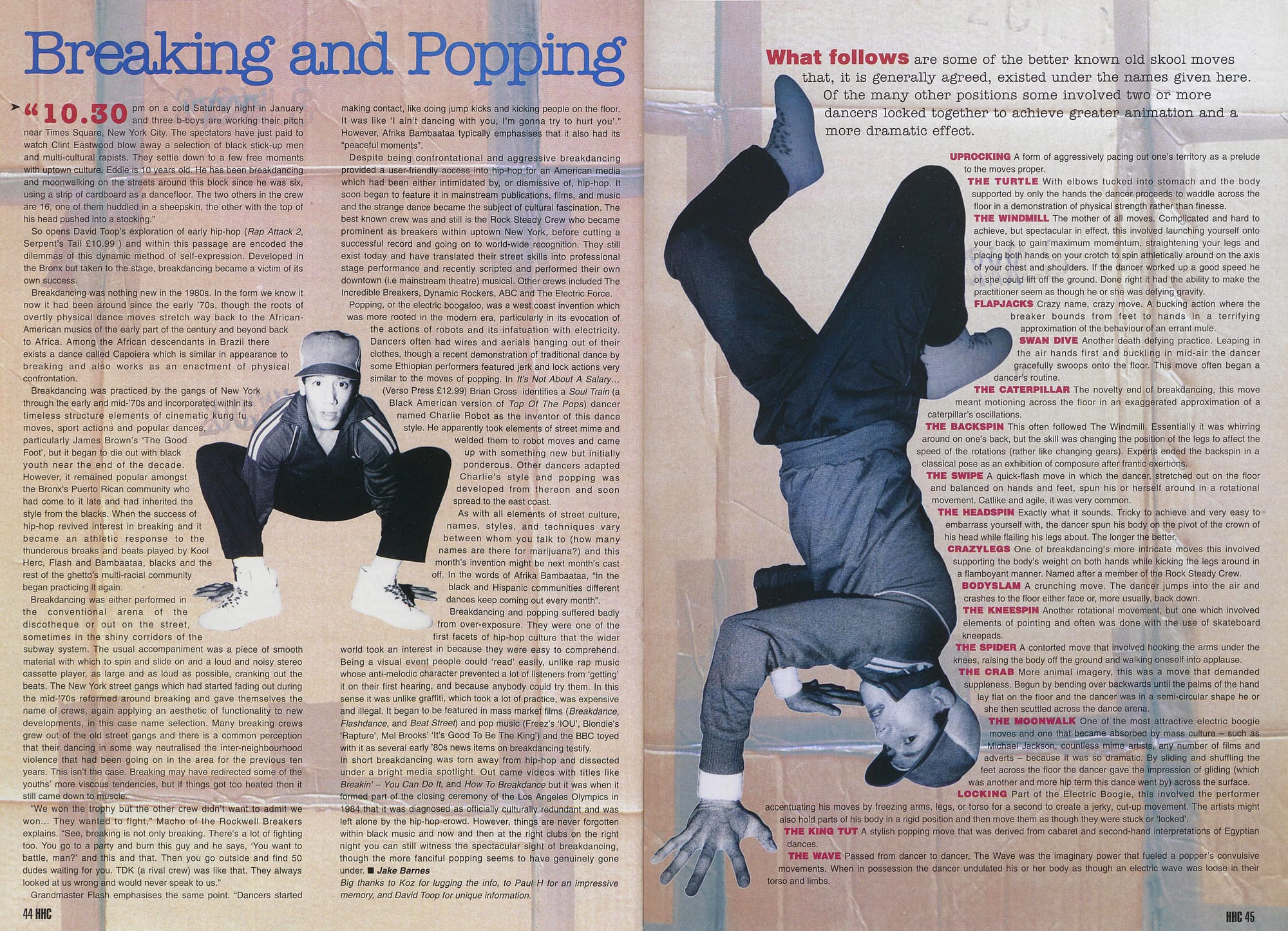
What follows are some of the better known old skool moves that, it is generally agreed, existed under the names given here. Of the many other positions some involved two or more dancers locked together to achieve greater animation and a more dramatic effect.
UPROCKING: A form of aggressively pacing out one's territory as a prelude
to the moves proper.
THE TURTLE: With elbows tucked into stomach and the body supported by only the hands the dancer proceeds to waddle across the floor in a demonstration of physical strength rather than finesse.
THE WINDMILL: The mother of all moves. Complicated and hard to achieve, but spectacular in effect, this involved launching yourself onto your back to gain maximum momentum, straightening your legs and placing both hands on your crotch to spin athletically around on the axis of your chest and shoulders. If the dancer worked up a good speed he or she could lift off the ground. Done right it had the ability to make the practitioner seem as though he or she was defying gravity.
FLAPJACKS: Crazy name, crazy move. A bucking action where the breaker bounds from feet to hands in a terrifying approximation of the behaviour of an errant mule.
SWAN DIVE: Another death defying practice. Leaping in the air hands first and buckling in mid-air the dancer gracefully swoops onto the floor. This move often began a
THE CATERPILLAR: The novelty end of breakdancing, this move meant motioning across the floor in an exaggerated approximation of a
caterpillar's oscillations.
THE BACKSPIN: This often followed The Windmill. Essentially it was whirring around on one's back, but the skill was changing the position of the legs to affect the speed of the rotations (rather like changing gears). Experts ended the backspin in a classical pose as an exhibition of composure after frantic exertions.
THE SWIPE: A quick-flash move in which the dancer, stretched out on the floor and balanced on hands and feet, spun his or herself around in a rotational movement. Catlike and agile, it was very common.
THE HEADSPIN: Exactly what it sounds. Tricky to achieve and very easy to embarrass yourself with, the dancer spun his body on the pivot of the crown of his head while flailing his legs about. The longer the better.
CRAZYLEGS: One of breakdancing's more intricate moves this involved supporting the body's weight on both hands while kicking the legs around in a flamboyant manner. Named after a member of the Rock Steady Crew.
BODYSLAM: A crunching move. The dancer jumps into the air and crashes to the floor either face or, more usually, back down.
THE KNEESPIN: Another rotational movement, but one which involved elements of pointing and often was done with the use of skateboard kneepads.
THE SPIDER: A contorted move that involved hooking the arms under the knees, raising the body off the ground and walking oneself into applause.
THE CRAB: More animal imagery, this was a move that demanded suppleness. Begun by bending over backwards until the palms of the hand lay flat on the floor and the dancer was in a semi-circular shape he or she then scuttled across the dance arena.
THE MOONWALK: One of the most attractive electric boogie moves and one that became absorbed by mass culture - such as Michael Jackson, countless mime artists, any number of films and - because it was so dramatic. By sliding and shuffling the feet across the floor the dancer gave the impression of gliding (which was another and more hip term this dance went by) across the surface.
LOCKING: Part of the Electric Boogie, this involved the performer accentuating his moves by freezing arms, legs, or torso for a second to create a jerky, cut-up movement. The artists might also hold parts of his body in a rigid position and then move them as though they were stuck or 'locked".
THE KING TUT: A stylish popping move that was derived from cabaret and second-hand interpretations of Egyptian dances.
THE WAVE: Passed from dancer to dancer, The Wave was the imaginary power that fueled a popper's convulsive movements. When in possession the dancer undulated his or her body as though an electric wave was loose in their torso and limbs.