'Old Skool - Part 1' Hip-Hop Connection September 1994
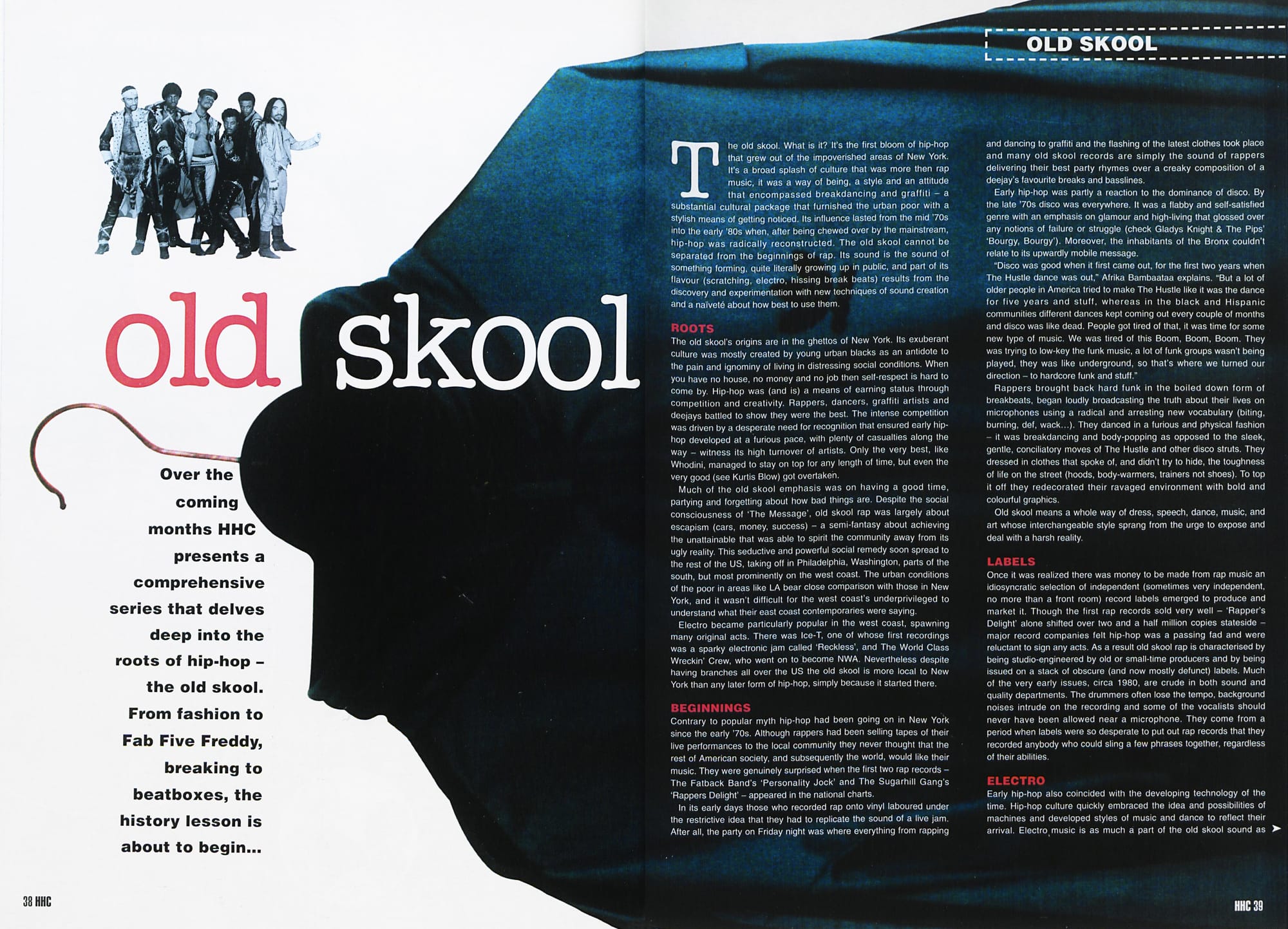
Over the coming months HHC presents a comprehensive series that delves deep into the roots of hip-hop-the old skool. From fashion to Fab Five Freddy, breaking to beatboxes, the history lesson is about to begin…
The old skool. What is it? It's the first bloom of hip-hop that grew out of the impoverished areas of New York. It's a broad splash of culture that was more then rap music, it was a way of being, a style and an attitude that encompassed breakdancing and graffiti — a substantial cultural package that furnished the urban poor with a stylish means of getting noticed. Its influence lasted from the mid 70s into the early '80s when, after being chewed over by the mainstream, hip-hop was radically reconstructed. The old skool cannot be separated from the beginnings of rap. Its sound is the sound of something forming, quite literally growing up in public, and part of its flavour (scratching, electro, hissing break beats) results from the discovery and experimentation with new techniques of sound creation and a naiveté about how best to use them.
ROOTS - The old skool's origins are in the ghettos of New York. Its exuberant culture was mostly created by young urban blacks as an antidote to the pain and ignominy of living in distressing social conditions. When you have no house, no money and no job then self-respect is hard to come by. Hip-hop was (and is) a means of earning status through competition and creativity. Rappers, dancers, graffiti artists and deejays battled to show they were the best. The intense competition was driven by a desperate need for recognition that ensured early hip-hop developed at a furious pace, with plenty of casualties along the way — witness its high turnover of artists. Only the very best, like Whodini, managed to stay on top for any length of time, but even the very good (see Kurtis Blow) got overtaken.
Much of the old skool emphasis was on having a good time, partying and forgetting about how bad things are. Despite the social consciousness of 'The Message', old skool rap was largely about escapism (cars, money, success) — a semi-fantasy about achieving the unattainable that was able to spirit the community away from its ugly reality. This seductive and powerful social remedy soon spread to the rest of the US, taking off in Philadelphia, Washington, parts of the south, but most prominently on the west coast. The urban conditions of the poor in areas like LA bear close comparison with those in New York, and it wasn't difficult for the west coasts underprivileged to understand what their east coast contemporaries were saying.
Electro became particularly popular in the west coast, spawning many original acts. There was Ice-T, one of whose first recordings was a sparky electronic jam called 'Reckless', and The World Class Wreckin' Crew, who went on to become NWA. Nevertheless despite having branches all over the US the old skool is more local to New York than any later form of hip-hop, simply because it started there.
BEGINNINGS - Contrary to popular myth hip-hop had been going on in New York since the early '70s. Although rappers had been selling tapes of their live performances to the local community they never thought that the rest of American society, and subsequently the world, would like their music. They were genuinely surprised when the first two rap records — The Fatback Band's 'Personality Jock' and The Sugarhill Gang's 'Rappers Delight' — appeared in the national charts.
In its early days those who recorded rap onto vinyl laboured under the restrictive idea that they had to replicate the sound of a live jam. After all, the party on Friday night was where everything from rapping and dancing to graffiti and the flashing of the latest clothes took place and many old skool records are simply the sound of rappers delivering their best party rhymes over a creaky composition of a deejay's favourite breaks and basslines.
Early hip-hop was partly a reaction to the dominance of disco. By the late '70s disco was everywhere. It was a flabby and self-satisfied genre with an emphasis on glamour and high-living that glossed over any notions of failure or struggle (check Gladys Knight & The Pips' 'Bourgy, Bourgy'). Moreover, the inhabitants of the Bronx couldn't relate to its upwardly mobile message.
"Disco was good when it first came out, for the first two years when The Hustle dance was out," Afrika Bambaataa explains. "But a lot of older people in America tried to make The Hustle like it was the dance for five years and stuft, whereas in the black and Hispanic communities different dances kept coming out every couple of months and disco was like dead. People got tired of that, it was time for some new type of music. We was tired of this Boom, Boom, Boom. They was trying to low-key the funk music, a lot of funk groups wasn't being played, they was like underground, so that's where we turned our direction — to hardcore funk and stuff."
Rappers brought back hard funk in the boiled down form of breakbeats, began loudly broadcasting the truth about their lives on microphones using a radical and arresting new vocabulary (biting burning, def, wack...). They danced in a furious and physical fashion — it was breakdancing and body-popping as opposed to the sleek, gentle, conciliatory moves of The Hustle and other disco struts. They dressed in clothes that spoke of, and didn't try to hide, the toughness of life on the street (hoods, body-warmers, trainers not shoes). To top it off they redecorated their ravaged environment with bold and colourful graphics.
Old skool means a whole way of dress, speech, dance, music, and art whose interchangeable style sprang from the urge to expose and deal with a harsh reality.
LABELS - Once it was realized there was money to be made from rap music an idiosyncratic selection of independent (sometimes very independent, no more than a front room record labels emerged to produce and market it. Though the first rap records sold very well - Rapper's Delight' alone shifted over two and a half million copies stateside - major record companies felt hip-hop was a passing fad and were reluctant to sign any acts. As a result old skool rap is characterised by being studio-engineered by old or small-time producers and by being issued on a stack of obscure (and now mostly defunct) labels. Much of the very early issues, circa 1980, are crude in both sound and quality departments. The drummers often lose the tempo, background noises intrude on the recording and some of the vocalists should never have been allowed near a microphone. They come from a period when labels were so desperate to put out rap records that they recorded anybody who could sling a few phrases together, regardless of their abilities.
ELECTRO - Early hip-hop also coincided with the developing technology of the time. Hip-hop culture quickly embraced the idea and possibilities of machines and developed styles of music and dance to reflect their arrival. Electro, music is as much a part of the old skool sound as rapping. The two were often inseparable — 'Planet Rock' being the earliest example — though they remained distinct enough to be told apart. Electro, more than any other contemporary art form, expressed the fear within mass society over the sociological effect of computers and unregulated automation. During the early '80s there was widespread fear that unaccountable and unemotional gadgets were going to dominate the human race and this anxiety fuelled the nervous beat of electro. The crackle of electronic voices, rigid beats and cold melodies that make up electro's character play on and exaggerate the dread of the chip, whilst at the same time celebrate the dawning of a new and exciting era.
Likewise body-popping hinted at how man might become a machine in the RAM and ROM age. It is possible that to the downtrodden inhabitants of the ghetto, the computer age suggested a bright new future free of poverty and squalor, which is why they so readily embraced it when most of the world looked at advanced electronic equipment with apprehension.
Technology also had a direct influence on the sound of the old skool. Hip-hop coincided with the development of loud portable cassette players which soon became established articles of street wear. The ability to blast out the latest rap tunes while on the move affected the sound of early hip-hop. Producers began making tracks with the extra bass and treble that these machines could enhance and the playing of tapes of live jams and home recordings enabled the latest sound to be spread quickly throughout the 'hoods. New and/or underdeveloped sonic tools like mixers, vari-speed turntables, drum machines and synthesizers were eagerly put into action by music makers searching for a different and harder sound. Samplers, though around, were rarely used. The fluid style of seamlessly repeating loops that they facilitated didn't arrive until Marley Marl came up with Eric B & Rakim's 'Paid In Full.’ Yes, looped breaks were a central feature of old skool music, but the repetition was always done on the decks.
DEEJAY SKILLS - Techniques such as scratching, cutting, looping and cueing were created by hip-hop deejays in the mid '70s. Disco deejays had begun segueing one record into another, but any kind of physical manipulation of records was the patent of hip-hop. The dramatic sound of scratching initially caused a lot of concern among non-aficionados, particularly club owners who thought their equipment was being torn to pieces. There is a raw and crude type of scratching that characterizes old skool rap. It is the sound of a fragile turntable being forced to savage a dense and often decrepid piece of vinyl.
Many people couldn't understand why deejays wanted to produce such an abrasive sound, but the cuts in hip-hop gave the deejay set an immediacy which shocked his or her crowd out of any disco-induced torpor they might be experiencing. In David Toop's comprehensive study Rap Attack 2: African Rap to Global Hip-Hop (Serpent's Tail 1992, £10.99) the legendary Grandmaster Flash describes witnessing the explosive impact these new methods had.
"The place held 3,000 people... And the night before I had come up with a way to cut without cueing... Melvin (Melle Mel) introduces me:
The world's greatest deejay — Grandmaster Flash'. Everybody thought I was going to do regular stuff. I went into my spinning back, turning backwards. After a while, I had to do the other thing, which is taking the needle and dropping it with no cueing at all — keeping the beat on time. It was taking one beat — dropping it and counting. This is blind — Bam, Bam — I kept it on time. I did it about ten times, backed off and the crowd went berserk. The fucking floor was like about to cave in. After that night I felt so good. That was September 2, 1976."
In old skool rap the cuts are sometimes clumsy and the records often full of static as unsophisticated equipment is forced to perform tasks for which it was never designed. In the drive to squeeze maximum self-expression out of any type of performance the flamboyant exertions of breakdancing were applied to the art of deejaying. Scratching with noses, elbows, knees, and every other part of the human anatomy became part of the old skool show. To some extent this practice has now understandably died out, but what it shows is that every function of early hip-hop was open to experimentation. Some worked (scratching), others didn't (scratching with nose).
MULTI-RACIAL SKOOL - That today's rap music sounds stunning can't be questioned, but the old skool had one or two admirable features that have disappeared from sight in recent years. Firstly, despite being a largely African-American creation, it was a multi-racial movement. Poverty not race is the real divider in society and the underfunded inhabitants of the Bronx and Harlem were united by lack of dollars Photographs, songs, videos, and graffiti all testify to the presence of South American, Afro-Caribbean, Afro-American, white, and Jewish people in old skool culture. They also show that a larger proportion of women were involved, particularly in music. These two factors possibly bear relation to the air of innocence and generosity that pervaded the cultural period. They disappeared once rap music became a very lucrative profession where only the tough get paid.
The first wave of hip-hop had a snowball effect on a mass culture enthralled by its exuberance, provoking a stream of spin-off books, films, documentaries, and murals. For a period it was enthusiastically embraced as the latest youth cult - as something that was fun but ultimately throwaway.
It took a while for people to realize hip-hop was serious, and it was probably Public Enemy who pointed it out to them. But by this time the old skool had become a victim of its own success.
END OF AN ERA? - The old skool style lasted roughly from the mid '70s up until 1984. Its end coincided with a movement into the mainstream. Once they discovered hip-hop, the mass media became infatuated with its style and began making it their own. Graffiti became the typeface corporations turned to when they wanted to appeal to the youth market and, despite being taken up by youths world-wide, breakdancing fell into the trap of being a hugely popular but short-lived fad, like rollerskating after it. It even went as far as featuring in the closing ceremony to the 1984 Los Angeles Olympic Games and being the tool that dealt mousey heroine, Jennifer Beal, a coating of hipness in the tame performance movie Flashdance. Worse, Grandmaster Flash & The Furious Five split up and the pivotal Sugarhill label started to spin out of control.
Once films like Beat Street, Flashdance, and Breakdance pushed hip-hop out into the international limelight, and established pop groups like Wham! and Blondie took up rapping, hip-hop went out of reach of those who had designed it. As a result the folks in Harlem and the Bronx revised hip-hop's naive enthusiasm and came up with something new and harder that was less easy for the mainstream to absorb. That defiant rebirth can be heard on Run DC's 'Sucker MCs' - the sound of no sell-out and a fanfare for a new beginning
Hip-hop today is more than just music, but in the present era it's the rapping that overshadows everything else. The old skool was unique because it attempted to reconcile its many different features into one unified movement. Ultimately it failed. Electro became house music and rap turned in on itself to develop Graffiti and breakdancing eventually became outdated (though they still go on) and the clothes, slang, and other trappings were updated. Yet for a period it seemed possible that a new consolidated society could rise out of the wreckage of the ghettos and provide a way out of the mess for everyone.
The old skool was a fascinating period of creativity whose invention and flair can seem breathtaking, but it shouldn't be romanticised. Listening to many old skool records today can be a painful experience. Compared to the high-calibre production of modern rap, many struggle to hold their own. Bear in mind that progress has been made since The Treacherous Three split up.
But finding out about the first wave of hip-hop is a lesson in where Snoop Doggy Dogg, Public Enemy, Gang Starr and all the others got their inspiration from.
- Jake Barnes
Thanks to Paul H, Andy and staff at NSA, Nick Seresin, and Davia Toop.
MASTER CLASS - FIVE ARCHITECTS OF THE OLD SKOOL SOUND
One of the old skool's distinguishing features is that significant developments within it can be traced back to individuals. It was possible for one person to radically affect the current style – in the way Snoop Doggy Dogg has introduced melodious singing into rap – because it was a relatively small scene and old skool culture is so local to one area, it's relatively simple to nail down who was responsible for what. In the manner of Chinese Whispers early hip-hop was passed from borough to borough and from individual to individual, each adding their own interpretation to the message. Some tacked on more than others and what follows are five of the most crucial figures in the old skool rap music. They are not necessarily rap's first innovators, but they were the ones who had the talent to take what was going on in the Bronx and Harlem and translate it to a wider stage. Their contribution to rap's formation had a direct and lasting effect.
GRANDMASTER FLASH - Grandmaster Flash (aka Joseph Sadler) was a student of electronics who applied his learning to the art of dejaying. In the mid '70s he ran a mobile disco in the south and central Bronx sections of New York, competing with other established players such as Afrika Bambaataa and Kool Herc to draw the largest crowds. The drive to be the best deejay led them to invent new styles of moving party people tired of old sounds like disco and straight-up funk. Kool Herc had been having a lot of success playing 'breaks' from records and Flash took notice, ransacking his father's sizable collection of vinyl for better and more dynamic breaks, and introducing them into his set with original performance techniques.
Flash's inventions are well-documented and he has spoken at length of the process of elimination by which he arrived at a fluid, danceable method of linking breaks and the then shocking sound of scratching. The playing of breaks was popular before Flash got involved, but one of his discoveries was to construct a mixer that allowed the deejay to hear a record before it was played and enable him to cue up the groove. Cutting and scratching weren't his invention - indeed, there is a suggestion that the 13-year-old Grand Wizard Theodore was the first deejay to manipulate his decks in this way — but as with the playing of breaks it was Flash who refined the technique. In David Toop's Rap Attack, Flash plainly describes his methods: "My main objective was to take small parts of records and, at first, keep it on time, no tricks, keep it on time. I'm talking about very short beats, maybe 40 seconds, keeping it going for about five minutes, depending on how popular that particular record was. After that, I mastered punch phasing — taking certain parts of a record where there's a vocal or drum slap or a horn.
I would throw it and bring it back, keeping the other turntable playing. If this record had a horn in it before the break came down I would go BAM, BAM, BAM-BAM - just to try this on the crowd. The crowd, they didn't understand it at first, but after a while it became a thing."
Flash seemed driven to concoct a new sound but found that simply playing breaks to a perplexed crowd wasn't enough to make them dance. As a solution he encouraged friends and acquaintances to talk-up the crowd on a mic. After some experimentation he found himself emcees who could whip-up the crowd's enthusiasm and together they presented a formidable show of rapping and deejaying.
When ‘Rapper's Delight' suddenly blew the music out into the mass market Flash and his crew were taken by surprise. He considered himself to be at the top of the rap tree, but had undoubtedly been deposed by The Sugarhill Gang. It prompted him to embark on a new career as a recording artist, cutting several seminal discs including 'We Rap More Mellow' by The Younger Generation (aka Flash and MCs), The Message' by Grandmaster Flash & The Furious Five and 1981's 'Flash's Adventures On The Wheels Of Steel'. The latter was a stunning demonstration of the new techniques of cutting and scratching and was, more than anything else, responsible for introducing these innovations to the rest of the world. All in all, Flash is a key figure in hip-hop's evolution.
AFRIKA BAMBAATAA - If Flash was responsible for popularising cutting and scratching then Bambaataa's triumph was to invent electro. Like Flash, Bambaataa was a mobile deejay in the Bronx who graduated to recording artist. Though primarily into funk,
Bambaataa's strength was to play records by artists no other deejay would consider — the likes of Gary Numan, The Rolling Stones and The Beatles. Along the way he developed a taste for European electronic music, Germany's Kraftwerk being the best example, which he found was very popular with his choosy crowd. As a direct result he went on to make the massively influential Planet Rock', a record based around Kraftwerk's 'Trans Europe Express'. He added funk rhythms and snatches of rap to the pulsing original and set a template for modern black electronic dance music. He also tapped into the public fascination with computers. Speaking in 1984, Bambaataa explained why he cultivated this type of sound: "Electronic music is hot. It's the music of the future and people need to stop knocking it 'cos everywhere's space age this, videos that, video movies getting into outer space - who's gonna get to another planet to blow the earth up? Star Wars? Everyone's getting into this space age, so they might as well deal with it 'cos its gonna be here".
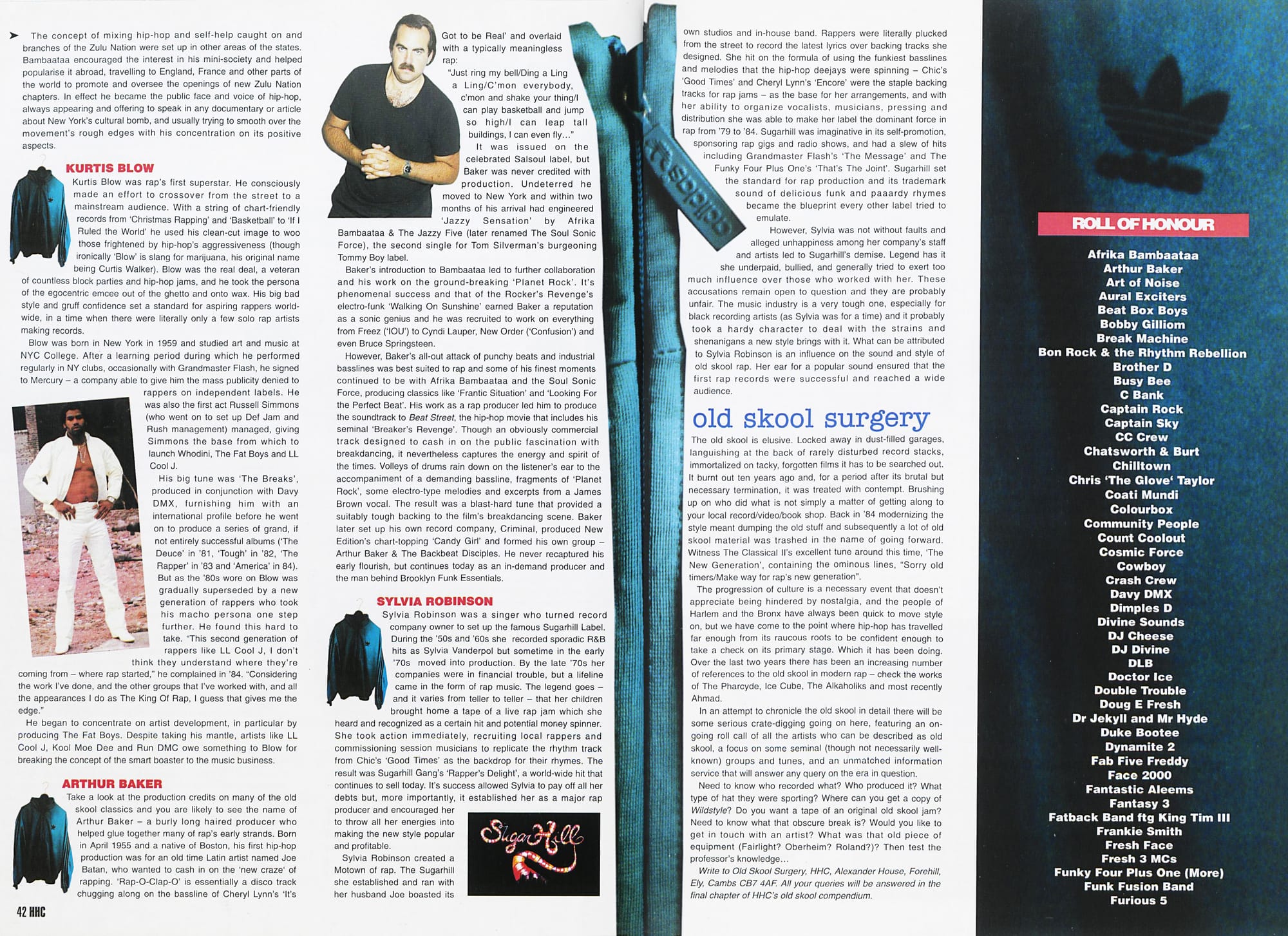
After his early success with 'Planet Rock' ('Jazzy Sensation' was his debut recording) Bambaataa made a number of similarly experimental and popular records featuring metronomic snares, clashing percussion and synthesized chants and raps. Along with the rest of his band - The Soul Sonic Force - his best and most innovative recordings included 'Looking For The Perfect Beat', 'Frantic Situation (which he performed in the hip-hop movie Beat Street), and 'Renegades Of Funk'.
However, Bambaataa was more than a recording artist. While running his mobile sound system in the Bronx he built up a massive following which he moulded into a unified movement he named the Zulu Nation. With its origins in the street gangs of New York (Bambaataa was once a member of the reportedly notorious Black Spades) The Zulu Nation had its own rules, standards, dances and dress. It aimed to give directionless youth a sense of belonging and placed emphasis on peace and strength through unity. In Bam's words: "The aims are all tied up with the politics of the street, it's about survival, keeping young adults from getting into heavy crime and all types of wrongness. Music plays a big role within the Zulu Nation, but it's there to support all types of activity — dance groups like the NYC Breakers, graffiti artists, freestyle dancers..."
The concept of mixing hip-hop and self-help caught on and branches of the Zulu Nation were set up in other areas of the states. Bambaataa encouraged the interest in his mini-society and helped popularise it abroad, travelling to England, France and other parts of the world to promote and oversee the openings of new Zulu Nation chapters. In effect he became the public face and voice of hip-hop, always appearing and offering to speak in any documentary or article about New York's cultural bomb, and usually trying to smooth over the movement's rough edges with his concentration on its positive aspects.
KURTIS BLOW - Kurtis Blow was rap's first superstar. He consciously made an effort to crossover from the street to a mainstream audience. With a string of chart-friendly records from 'Christmas Rapping' and 'Basketball’ to 'If I Ruled the World’ he used his clean-cut image to woo those frightened by hip-hop's aggressiveness (though ironically 'Blow' is slang for marijuana, his original name being Curtis Walker). Blow was the real deal, a veteran of countless block parties and hip-hop jams, and he took the persona of the egocentric emcee out of the ghetto and onto wax. His big bad style and gruff confidence set a standard for aspiring rappers world-wide, in a time when there were literally only a few solo rap artists making records.
Blow was born in New York in 1959 and studied art and music at NYC College. After a learning period during which he performed regularly in NY clubs, occasionally with Grandmaster Flash, he signed to Mercury — a company able to give him the mass publicity denied to rappers on independent labels. He was also the first act Russell Simmons who went on to set up Def Jam and Rush management) managed, giving Simmons the base from which to launch Whodini, The Fat Boys and LL Cool J.
His big tune was 'The Breaks' produced in conjunction with Davy DMX, furnishing him with an international profile before he went on to produce a series of grand, if not entirely successful albums ('The Deuce' in '81, 'Tough' in '82, 'The Rapper' in '83 and 'America' in 84). But as the '80s wore on Blow was gradually superseded by a new generation of rappers who took his macho persona one step further. He found this hard to take. "This second generation of rappers like LL Cool J, I don't
think they understand where they're coming from — where rap started," he complained in '84. "Considering the work I've done, and the other groups that I've worked with, and all the appearances I do as The King Of Rap, I guess that gives me the edge."
He began to concentrate on artist development, in particular by producing The Fat Boys. Despite taking his mantle, artists like LL Cool J, Kool Moe Dee and Run DMCowe something to Blow for breaking the concept of the smart boaster to the music business.
ARTHUR BAKER - Take a look at the production credits on many of the old skool classics and you are likely to see the name of Arthur Baker – a burly long haired producer who helped glue together many of rap's early strands. Born in April 1955 and a native of Boston, his first hip-hop production was for an old time Latin artist named Joe Batan, who wanted to cash in on the 'new craze' of rapping. 'Rap-O-Clap-O' is essentially a disco track chugging along on the bassline of Cheryl Lynn's 'It's Got to be Real and overlaid with a typically meaningless rap: "Just ring my bell/Ding a Ling a Ling/C'mon everybody, c'mon and shake your thing/l can play basketball and jump so high/l can leap tall buildings, I can even fly..."
It was issued on the celebrated Salsoul label, but Baker was never credited with production. Undeterred he moved to New York and within two months of his arrival had engineered ‘Jazzy Sensation' by Afrika Bambaataa & The Jazzy Five (later renamed The Soul Sonic Force), the second single for Tom Silverman's burgeoning Tommy Boy label.
Baker's introduction to Bambaataa led to further collaboration and his work on the ground-breaking Planet Rock'. It's phenomenal success and that of the Rocker's Revenge's electro-funk Walking On Sunshine' earned Baker a reputation as a sonic genius and he was recruited to work on everything from Freez (‘IOU’) to Cyndi Lauper, New Order ('Confusion') and even Bruce Springsteen.
However, Baker's all-out attack of punchy beats and industrial basslines was best suited to rap and some of his finest moments continued to be with Afrika Bambaataa and the Soul Sonic Force, producing classics like 'Frantic Situation' and 'Looking For the Perfect Beat'. His work as a rap producer led him to produce the soundtrack to Beat Street, the hip-hop movie that includes his seminal 'Breaker's Revenge'. Though an obviously commercial track designed to cash in on the public fascination with breakdancing, it nevertheless captures the energy and spirit of the times. Volleys of drums rain down on the listener's ear to the accompaniment of a demanding bassline, fragments of Planet Rock', some electro-type melodies and excerpts from a James Brown vocal. The result was a blast-hard tune that provided a suitably tough backing to the film's breakdancing scene. Baker later set up his own record company, Criminal, produced New Edition's chart-topping 'Candy Girl' and formed his own group — Arthur Baker & The Backbeat Disciples. He never recaptured his early flourish, but continues today as an in-demand producer and the man behind Brooklyn Funk Essentials.
SYLVIA ROBINSON - Sylvia Robinson was a singer who turned record company owner to set up the famous Sugarhill Label. During the '50s and '60s she recorded sporadic R&B hits as Sylvia Vanderpol but sometime in the early '70s moved into production. By the late '70s her companies were in financial trouble, but a lifeline came in the form of rap music. The legend goes - and it varies from teller to teller - that her children brought home a tape of a live rap jam which she heard and recognized as a certain hit and potential money spinner. She took action immediately, recruiting local rappers and commissioning session musicians to replicate the rhythm track from Chic's 'Good Times' as the backdrop for their rhymes. The result was Sugarhill Gang's 'Rapper's Delight', a world-wide hit that continues to sell today. Its success allowed Sylvia to pay off all her debts but, more importantly, it established her as a major rap producer and encouraged her to throw all her energies into making the new style popular and profitable.
Sylvia Robinson created a Motown of rap. The Sugarhill she established and ran with her husband Joe boasted its own studios and in-house band. Rappers were literally plucked from the street to record the latest lyrics over backing tracks she designed. She hit on the formula of using the funkiest basslines and melodies that the hip-hop deejays were spinning — Chic's 'Good Times' and Cheryl Lynn's 'Encore' were the staple backing tracks for rap jams — as the base for her arrangements, and with her ability to organize vocalists, musicians, pressing and distribution she was able to make her label the dominant force in rap from '79 to '84. Sugarhill was imaginative in its self-promotion, sponsoring rap gigs and radio shows, and had a slew of hits including Grandmaster Flash's The Message' and The Funky Four Plus One's 'That's The Joint'. Sugarhill set the standard for rap production and its trademark sound of delicious funk and paaardy rhymes became the blueprint every other label tried to emulate.
However, Sylvia was not without faults and alleged unhappiness among her company's staff and artists led to Sugarhill's demise. Legend has it she underpaid, bullied, and generally tried to exert too much influence over those who worked with her. These accusations remain open to question and they are probably unfair. The music industry is a very tough one, especially for black recording artists (as Sylvia was for a time) and it probably took a hardy character to deal with the strains and shenanigans a new style brings with it. What can be attributed to Sylvia Robinson is an influence on the sound and style of old skool rap. Her ear for a popular sound ensured that the first rap records were successful and reached a wide audience.
OLD SKOOL SURGERY
The old skool is elusive. Locked away in dust-filled garages, languishing at the back of rarely disturbed record stacks, immortalized on tacky, forgotten films it has to be searched out. It burnt out ten years ago and, for a period after its brutal but necessary termination, it was treated with contempt. Brushing up on who did what is not simply a matter of getting along to your local record/video/book shop. Back in '84 modernizing the style meant dumping the old stuff and subsequently a lot of old skool material was trashed in the name of going forward Witness The Classical II's excellent tune around this time, 'The New Generation', containing the ominous lines, "Sorry old timers/Make way for rap's new generation."
The progression of culture is a necessary event that doesn't appreciate being hindered by nostalgia, and the people of Harlem and the Bronx have always been quick to move style on, but we have come to the point where hip-hop has travelled far enough from its raucous roots to be confident enough to take a check on its primary stage. Which it has been doing. Over the last two years there has been an increasing number of references to the old skool in modern rap - check the works of The Pharcyde, Ice Cube, The Alkaholiks and most recently Ahmad.
In an attempt to chronicle the old skool in detail there will be some serious crate-digging going on here, featuring an ongoing roll call of all the artists who can be described as old skool, a focus on some seminal (though not necessarily well-known) groups and tunes, and an unmatched information service that will answer any query on the era in question.
Need to know who recorded what? Who produced it? What type of hat they were sporting? Where can you get a copy of Wildstyle? Do you want a tape of an original old skool jam? Need to know what that obscure break is? Would you like to get in touch with an artist? What was that old piece of equipment (Fairlight? Oberheim? Roland?)? Then test the professor's knowledge...
Write to Old Skool Surgery, HHC, Alexander House, Forehill, Ely, Cambs CB7 4AF. All your queries will be answered in the final chapter of HHC's old skool compendium.
ROLL OF HONOUR
Afrika Bambaataa
Arthur Baker
Art of Noise
Aural Exciters
Beat Box Boys
Bobby Gilliom
Break Machine
Bon Rock & the Rhythm Rebellion
Brother D
Busy Bee
C Bank
Captain Rock
Captain Sky
CC Crew
Chatsworth & Burt|
Chilltown
Chris "The Glove' Taylor
Coati Mundi
Colourbox
Community People
Count Coolout
Cosmic Force
Cowboy
Crash Crew
Davy DMX
Dimples D
Divine Sounds
DJ Cheese
DJ Divine
DLB
Doctor Ice
Double Trouble
Doug E Fresh
Dr Jekyll and Mr Hyde
Duke Bootee
Dynamite 2
Fab Five Freddy
Face 2000
Fantastic Aleems
Fantasy 3
Fatback Band ft King Tim III
Frankie Smith
Fresh Face
Fresh 3 MCs
Funky Four Plus One (More)
Funk Fusion Band
Furious 5