
'Nowhere' - Fineboys 1996
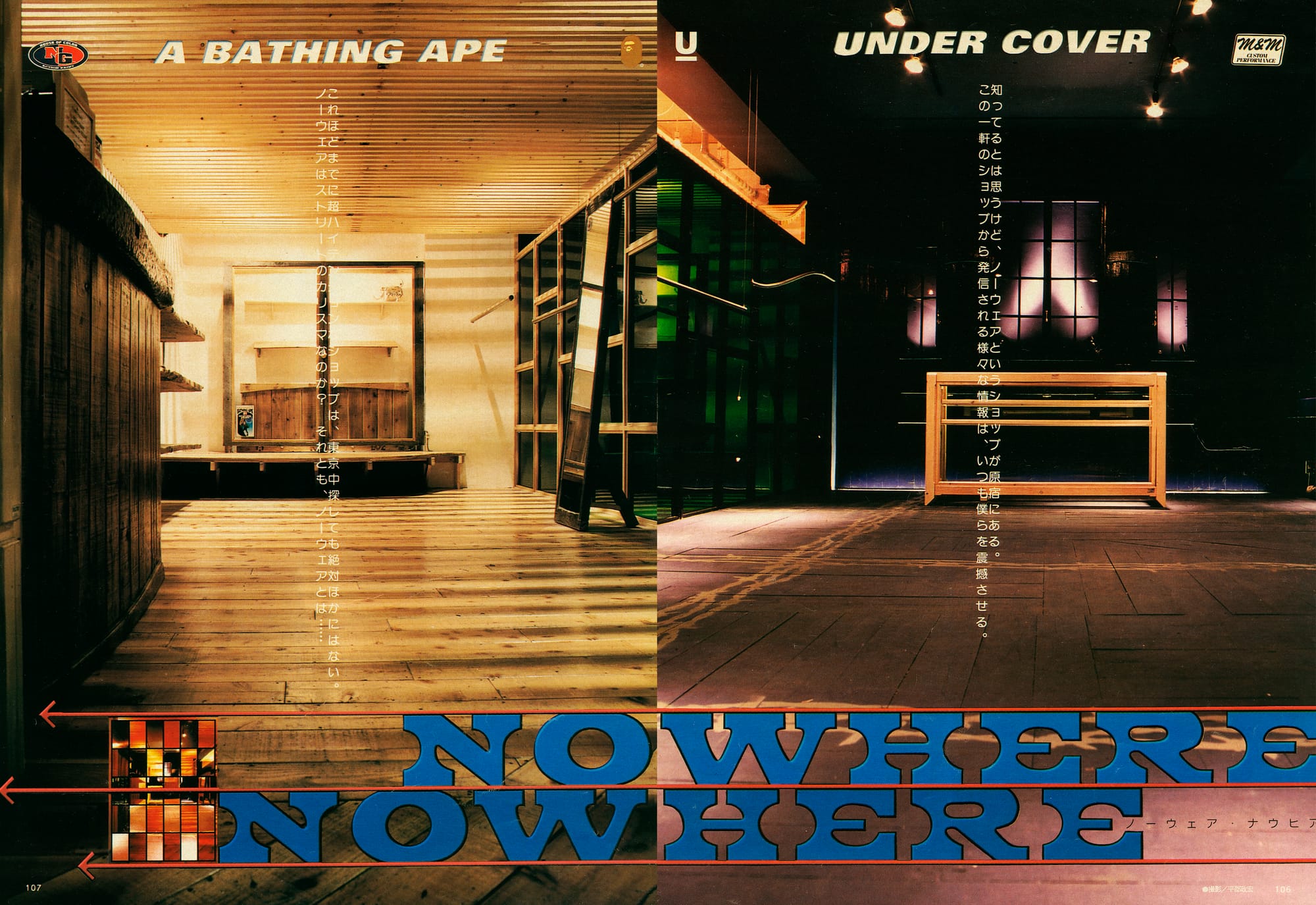
Though it exists nowhere, it is here.
That is Nowhere. Nowhere is here.
But where it is headed, no one knows.
Nowhere is not a brand name. It is the name of a shop in Harajuku.
Apologies to anyone thinking, why state the obvious? But this is the first time Fine Boys has introduced Nowhere. So let’s start from the beginning.
You have probably heard of brands like Undercover and A Bathing Ape. Rather, it would be stranger if you hadn’t. Both are among the most talked-about streetwear brands right now. These two brands are only stocked in a limited number of shops nationwide. That rarity gives them a special aura: clothes that sell out immediately upon arrival, with no word on future restocks. In other words, ultra-scarce items with extraordinary cachet.
The shop that carries both of these brands is Nowhere.
In fact, there are probably surprisingly few people who really know much about Nowhere itself.
Even in a feature like “A Grand Gathering of Fall Brands,” it would be rare to see Undercover or A Bathing Ape included. And yet, mention the name Nowhere and plenty of people instantly react. Why does it have that kind of pull? Read on, and the reason should become clear.
Before that, though, there is something important to understand.
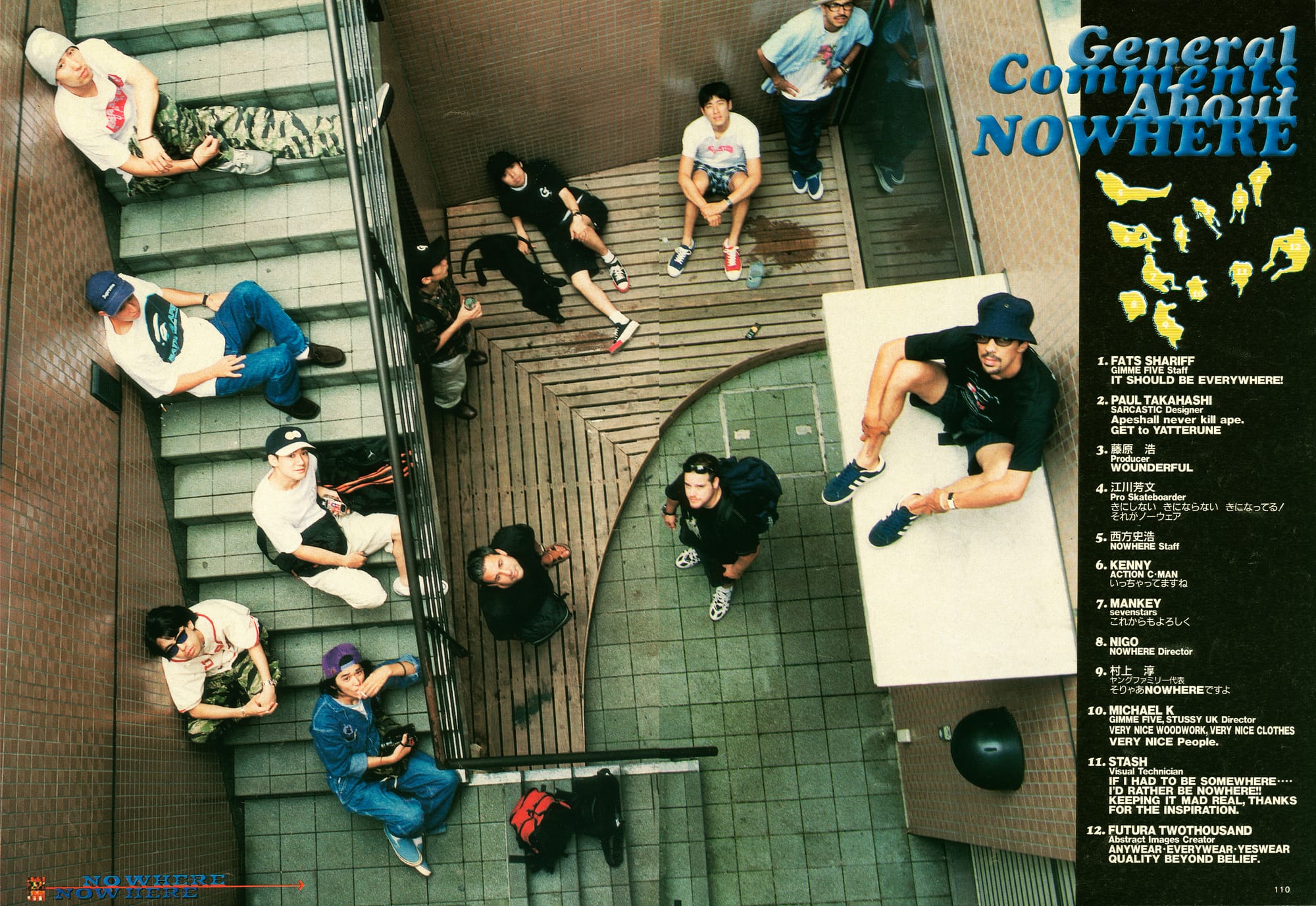
When people talk about Nowhere, they immediately think of JONIO and NIGO. Around these two, and the network surrounding them, the whole identity of Nowhere takes shape. The two had been friends since their days at Bunka Fashion College, where JONIO was the senior. JONIO founded Undercover in 1989 while he was still a student. NIGO, meanwhile, was formerly a stylist and DJ. His current title is director of Nowhere. A Bathing Ape is the brand directed by NIGO.
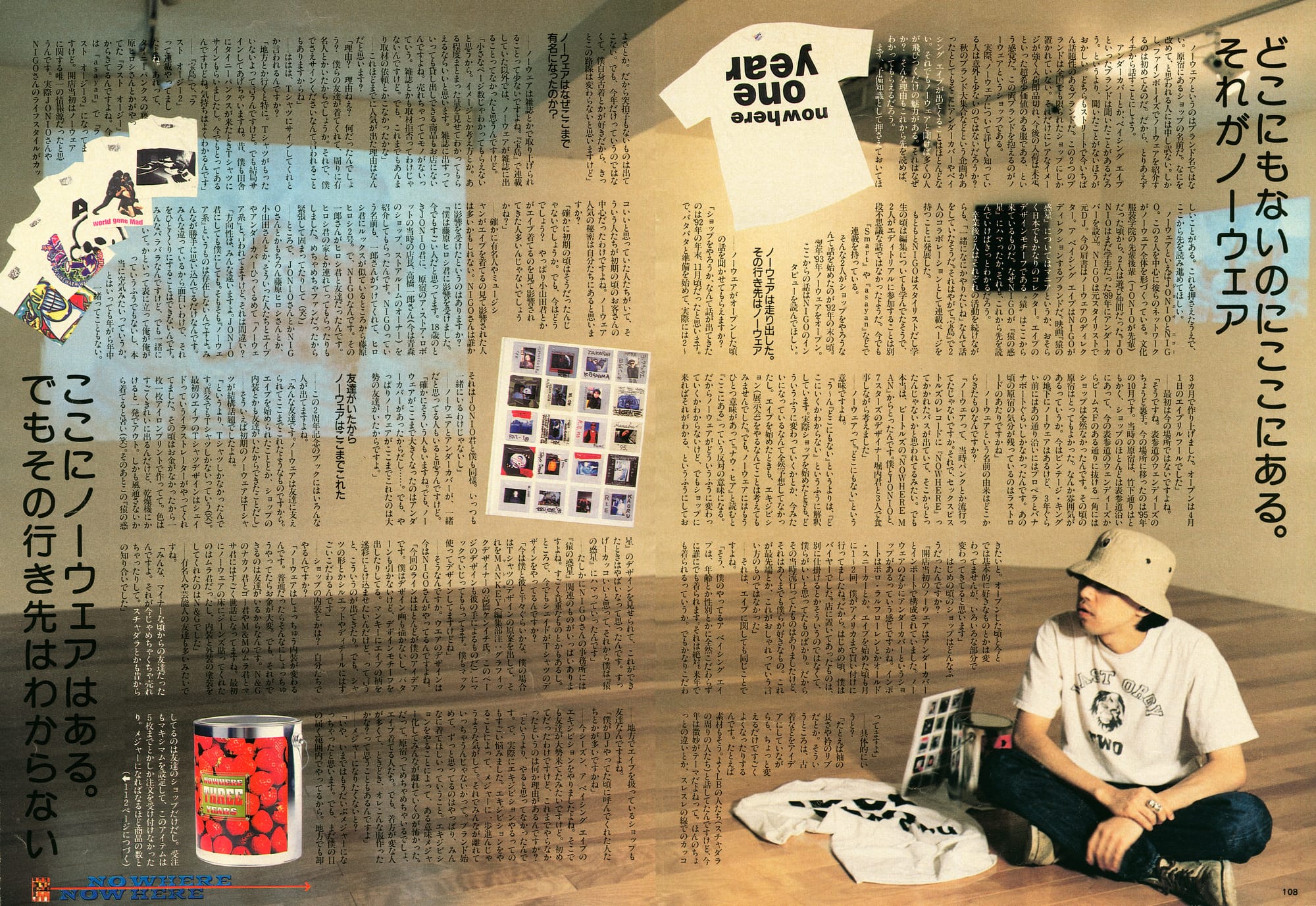
As for the film Planet of the Apes, NIGO is more than a fan; he is probably one of Japan’s most serious collectors. The ape motif used in the brand’s designs comes from there. Why NIGO became so obsessed with Planet of the Apes is something that will also become clearer as you read on.
After graduation, both continued their own work, but they talked about wanting to do something together. That eventually developed into a collaborative serialized feature in Takarajima.
NIGO had originally been a stylist, and while he was a student he had also studied editing, so it was not particularly surprising that the two of them became involved in editorial work. Even now, they continue serials in magazines like Smart and asayan.
It was around the end of 1992 that the two first began talking seriously about opening a shop. The following year, in 1993, Nowhere opened.
From here on, it is best to let NIGO tell the story himself.
Nowhere Took Off
Its destination: Nowhere
FB: Can you tell us about the time when Nowhere first opened?
N: “It must have been around the end of 1992, maybe November, that the idea of opening a shop first came up. Then we hurriedly started getting ready, and in the end we put it together in about three months. We opened on April 1st, April Fool’s Day.”
FB: At first it wasn’t in the current location, right?
N: “That’s right. It was just behind the Wendy’s in Omotesando. We moved to the current location in October 1995. Back then, apart from Takeshita Street, most shops in Harajuku were lined along Omotesando, and the stretch from the Wendy’s there to the street with Beams F didn’t really have shops at all. Harajuku was really great at the time. It had a certain atmosphere. Now Nowhere is in the basement of Vintage King, but about three years ago the only places on that street were Propeller and Banana Boat. If any part of old Harajuku’s mood still remains, it’s probably around Last Road.”
FB: Where did the name Nowhere come from?
N: “Back then punk was popular, so some people seem to think it came from a bus with ‘NOWHERE’ written on it that appeared on a Sex Pistols record. But actually, it came from the Beatles’ ‘Nowhere Man.’ JONIO, Horiuchi-kun from 7 Stars, and I came up with it while we were having dinner.”
FB: Nowhere means ‘not anywhere,’ right?
N: “Well, rather than ‘not anywhere,’ I interpret it more as ‘not knowing where it’s going.’ When we started the shop, we had no idea how it would change or that it would become what it is now. Even when I started Ape, I never imagined we’d be doing exhibitions. But Nowhere has another meaning too: if you read it as ‘Now Here,’ it becomes the opposite — ‘here, now.’ So even if we don’t know how Nowhere will change, if you come to the shop, you’ll understand it.”
FB: Why Did Nowhere Become So Famous?
Nowhere doesn’t get featured in magazines very often, does it? Aside from the serial in Takarajima, I don’t remember seeing it in magazines much at all.
N: “I don’t think people can understand it from just a few pages. The image, the thinking behind it — if we can show a certain amount all at once and have people understand it, then that’s fine. Also, even if we wanted to appear in magazines, we usually don’t have any product to loan out. Everything’s already sold out. It’s not that we’ve been refusing magazine coverage. It’s just that, until now, we didn’t really get that many requests anyway.”
FB: Why do you think it became this popular?
N: “Why? Hmm… why was that? Maybe because our friends wore the clothes, and we happened to have some famous people around us. Even I sometimes get asked for autographs.”
FB: Really? People ask you to sign T-shirts?
N: “Especially when I go to the provinces. I tell them, ‘That T-shirt’s too good to ruin.’ But in the end I sign it anyway. Long ago, when Tiny Punks came to the countryside, I got them to sign my T-shirt too. I still have it. So I understand the feeling.”
FB: In Takarajima, there was a serial called Last Orgy 2, wasn’t there? That title came from Last Orgy, the series by Hiroshi Fujiwara of Tiny Punks and others. Now it’s become Last Orgy 3 in asayan. At the time Nowhere first opened, that was basically the only source of information about it. It gave readers a glimpse not just of the clothes, but of the lifestyles of JONIO and NIGO as well.
Influences, Friends, and “Nowhere-kei”
FB: People often lump together Ape, Undercover, Hiroshi Fujiwara, Oyamada, and others under the label “Nowhere-kei.” Is that mistaken?
N: “Our directions are all different. JONIO-kun and I are different too. To begin with, there is no such thing as ‘Nowhere-kei.’ People just imagine that there is. It’s interesting precisely because everyone is different. You can’t lump it all together. Everyone is separate, but still together. At the same time, nobody is standing out front shouting ‘me, me, me.’ It’s more like air. But even so, it’s not as if we’re together all year round.”
FB: There are probably people who think Nowhere and Undercover are the same thing.
N: “Sure, there are people like that. But it’s true that Nowhere grew as big as it did because Undercover was there… Still, in the end, what really got Nowhere this far was having so many friends.”
Nowhere Got This Far Because of Friends
FB: A lot of people appear in this second-anniversary book, don’t they?
N: “They’re all friends. Nowhere is something that got this far because it was supported by friends. Starting Ape, doing the shop interior — all of that was only possible because we had friends.”
FB: Speaking of the early days, Nowhere’s T-shirts were quite a topic, weren’t they?
N: “More than that, T-shirts were all we had. Even in the middle of winter, it was nothing but T-shirts. The first Ape T-shirt designs were done by an illustrator called Sk8thing. We didn’t have any money back then, so each one was made with iron-on prints. They looked great, but if you put them in the dryer they were done for in one shot. And they didn’t breathe at all, so they were hot as hell to wear.”
“Then I was shown this Planet of the Apes design, and when that came together I thought, this is dangerous. It looked insanely cool. That’s when I really got hooked on Planet of the Apes.”
FB: There are a lot of Planet of the Apes items in your office, including some really rare ones. Does Sk8thing still design the T-shirts now?
N: “Now it’s about half-and-half between him and me. In my case, I come up with the initial idea for the T-shirt design, and then I have MANKEY — that’s graphic designer Kenichi Takahashi, who also designed these pages — work on it on a Mac. I use a Mac for design too.”
FB: So now you’re the one designing the clothes?
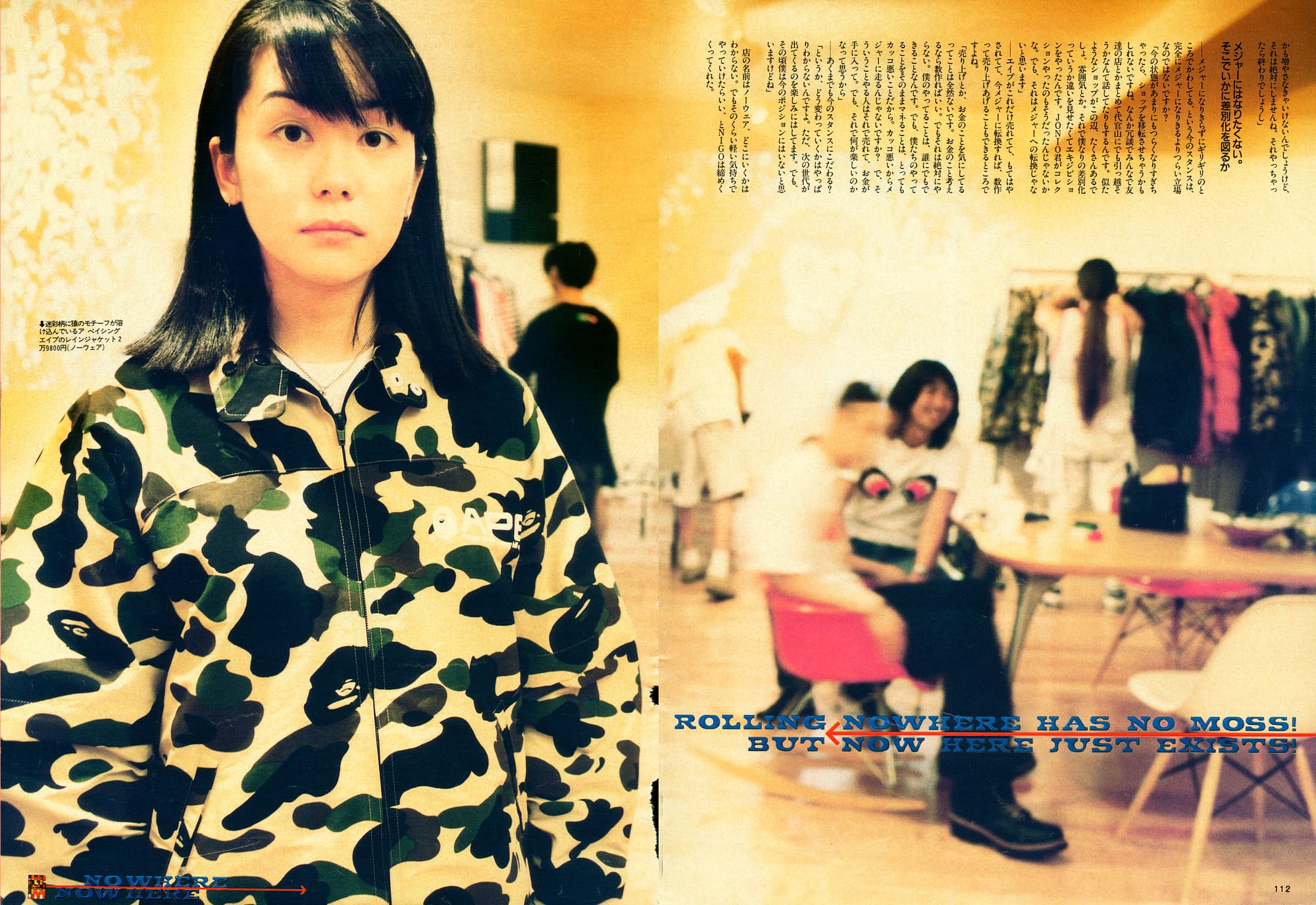
N: “For this line, most of the ideas are mine. I don’t draw fashion sketches or make patterns, but I come up with the design motifs. For example, I might tell MANKEY, ‘I want to blend the Ape pattern into camouflage,’ and then something like that comes back. But I’m extremely particular about the shirt shapes, the silhouettes, and the details.”
FB: What about the store interior? Do you do that yourselves too?
N: “Nowhere’s interior changes all the time. Normally that would be financially impossible. But we can do it because we have friends. Nakano-kun and Go-kun from N&G, and Mura-kun and Masa from M&M have really taken care of us. It was Mura-kun who first glued jeans onto the floor of Nowhere, and N&G handled the interior and exterior painting.”
FB: You seem to have a lot of celebrity and musician friends too.
N: “They were all friends from before they became famous. Now they’ve gotten huge. Scha Dara Parr, for example, were acquaintances from way back.”
FB: And the shops outside Tokyo that carry Ape — those are also run by friends, right?
N: “A lot of them were people who invited me when I was still DJing.”
Not Wanting to Go Fully Major
FB: This season, A Bathing Ape held an exhibition. A lot of friends showed up there too. Since it was the first one, was there a reason you hadn’t done one before?
N: “It’s more that I never thought we would. And when it became real, I agonized over it. I felt that holding an exhibition might be taking a step toward the mainstream, and I was afraid people would drift away because of that. Ever since I started the brand, I’ve always wanted people to wear it. But I was scared that doing an exhibition would make us ‘major’ in a certain sense, and that people would leave.”
“Because look around Harajuku — there are tons of people wearing Ape. But a lot of them wear it strangely, and sometimes I find myself thinking, Did I really make clothes like this?”
FB: So you don’t want to become mainstream?
N: “No, by now I think we’ve already become fairly mainstream. But we’re still operating within a range I can keep an eye on. Even in regional areas, we only wholesale to friends’ shops. We set maximum order quantities too — like only five pieces of a particular item. The more major you get, the more you probably have to increase production. But I’ll never do that. If we did, that would be the end.”
Differentiation at the Edge
FB: Not becoming fully mainstream, but continuing to dodge just at the edge of it — isn’t that harder than simply going all the way?
N: “If things get too hard in the current situation, we might just move the shop. We joke sometimes about taking all our friends’ stores and moving them together to Daikanyama. There are a lot of shops around here with similar atmospheres, right? That’s why I wanted to show our own kind of differentiation — our own difference — and that’s why I did the exhibition. I think that may have been part of why JONIO-kun did his collection too. But that doesn’t mean turning mainstream.”
FB: With Ape selling this much and getting all this attention, you could switch to the mainstream right now, produce in larger quantities, and make a lot more money.
N: “I’m not thinking about sales or money at all. If money were the point, I’d just make more. But I’ll never do that. What I’m doing is something anyone could do. But directly copying what we do is incredibly uncool. Isn’t that why people run toward the mainstream — because they don’t want to be uncool? People like that sell, make money, and get rich. But I wonder what’s actually enjoyable about that.”
FB: So you’re committed to this stance?
N: “I mean, I still don’t know how things will change. I am looking forward to seeing the next generation emerge. But by then, I probably won’t be in the position I’m in now.”
The shop’s name is Nowhere: no one knows where it will go. But NIGO closed by saying that he hoped to keep doing it with exactly that kind of lightness.
Rolling Nowhere has no moss! But now here just exists!