
'No Half Steppin' - alife' Streetwear Today February 2005
Text & Interview: Steven Vogel
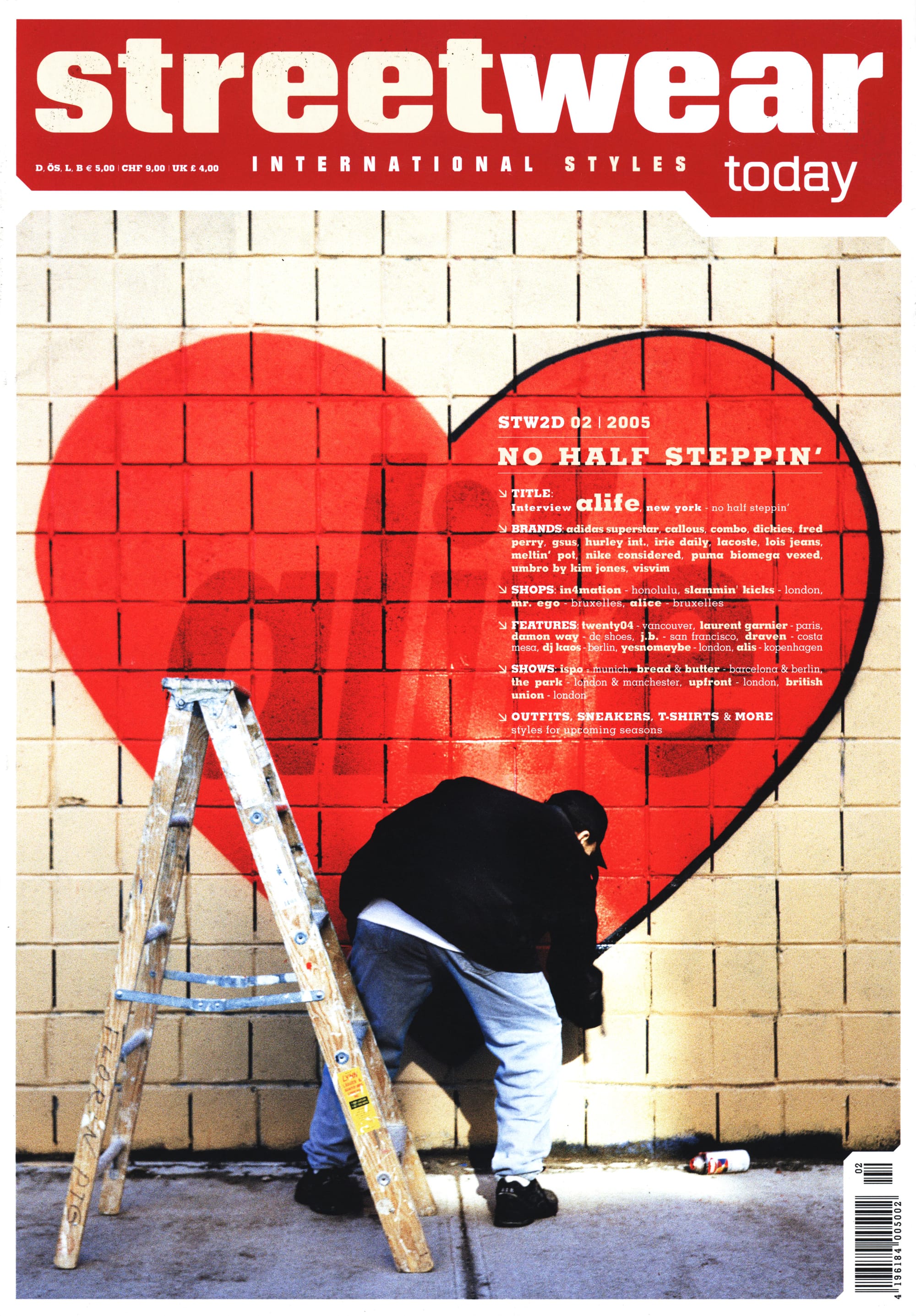
When we decided on our title theme for this issue, “no half steppin’,” our immediate thoughts turned to the main story. The title meant many different things to us and is also so easily interpreted by many different people and brands. Thus, the initial challenge that lay before us was deciding who represented the theme most. Just because streetwear has become interesting for the mainstream—which uses the term as an almost magic word and, unfortunately, a supposed key to success in today’s youth culture market—doesn’t mean that by superficially imposing the term onto a product we were going to give it our time or space. We were looking for something genuine. Real. A term that is indefinable, yet when you understand it, no definition is necessary. Something we admired and respected for its roots, its intentions, and—most importantly—its output. Output is how we judge and gauge relevance. Not unlike the stock exchange in New York. And that’s where this was going. New York City represents our title more than anything else. The city that never sleeps. One could argue that it was in New York where this culture was born in the late 1970s—with the sounds of Grandmaster Flash & the Furious Five, and with the visual language of artists like Dondi and Futura 2000, who were illustrating not just trains and subways, but entire neighborhoods. New York City has always been a melting pot of ideas and cultures, producing some of the greatest artists of the latter half of the 20th century—from Broadway to the jazz clubs of Harlem to the world’s most powerful musical medium: hip-hop. Hip-hop succeeded in this cauldron of influences for one reason: it wasn’t just one discipline. There were the four elements—B-Boyin’, DJ’ing, MC’ing, and graffiti. So to bring it back to “no half steppin’”: it’s the collaboration of multiple elements that makes something great. That makes it stand out. That’s how—and why—we decided to feature Alife.
I first heard of Alife in the early 2000s in London, when rumors of a new and exclusive store/label in New York City reached us. It had opened somewhere along Orchard Street—more of a community than the Starbucks- and McDonald’s-infested 42nd Street. It wasn’t long before I flew over to see what the hype was about—and I wasn’t disappointed. Orchard Street felt more like a club. A hybrid between gallery, store, and social space. A place to hang out and exchange ideas with people from all over the world who somehow just clicked. Even then, it was clear that Alife was far more than “just” a store or “just” a label. They were producing goods that represented the culture on every level. Frequent collaborations brought those ideas to life. Before long, Alife had become one of the most sought-after creative forces in the world. That’s what Alife is—and still is. Not simply a store selling T-shirts, but a creative platform. One that doesn’t just embrace culture, but participates in it. Reflects it. Without compromise. The story continued when, at the start of the sneaker boom, Rob, Tony, and Arnaud—the founders and partners of Alife—opened their second retail space: the Alife Rivington Club at 158 Rivington Street. A Savile Row–style destination for rare and exclusive sneakers. At the same time, major sneaker companies took notice. Rivington Street became a Nike “probe account”—a testing ground for experimental releases like the Air Woven. Then came the Alife x Adidas collaboration: three sneakers that still rank in many collectors’ top five. Beyond its own clothing line, Alife represents New York City, the culture, and the spirit of “no half steppin’” like few others can. stw2d had the opportunity to work with Rob, Arnaud, and Tony on this piece—and they took time out of their schedules to answer a few questions.