
‘Money Cash Clothes’ - VIBE Magazine September 2006
Writer: Rebecca Louie
Photos: Makoto Ishida
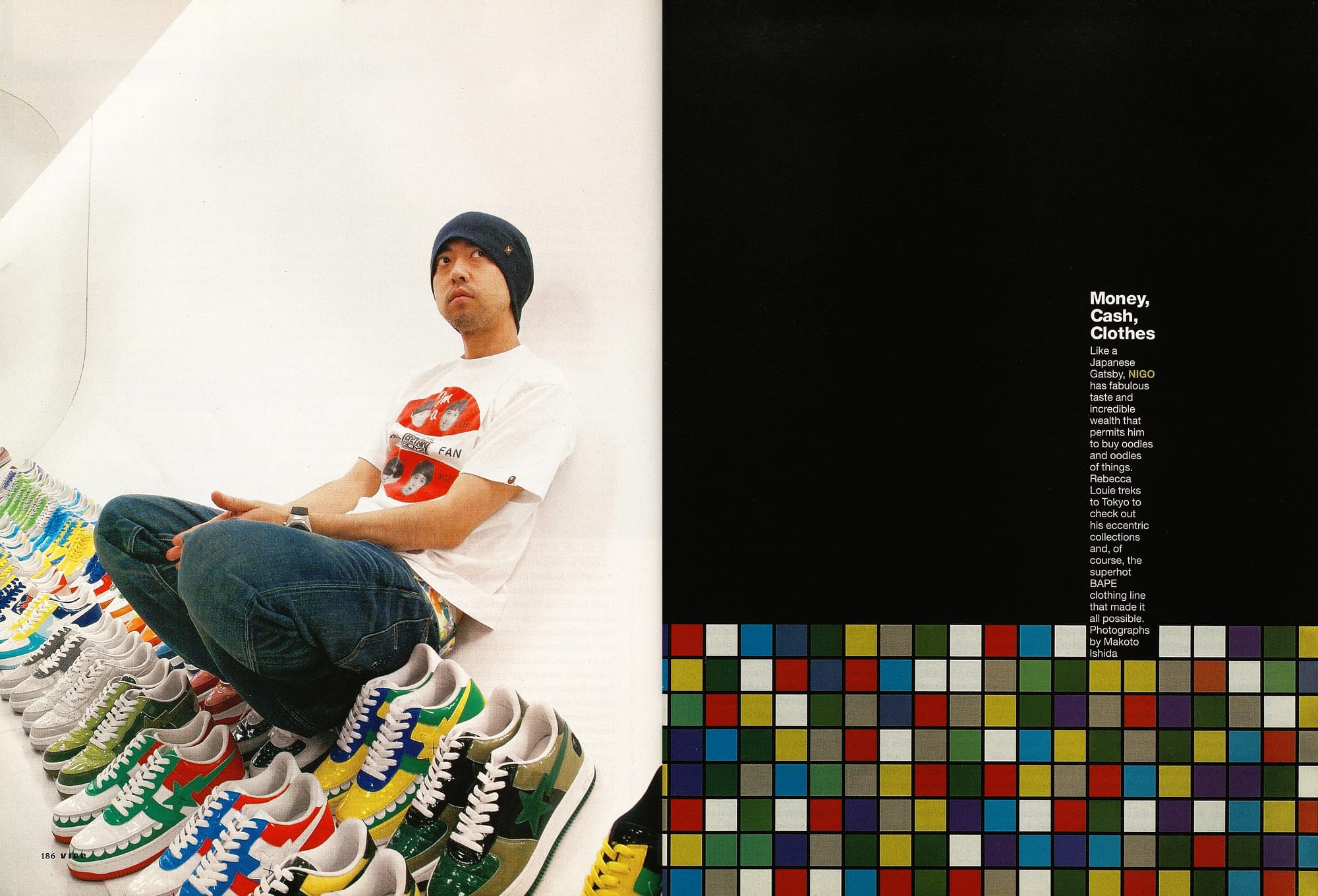
Like a Japanese Gatsby, NIGO has fabulous taste and incredible wealth that permits him to buy oodles and oodles of things. Rebecca Louie treks to Tokyo to check out his eccentric collections and, of course, the superhot BAPE clothing line that made it all possible.
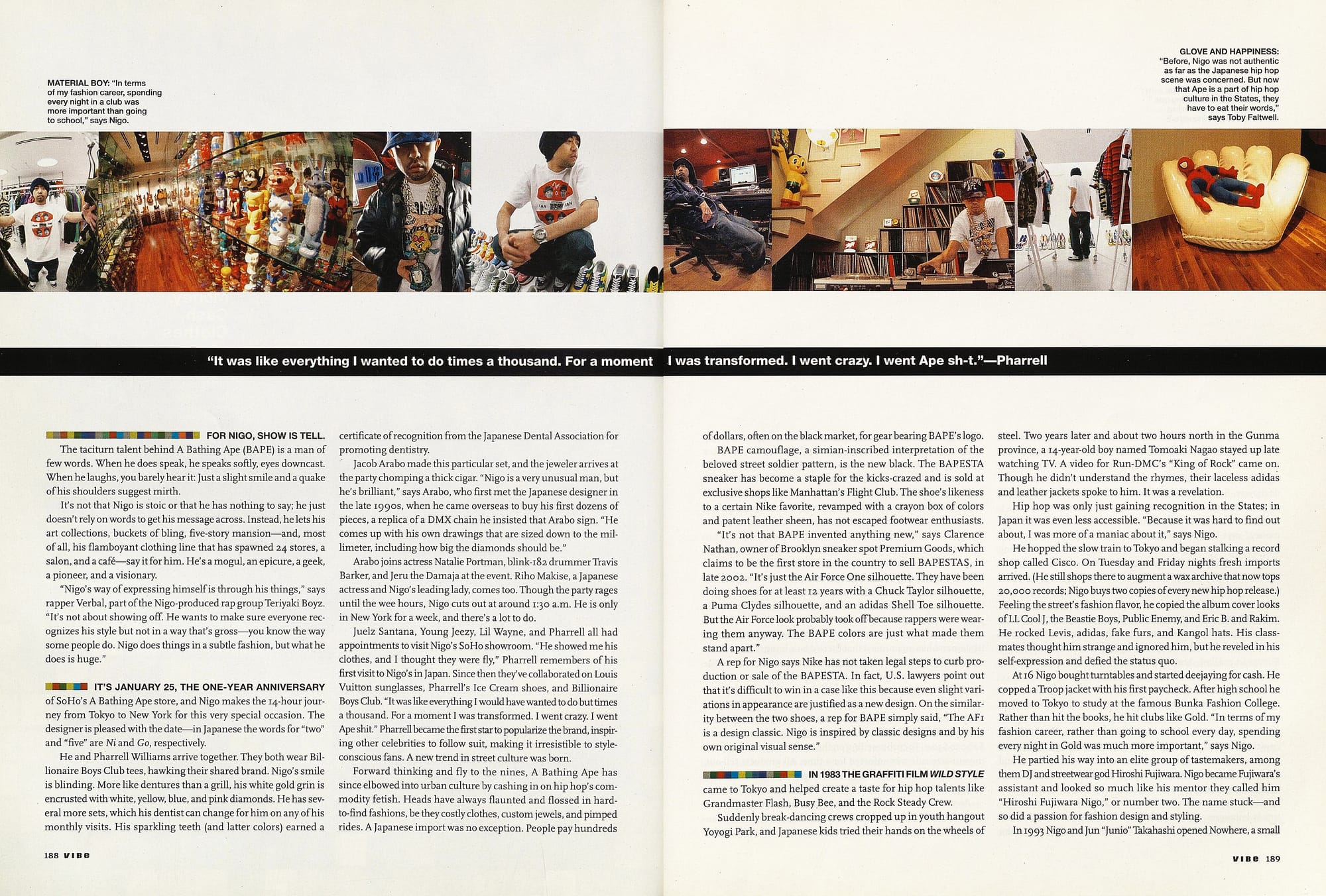
FOR NIGO, SHOW IS TELL. The taciturn talent behind A Bathing Ape (BAPE) is a man of few words. When he does speak, he speaks softly, eyes downcast. When he laughs, you barely hear it: Just a slight smile and a quake of his shoulders suggest mirth.
It's not that Nigo is stoic or that he has nothing to say; he just doesn't rely on words to get his message across. Instead, he lets his art collections, buckets of bling, five-story mansion and, most of all, his flamboyant clothing line that has spawned 24 stores, a salon, and a café—say it for him. He's a mogul, an epicure, a geek, a pioneer, and a visionary.
"Nigo's way of expressing himself is through his things," says rapper Verbal, part of the Nigo-produced rap group Teriyaki Boyz. "It's not about showing off. He wants to make sure everyone recognizes his style but not in a way that's gross—you know the way some people do. Nigo does things in a subtle fashion, but what he does is huge."
IT'S JANUARY 25, THE ONE-YEAR ANNIVERSARY of SoHo's A Bathing Ape store, and Nigo makes the 14-hour journey from Tokyo to New York for this very special occasion. The designer is pleased with the date—in Japanese the words for "two" and "five" are Ni and Go, respectively.
He and Pharrell Williams arrive together. They both wear Billionaire Boys Club tees, hawking their shared brand. Nigo's smile is blinding. More like dentures than a grill, his white gold grin is encrusted with white, yellow, blue, and pink diamonds. He has several more sets, which his dentist can change for him on any of his monthly visits. His sparkling teeth (and latter colors) earned a certificate of recognition from the Japanese Dental Association for promoting dentistry.
Jacob Arabo made this particular set, and the jeweler arrives at the party chomping a thick cigar. "Nigo is a very unusual man, but he's brilliant," says Arabo, who first met the Japanese designer in the late Iggos, when he came overseas to buy his first dozens of pieces, a replica of a DMX chain he insisted that Arabo sign. "He comes up with his own drawings that are sized down to the millimeter, including how big the diamonds should be."
Arabo joins actress Natalie Portman, blink-182 drummer Travis Barker, and Jeru the Damaja at the event. Riho Makise, a Japanese actress and Nigo's leading lady, comes too. Though the party rages until the wee hours, Nigo cuts out at around I:30 a.m. He is only in New York for a week, and there's a lot to do.
Juelz Santana, Young Jeezy, Lil Wayne, and Pharrell all had appointments to visit Nigo's SoHo showroom. "He showed me his clothes, and I thought they were fly," Pharrell remembers of his first visit to Nigo's in Japan. Since then they've collaborated on Louis Vuitton sunglasses, Pharrell's Ice Cream shoes, and Billionaire Boys Club. "It was like everything I would have wanted to do but times a thousand. For a moment I was transformed. I went crazy. I went Ape shit." Pharrell became the first star to popularize the brand, inspiring other celebrities to follow suit, making it irresistible to style-conscious fans. A new trend in street culture was born.
Forward thinking and fly to the nines, A Bathing Ape has since elbowed into urban culture by cashing in on hip hop's commodity fetish. Heads have always flaunted and flossed in hard-to-find fashions, be they costly clothes, custom jewels, and pimped rides. A Japanese import was no exception. People pay hundreds of dollars, often on the black market, for gear bearing BAPE's logo.
BAPE camouflage, a simian-inscribed interpretation of the beloved street soldier pattern, is the new black. The BAPESTA sneaker has become a staple for the kicks-crazed and is sold at exclusive shops like Manhattan's Flight Club. The shoe's likeness to a certain Nike favorite, revamped with a crayon box of colors and patent leather sheen, has not escaped footwear enthusiasts.
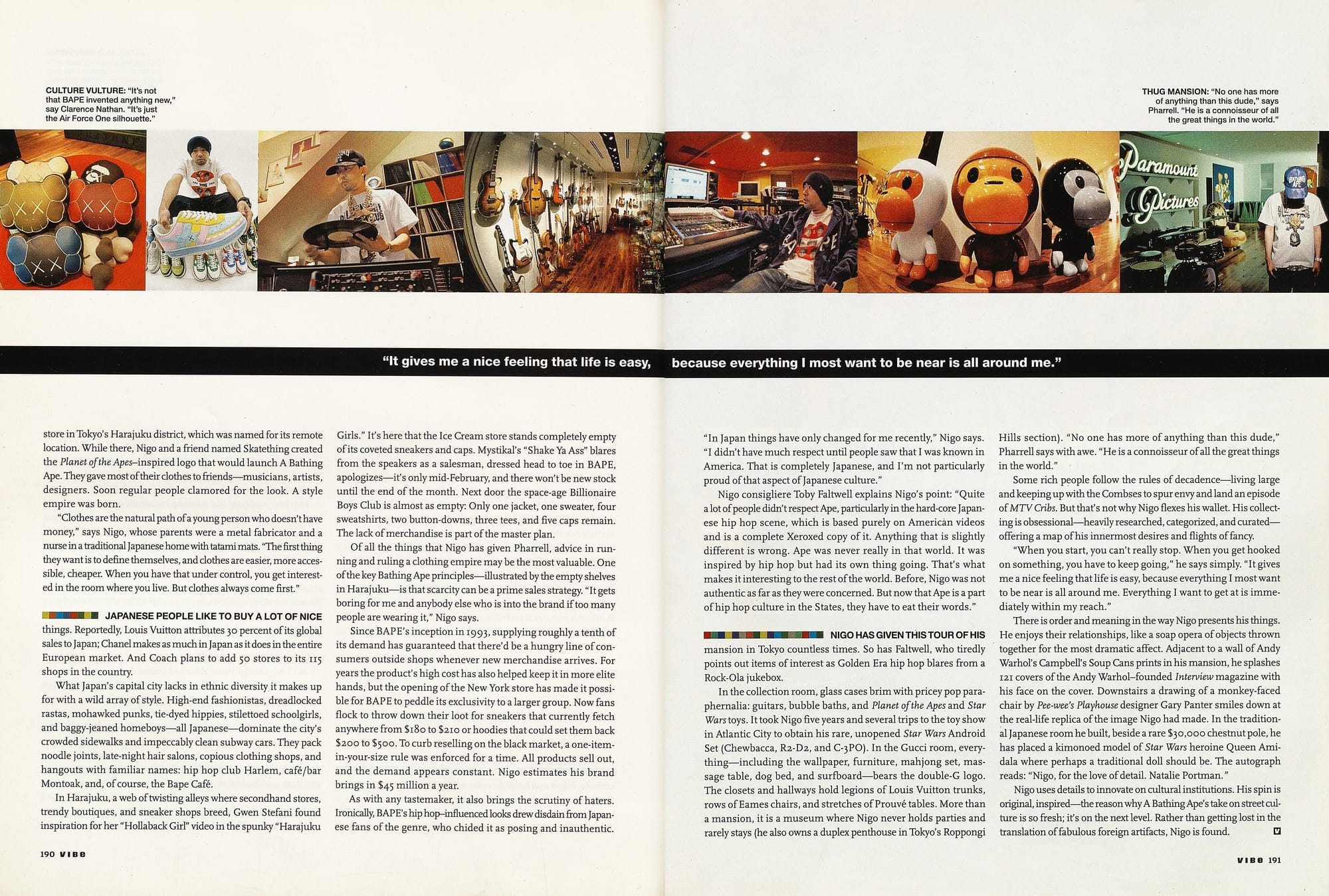
"It's not that BAPE invented anything new," says Clarence Nathan, owner of Brooklyn sneaker spot Premium Goods, which claims to be the first store in the country to sell BAPESTAS, in late 2002. "It's just the Air Force One silhouette. They have been doing shoes for at least 12 years with a Chuck Taylor silhouette, a Puma Clydes silhouette, and an adidas Shell Toe silhouette. But the Air Force look probably took off because rappers were wearing them anyway. The BAPE colors are just what made them stand apart.”
A rep for Nigo says Nike has not taken legal steps to curb production or sale of the BAPESTA. In fact, U.S. lawyers point out that it's difficult to win in a case like this because even slight variations in appearance are justified as a new design. On the similarity between the two shoes, a rep for BAPE simply said, "The AF1 is a design classic. Nigo is inspired by classic designs and by his own original visual sense."
IN 1983 THE GRAFFITI FILM WILD STYLE came to Tokyo and helped create a taste for hip hop talents like Grandmaster Flash, Busy Bee, and the Rock Steady Crew.
Suddenly break-dancing crews cropped up in youth hangout Yoyogi Park, and Japanese kids tried their hands on the wheels of steel. Two years later and about two hours north in the Gunma province, a 14-year-old boy named Tomoaki Nagao stayed up late watching TV. A video for Run-DMC's "King of Rock" came on. Though he didn't understand the rhymes, their laceless adidas and leather jackets spoke to him. It was a revelation.
Hip hop was only just gaining recognition in the States; in Japan it was even less accessible. "Because it was hard to find out about, I was more of a maniac about it," says Nigo.
He hopped the slow train to Tokyo and began stalking a record shop called Cisco. On Tuesday and Friday nights fresh imports arrived. (He still shops there to augment a wax archive that now tops 20,000 records; Nigo buys two copies of every new hip hop release.) Feeling the street's fashion flavor, he copied the album cover looks of LL Cool, the Beastie Boys, Public Enemy, and Eric B. and Rakim. He rocked Levis, adidas, fake furs, and Kangol hats. His classmates thought him strange and ignored him, but he reveled in his self-expression and defied the status quo.
At 16 Nigo bought turntables and started deejaying for cash. He copped a Troop jacket with his first paycheck. After high school he moved to Tokyo to study at the famous Bunka Fashion College.
Rather than hit the books, he hit clubs like Gold. "In terms of my fashion career, rather than going to school every day, spending every night in Gold was much more important," says Nigo.
He partied his way into an elite group of tastemakers, among them DJ and streetwear god Hiroshi Fujiwara. Nigo became Fujiwara's assistant and looked so much like his mentor they called him "Hiroshi Fujiwara Nigo," or number two. The name stuck-and so did a passion for fashion design and styling.
In 1993 Nigo and Jun "Junio" Takahashi opened Nowhere, a small store in Tokyo's Harajuku district, which was named for its remote location. While there, Nigo and a friend named Skatething created the Planet of the Apes-inspired logo that would launch A Bathing Ape. They gave most of their clothes to friends-musicians, artists, designers. Soon regular people clamored for the look. A style empire was born.
"Clothes are the natural path of a young person who doesn't have money," says Nigo, whose parents were a metal fabricator and a nurse in a traditional Japanese home with tatami mats. The first thing they want is to define themselves, and clothes are easier, more acces-sible, cheaper. When you have that under control, you get interested in the room where you live. But clothes always come first."
JAPANESE PEOPLE LIKE TO BUY A LOT OF NICE things. Reportedly, Louis Vuitton attributes 30 percent of its global sales to Japan; Chanel makes as much in Japan as it does in the entire European market. And Coach plans to add 50 stores to its 115 shops in the country.
What Japan's capital city lacks in ethnic diversity it makes up for with a wild array of style. High-end fashionistas, dreadlocked rastas, mohawked punks, tie-dyed hippies, stilettoed schoolgirls, and baggy-jeaned homeboys—all Japanese—dominate the city's crowded sidewalks and impeccably clean subway cars. They pack noodle joints, late-night hair salons, copious clothing shops, and hangouts with tamiliar names: hip hop club Harlem, café/bar Montoak, and, of course, the Bape Café.
In Harajuku, a web of twisting alleys where secondhand stores, trendy boutiques, and sneaker shops breed, Gwen Stefani found inspiration for her "Hollaback Girl" video in the spunky "Harajuku Girls." It's here that the Ice Cream store stands completely empty of its coveted sneakers and caps. Mystikal's "Shake Ya Ass" blares from the speakers as a salesman, dressed head to toe in BAPE, apologizes—it's only mid-February, and there won't be new stock until the end of the month. Next door the space-age Billionaire Boys Club is almost as empty: Only one jacket, one sweater, four sweatshirts, two button-downs, three tees, and five caps remain. The lack of merchandise is part of the master plan.
Of all the things that Nigo has given Pharrell, advice in running and ruling a clothing empire may be the most valuable. One of the key Bathing Ape principles-illustrated by the empty shelves in Harajuku—is that scarcity can be a prime sales strategy. "It gets boring for me and anybody else who is into the brand if too many people are wearing it," Nigo says.
Since BAPE's inception in 1993, supplying roughly a tenth of its demand has guaranteed that there'd be a hungry line of consumers outside shops whenever new merchandise arrives. For years the product's high cost has also helped keep it in more elite hands, but the opening of the New York store has made it possible for BAPE to peddle its exclusivity to a larger group. Now fans flock to throw down their loot for sneakers that currently fetch anywhere from $18o to $zio or hoodies that could set them back $200 to $500. To curb reselling on the black market, a one-item-in-your-size rule was enforced for a time. All products sell out, and the demand appears constant. Nigo estimates his brand brings in $45 million a year.
As with any tastemaker, it also brings the scrutiny of haters. Ironically, BAPE's hip hop-influenced looks drew disdain from Japanese fans of the genre, who chided it as posing and inauthentic.
"In Japan things have only changed for me recently," Nigo says. "I didn't have much respect until people saw that I was known in America. That is completely Japanese, and I'm not particularly proud of that aspect of Japanese culture."
Nigo consigliere Toby Feltwell explains Nigo's point: "Quite a lot of people didn't respect Ape, particularly in the hardcore Japanese hip hop scene, which is based purely on American videos and is a complete Xeroxed copy of it. Anything that is slightly different is wrong. Ape was never really in that world. It was inspired by hip hop but had its own thing going. That's what makes it interesting to the rest of the world. Before, Nigo was not authentic as far as they were concerned. But now that Ape is a part of hip hop culture in the States, they have to eat their words."
NIGO HAS GIVEN THIS TOUR OF HIS mansion in Tokyo countless times. So has Feltwell, who tiredly points out items of interest as Golden Era hip hop blares from a Rock-Ola jukebox.
In the collection room, glass cases brim with pricey pop paraphernalia: guitars, bubble baths, and Planet of the Apes and Star Wars toys. It took Nigo five years and several trips to the toy show in Atlantic City to obtain his rare, unopened Star Wars Android Set (Chewbacca, R2-D2, and C-PO). In the Gucci room, every-thing-including the wallpaper, furniture, mahjong set, massage table, dog bed, and surfboard-bears the double-G logo.
The closets and hallways hold legions of Louis Vuitton trunks, rows of Eames chairs, and stretches of Prouvé tables. More than a mansion, it is a museum where Nigo never holds parties and rarely stays (he also owns a duplex penthouse in Tokyo's Roppongi Hills section). "No one has more of anything than this dude," Pharrell says with awe. "He is a connoisseur of all the great things in the world."
Some rich people follow the rules of decadence—living large and keeping up with the Combses to spur envy and land an episode of MTV Cribs. But that's not why Nigo flexes his wallet. His collecting is obsessional-heavily researched, categorized, and curated—offering a map of his innermost desires and flights of fancy.
"When you start, you can't really stop. When you get hooked on something, you have to keep going," he says simply. "It gives me a nice feeling that life is easy, because everything most want to be near is all around me. Everything I want to get at is immediately within my reach."
There is order and meaning in the way Nigo presents his things. He enjoys their relationships, like a soap opera of objects thrown together for the most dramatic affect. Adjacent to a wall of Andy Warhol's Campbell's Soup Cans prints in his mansion, he splashes 121 covers of the Andy Warhol-founded Interview magazine with his face on the cover. Downstairs a drawing of a monkey-faced chair by Pee-wee's Playhouse designer Gary Panter smiles down at the real-life replica of the image Nigo had made. In the traditional Japanese room he built, beside a rare $30,000 chestnut pole, he has placed a kimonoed model of Star Wars heroine Queen Ami-dala where perhaps a traditional doll should be. The autograph reads: "Nigo, for the love of detail. Natalie Portman."
Nigo uses details to innovate on cultural institutions. His spin is original, inspired —the reason why A Bathing Ape's take on street culture is so fresh; it's on the next level. Rather than getting lost in the translation of fabulous foreign artifacts, Nigo is found.