
Interview with Maison Martin Margiela - Crash No. 12 2000
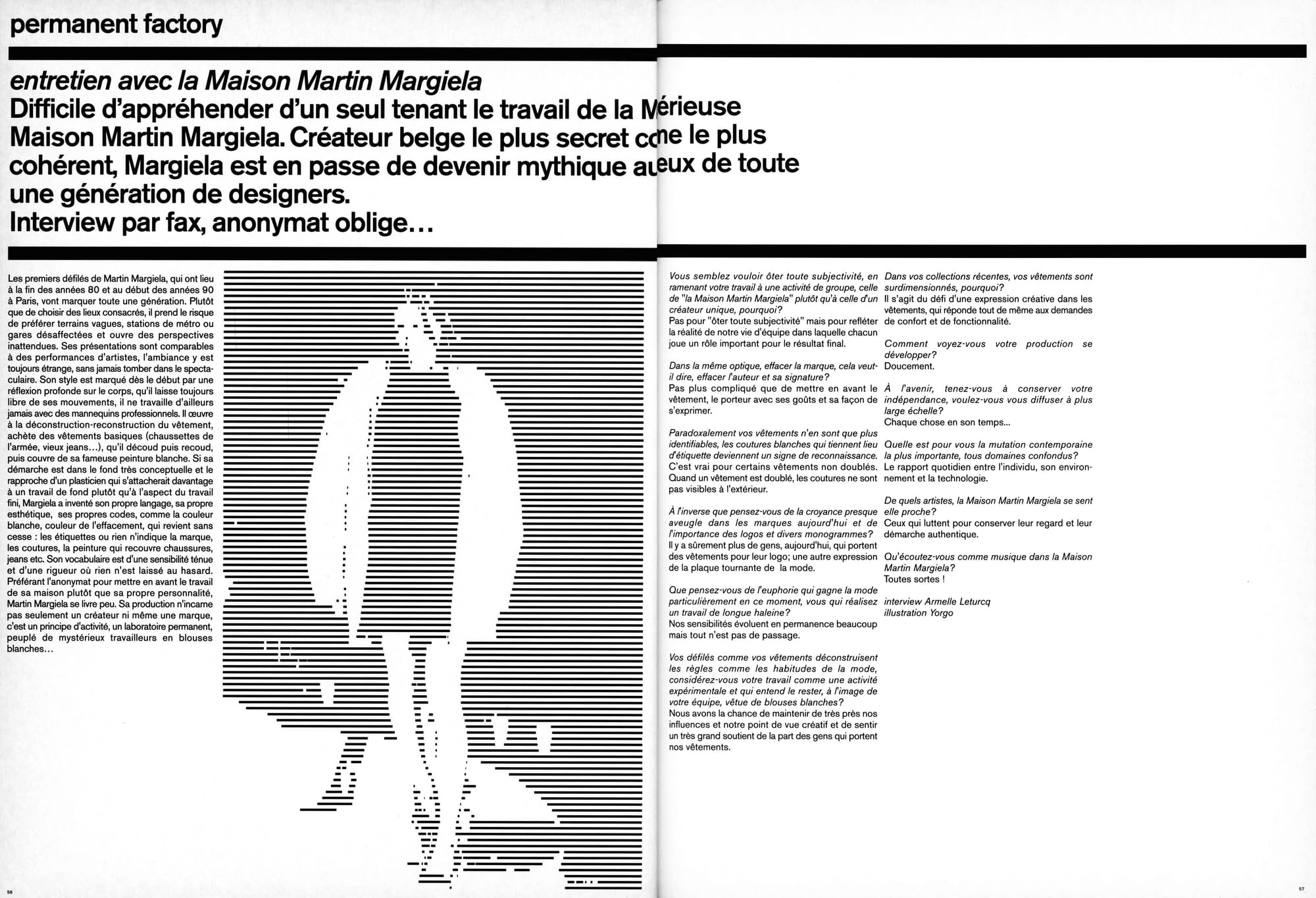
It is difficult to grasp the work of the enigmatic Maison Martin Margiela in a single view. The most secretive, yet also the most consistent, of Belgian designers, Margiela is on the verge of becoming a mythical figure in the eyes of an entire generation of designers.
Interview conducted by fax, anonymity obliges…
Interview by Armelle Leturcq
Illustration by Yorgo
Martin Margiela’s first runway shows, held in Paris in the late 1980s and early 1990s, left a mark on an entire generation. Rather than choosing established venues, he took the risk of favoring wastelands, metro stations, or disused train stations, opening up unexpected new possibilities. His presentations were comparable to artists’ performances: the atmosphere was always strange, yet never tipped into spectacle.
From the very beginning, his style was defined by a deep reflection on the body, which he always allowed complete freedom of movement; indeed, he never worked with professional models. He pursued a process of deconstructing and reconstructing clothing, buying basic garments such as army socks or old jeans, unpicking them and sewing them back together, then covering them with his famous white paint. Although his approach was fundamentally highly conceptual, and brought him close to a visual artist more concerned with the underlying work than with the finished appearance, Margiela invented his own language, his own aesthetic, and his own codes. White, the color of erasure, recurs constantly: labels that give no indication of the brand, exposed seams, paint covering shoes, jeans, and so on. His vocabulary possessed both delicate sensitivity and rigor, with nothing left to chance.
Preferring anonymity in order to foreground the work of his house rather than his own personality, Martin Margiela revealed little of himself. His output embodied not merely a designer, nor even simply a brand, but a principle of activity — a permanent laboratory populated by mysterious workers in white coats.
AL: You seem to want to remove all subjectivity, reducing your work to a group activity — that of “Maison Martin Margiela” rather than that of a single designer. Why?
MM: Not to “remove all subjectivity,” but to reflect the reality of our life as a team, in which each person plays an important role in the final result.
Full scans of Crash No. 12 2000