
'Man & Toy' Esquire December 2003
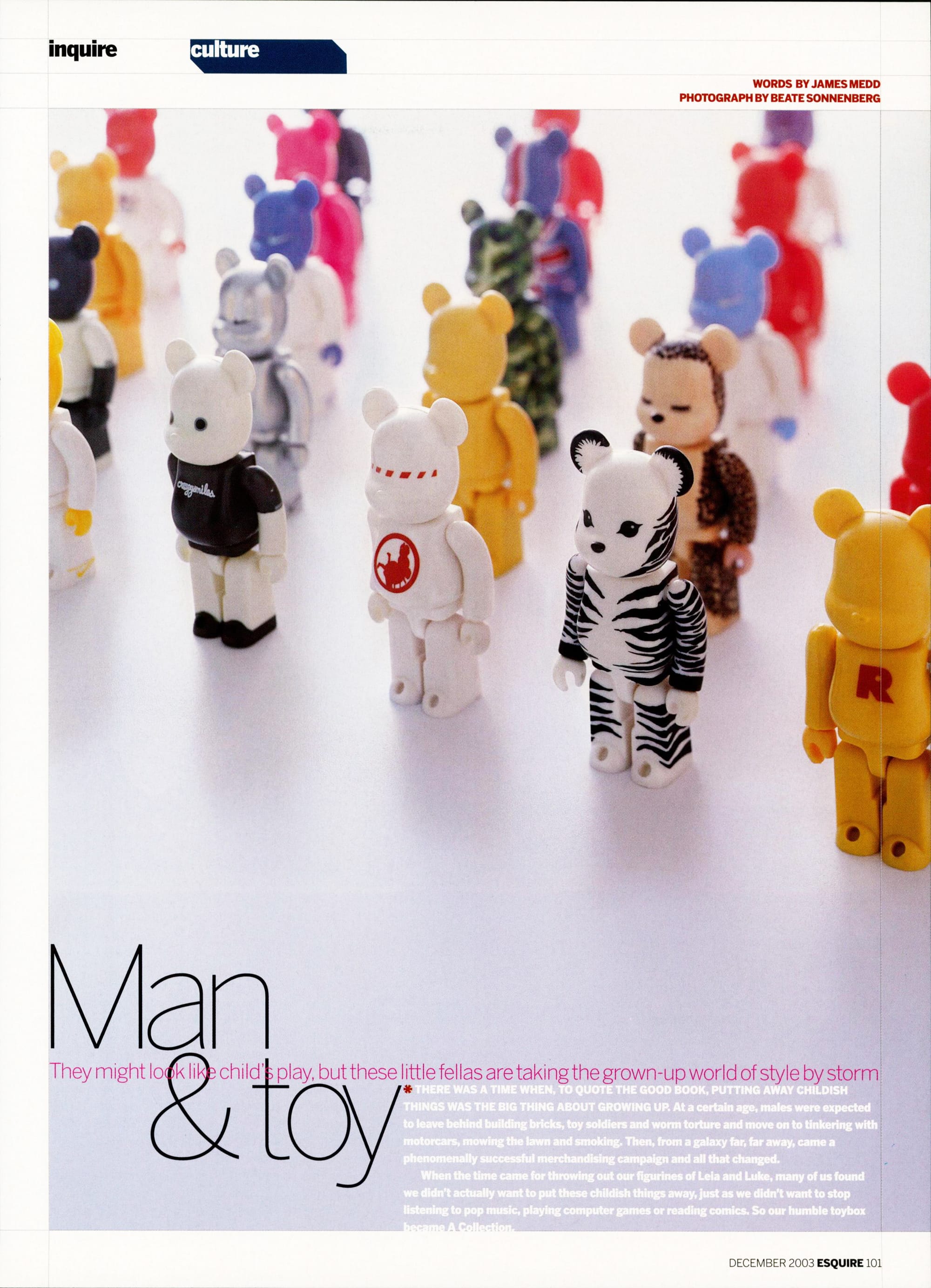
They might look like child's play, but these little fellas are taking the grown-up world of style by storm.
Writer: James Medd
Photos: Beate Sonnenberg
There was a time when, to quote the good book, putting away childish things was the big thing about growing up. At a certain age, males were expected to leave behind building bricks, toy soldiers and worm torture and move on to tinkering with motorcars, mowing the lawn and smoking. Then, from a galaxy far, far away, came a phenomenally successful merchandising campaign and all that changed.
When the time came for throwing out our figurines of Leia and Luke, many of us found we didn't actually want to put these childish things away, just as we didn't want to stop listening to pop music, playing computer games or reading comics. So our humble toybox became A collection.
Twenty-five years on, the legacy of ‘Star Wars’ (or rather, one of many) can be seen on the living-room shelves of style leaders in the worlds of fashion, design, music and advertising, in the shape of boldly cartoonish or darkly gothic models, small Lego-like characters and monsters of every size and species. And though most of them are only the size of a Player's Navy Cut, they can cost more than a decent mower.
Like many of modern life's greatest but least necessary pleasures (the Walkman, Shiatsu massage, instant noodles, those creased dogs), it came from the East. The Godzilla of the adult toy world (and it is a world) is Tokyo company Medicom, makers of two massive-selling ranges, Kubricks and Bearbricks. The Kubrick is a two-and-a-half-inch Lego-based figurine mould that is modified to portray different characters, generally drawn from iconic films or brands: Star Wars (of course), Planet of the Apes, Alien, The Great Escape, horror movies, Disney, Kellogg's and Sesame Street. For men of a certain age and disposition, the resulting combination of nostalgia and what can only be described as "dinkiness" is overwhelming.
The Bearbrick, meanwhile, was designed to appeal to girls (or rather, the fairer sex; the packaging on these things says "Ages 14 and up" - this isn't a case of adults hijacking a children's toy), with the idea that they might be scared by the sci-fi/war themes prevalent in Kubricks. It is another basic mould but, unlike the Kubrick, it is a blank canvas: the shape is constant, only the decoration changes. This gives it limitless scope. The appeal here is more rarefied; it tends to appeal to two types, the artistic and the autistic.
Both of these concepts are down to one man, Narue Oka, a toy collector himself and, like many others involved in the toy business, a big hip-hop and trainer fan. The success of Kubricks and Bearbricks has allowed Narue to delve deeper into his own interests; designs have included collaborations with graffiti artists Futura 2000 and Kaws, fashion designers Maharishi, Stüssy and A Bathing Ape and musicians UNKLE.
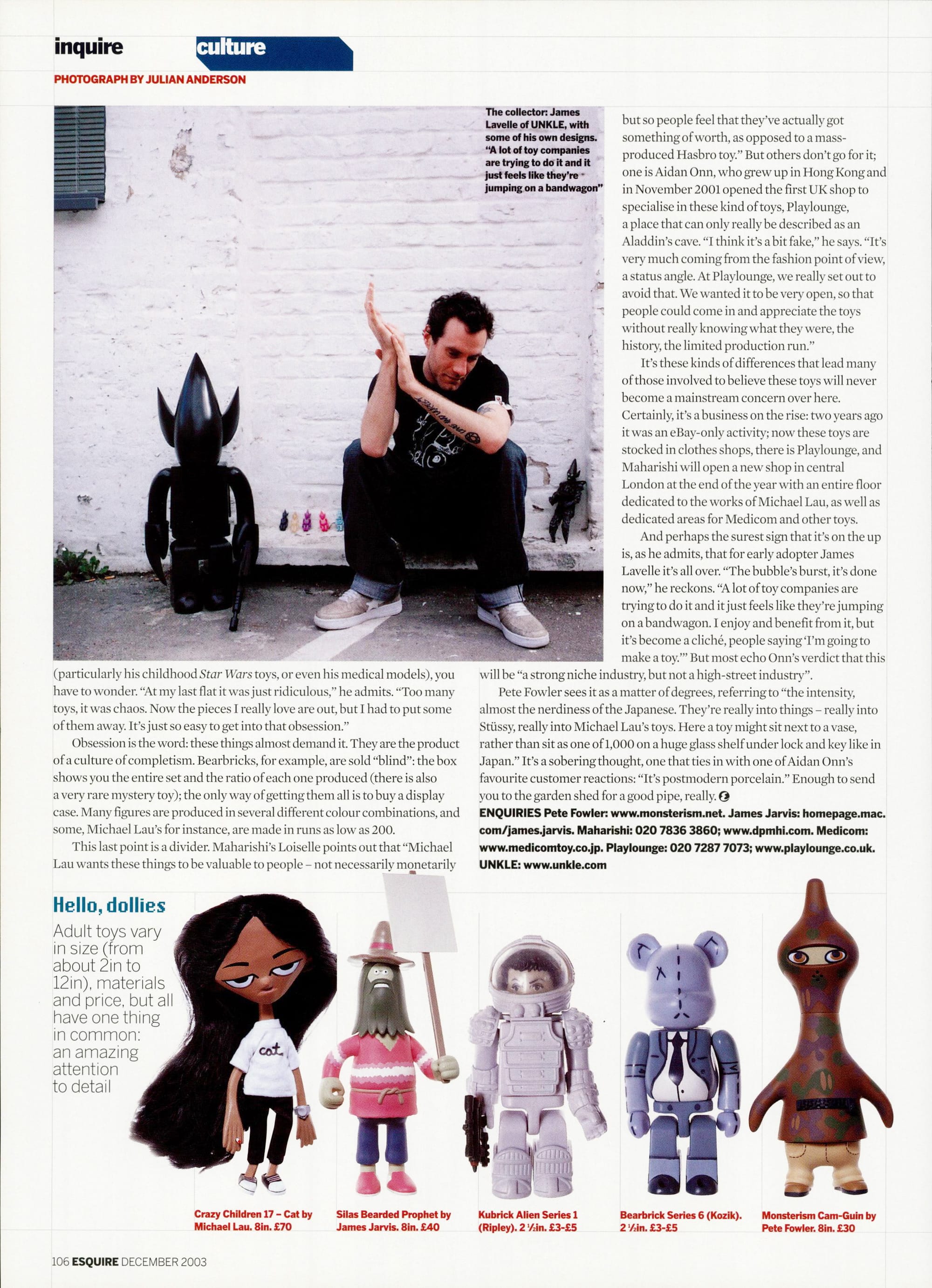
James Lavelle of UNKLE knew Narue as a fellow collector. "I love the fact that Oka has fucked around with commercial culture, and brought in these alternative things," he says. "That comes from the fact that he was into the street scene: he used to hang in clubs and be into the same sort of clothes as me, and I used to buy toys from his shop."
This is still - just - a business run by fans, and that is reflected in the high quality of the products. You can see the enthusiasm, the love, even. As Damian Loiselle, marketing manager at fashion label Maharishi, now the UK representatives for Medicom, says, "Medicom are not half-hearted. They're huge toy fans themselves, they're not cynical businessmen looking at it as a way of making an insane amount of money."
But the success of Kubricks and Bearbricks has tempted a number of other companies into the "mini-figures" business. One of the most imitated designers is Hong Kong's Michael Lau, inventor of a whole other genre called Urban Vinyl. Lau made his name with a series of one-off figures called The Gardeners, inspired by his hip-hop and skate-obsessed friends, which has become something of a holy grail for collectors. Maharishi's Loiselle explains: "In 1999, he made 99 figures and exhibited them in Perspex cubes. Every year since then he's added one or two; in 2001 it was Futura 2000 and James Lavelle, in 2002 it was [Maharishi founder] Hardy Blechman and then in 2003 it was a figure called No War - all broken up and on crutches."
The Gardeners are not for sale (though figures claiming to be from the series pop up on eBay for $8-$10,000), but Lau makes others that are. While the action figure (or "1/6 scale"), the inspiration for the Gardeners, is becoming more and more precise, his work (and Urban Vinyl generally) is heading in an increasingly abstract direction. His latest collection, The Bear One, is more reminiscent of primitive stone carving than Action Man.
Like Lau, Britain's two star toy designers, James Jarvis and Pete Fowler, started out as artists. Jarvis, a trained illustrator who cites Hergé and Richard Scarry as his chief influences, made his reputation with his cartoons for the Silas streetwear label. He has created what he calls a "potato-headed multiverse", a deceptively strict and onion-layer-complex world of which both his comic World of Pain and toy collection the In-Crowd are a part. His latest series of toys, the Ages of Metal, features versions of Ozzy Osbourne, Axl Rose and other gods of rock from an alternate, altogether cuter, dimension. "I want people to take them into their hearts," he explains. "The idea is that the different series will make up a weird collection - knights, Vikings, spacemen, Fifties bikers, zombies..." His creations are an outlet for his obsessions, which are usually rather more unusual than what he calls the "limited-edition, yo-money, hip-hop thing": future plans include religious figures, people in national dress, dictators and cavaliers and roundheads.
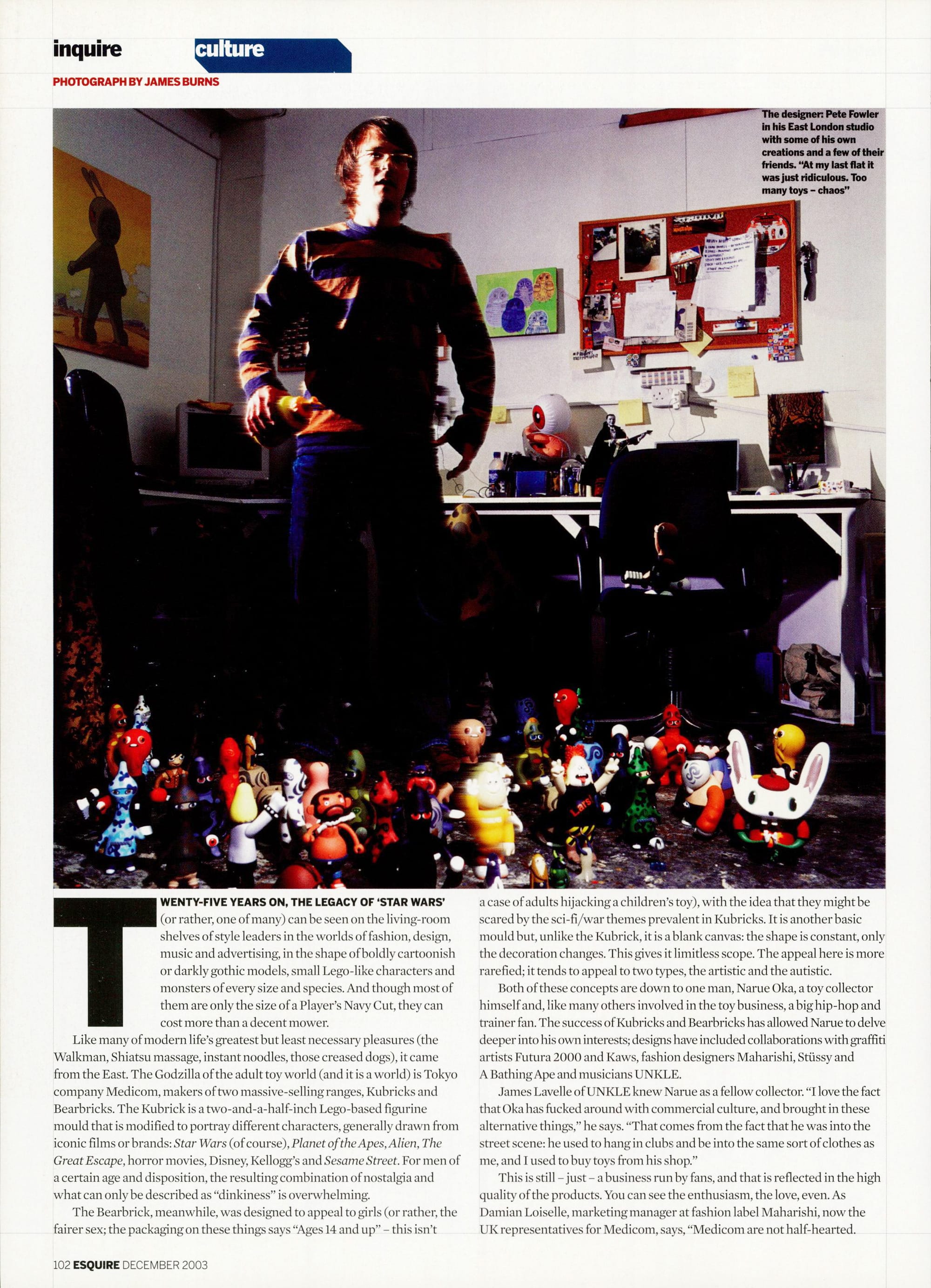
Fowler's world is called Monsterism, and is populated by hallucinogenic. brightly coloured creatures reminiscent of the results of cinema oil slides or funfair mirrors. Trained as a fine artist, Fowler developed his distinctive style as an illustrator and designer, notably for fellow Welshmen Super Furry Animals. He is now working on a pilot for a Monsterism animation series, but, unlike Jarvis, who sees the toys as merely an extension of his drawing; for him making toys is a "dream come true". He claims not to be a dedicated collector himself, but to hear him talk about his personal collection (particularly his childhood Star Wars toys, or even his medical models, you have to wonder. "At my last flat it was just ridiculous," he admits. "Too many toys, it was chaos. Now the pieces I really love are out, but I had to put some of them away. It's just so easy to get into that obsession."
Obsession is the word: these things almost demand it. They are the product of a culture of completism. Bearbricks, for example, are sold "blind": the box shows you the entire set and the ratio of each one produced (there is also a very rare mystery toy; the only way of getting them all is to buy a display case. Many figures are produced in several different colour combinations, and some, Michael Lau's for instance, are made in runs as low as 200.
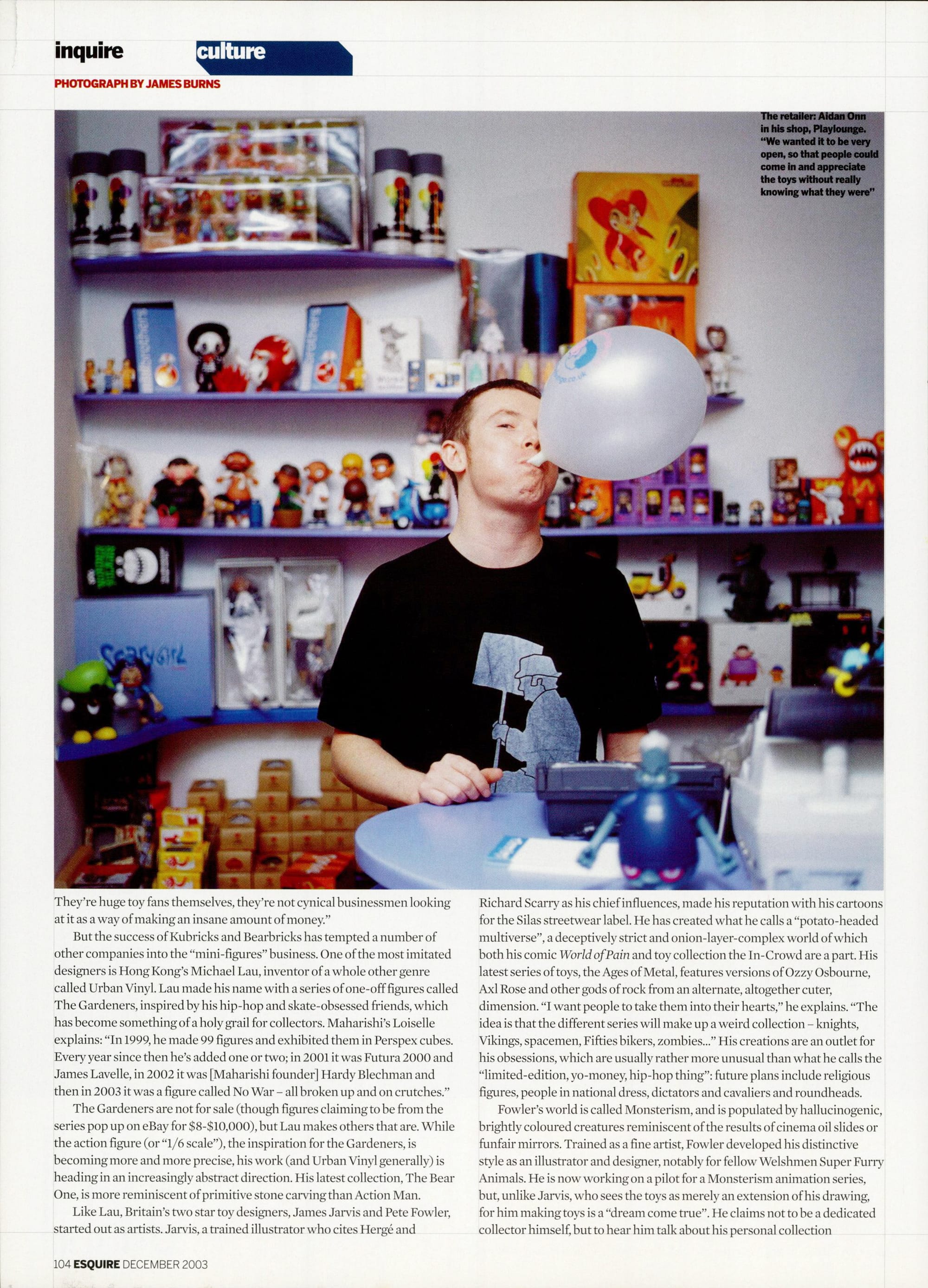
This last point is a divider. Maharishi's Loiselle points out that "Michael Lau wants these things to be valuable to people - not necessarily monetarily but so people feel that they've actually got something of worth, as opposed to a mass-produced Hasbro toy." But others don't go for it; one is Aidan Onn, who grew up in Hong Kong and in November 2001 opened the first UK shop to specialise in these kind of toys, Playlounge, a place that can only really be described as an Aladdin's cave. "I think it's a bit fake," he says. "It's very much coming from the fashion point of view, a status angle. At Playlounge, we really set out to avoid that. We wanted it to be very open, so that people could come in and appreciate the toys without really knowing what they were, the history, the limited production run."
It's these kinds of differences that lead many of those involved to believe these toys will never become a mainstream concern over here. Certainly, it's a business on the rise: two years ago it was an eBay-only activity; now these toys are stocked in clothes shops, there is Playlounge, and Maharishi will open a new shop in central London at the end of the year with an entire floor dedicated to the works of Michael Lau, as well as dedicated areas for Medicom and other toys.
And perhaps the surest sign that it's on the up is, as he admits, that for early adopter James Lavelle it's all over. "The bubble's burst, it's done now," he reckons. "A lot of toy companies are trying to do it and it just feels like they're jumping on a bandwagon. I enjoy and benefit from it, but it's become a cliché, people saying I'm going to make a toy.'" But most echo Onn's verdict that this will be "a strong niche industry, but not a high-street industry".
Pete Fowler sees it as a matter of degrees, referring to "the intensity, almost the nerdiness of the Japanese. They're really into things - really into Stüssy, really into Michael Lau's toys. Here a toy might sit next to a vase, rather than sit as one of 1,000 on a huge glass shelf under lock and key like in Japan." It's a sobering thought, one that ties in with one of Aidan On's favourite customer reactions: "It's postmodern porcelain." Enough to send you to the garden shed for a good pipe, really.