
'Issey Come, Issey Go - Naoki Takizawa' Surface Magazine January 2005
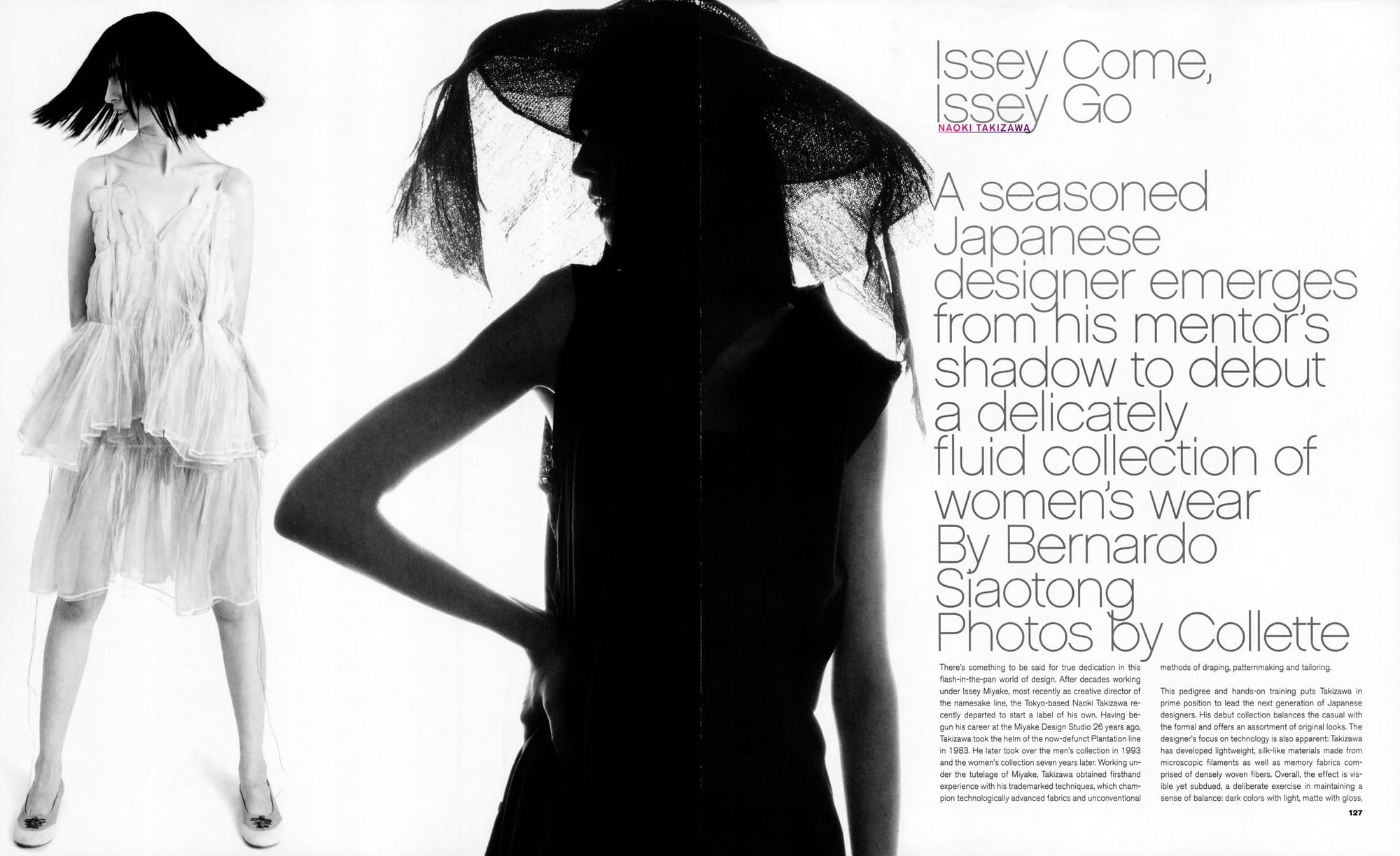
A seasoned Japanese designer emerges from his mentor's shadow to debut a delicately fluid collection of women's wear.
Text: Bernando Siotong
Photos: Collette
There's something to be said for true dedication in this flash-in-the-pan world of design. After decades working under Issey Miyake, most recently as creative director of the namesake line, the Tokyo-based Naoki Takizawa recently departed to start a label of his own. Having begun his career at the Miyake Design Studio 26 years ago, Takizawa took the helm of the now-defunct Plantation line in 1983. He later took over the men's collection in 1993 and the women's collection seven years later. Working under the tutelage of Miyake, Takizawa obtained firsthand experience with his trademarked techniques, which champion technologically advanced fabrics and unconventional methods of draping, patternmaking, and tailoring.
This pedigree and hands-on training puts Takizawa in prime position to lead the next generation of Japanese designers. His debut collection balances the casual with the formal and offers an assortment of original looks. The designer's focus on technology is also apparent: Takizawa has developed lightweight, silk-like materials made from microscopic filaments as well as memory fabrics comprised of densely woven fibers. Overall, the effect is visible yet subdued, a deliberate exercise in maintaining a sense of balance: dark colors with light, matte with gloss, masculine with feminine and sheer with opaque. "It's become a part of my DNA to blend various elements," he explains. Certainly, understanding one's past can only aid in planning one's future.
What was your first encounter with Issey Miyake?
"I was studying fashion at the Kurasawa Design School in Shibuya when I came across a shirt designed by Issey Miyake. Unlike anything at the time, it was made from one piece of fabric and was entirely idiosyncratic in its design. At that moment, I decided to work for him and develop my career as a designer."
What was it like working with such a virtuoso?
"Miyake taught me how important fabrics and research are to the design process. I also think he was the first designer to successfully create a fusion of Eastern and Western cultures in a purely visual form. When Miyake entrusted me to design the men's and women's collections, I did so by emulating his unmistakable point-of-view. Once I realized that I had to design from my own perspective and draw from my own experience, everything changed and I began to operate independently and tap into my own sense of creativity."
What are some of the key features of your new line?
"Fabric is always the starting point for me. In fact, 95 percent of the textiles used - some of which are suited for more industrial purposes - are exclusive to my line.
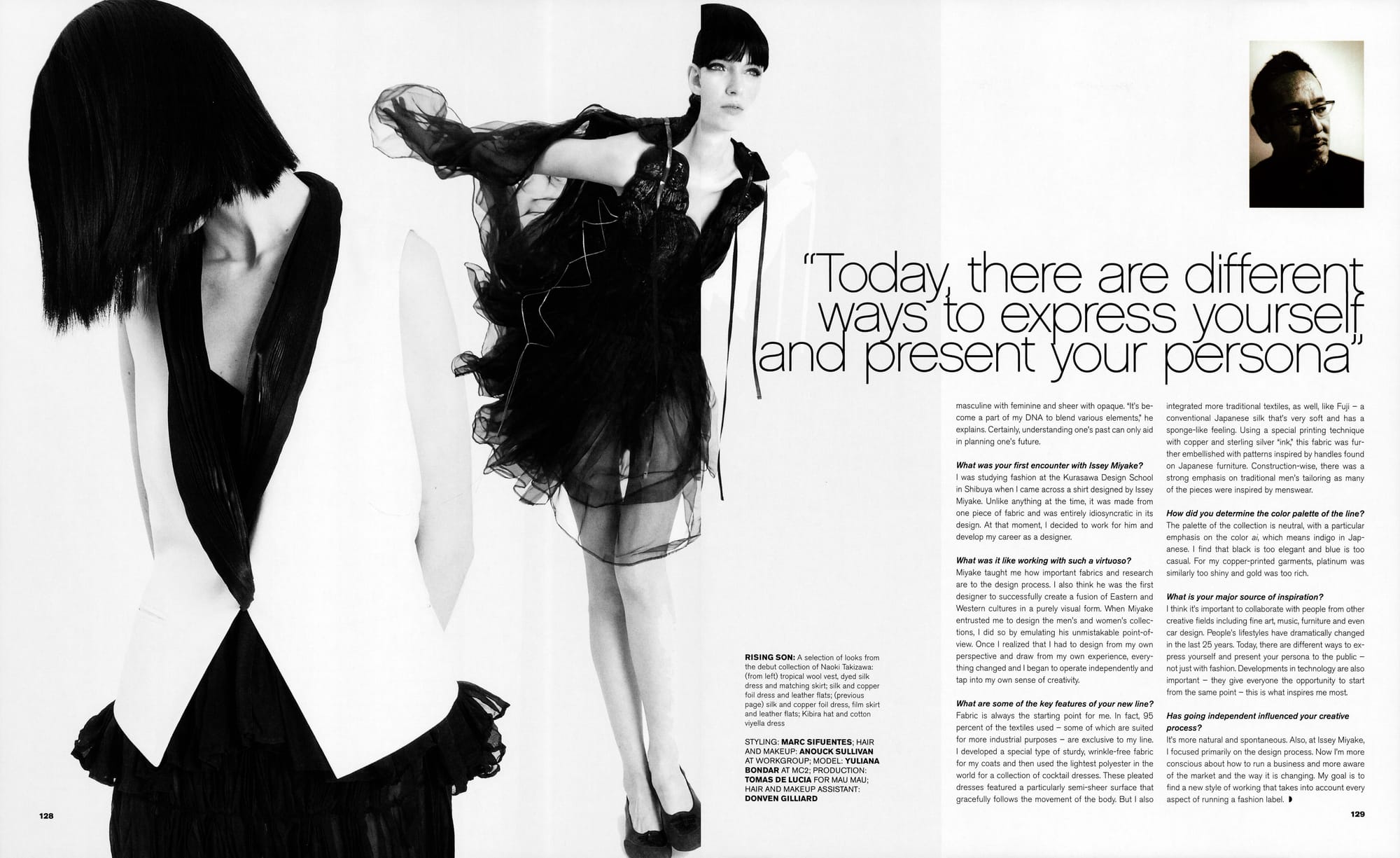
I developed a special type of sturdy, wrinkle-free fabric for my coats and then used the lightest polyester in the world for a collection of cocktail dresses. These pleated dresses featured a particularly semi-sheer surface that gracefully follows the movement of the body. But I also integrated more traditional textiles, as well, like Fuji - a conventional Japanese silk that's very soft and has a sponge-like feeling. Using a special printing technique with copper and sterling silver "ink," this fabric was further embellished with patterns inspired by handles found on Japanese furniture. Construction-wise, there was a strong emphasis on traditional men's tailoring as many of the pieces were inspired by menswear."
How did you determine the color palette of the line?
"The palette of the collection is neutral, with a particular emphasis on the color 'ai', which means indigo in Japanese. I find that black is too elegant and blue is too casual. For my copper-printed garments, platinum was similarly too shiny and gold was too rich."
What is your major source of inspiration?
"I think it's important to collaborate with people from other creative fields including fine art, music, furniture and even car design. People's lifestyles have dramatically changed in the last 25 years. Today, there are different ways to express yourself and present your persona to the public - not just with fashion. Developments in technology are also important - they give everyone the opportunity to start from the same point - this is what inspires me most."
Has going independent influenced your creative process?
"It's more natural and spontaneous. Also, at Issey Miyake, I focused primarily on the design process. Now I'm more conscious about how to run a business and more aware of the market and the way it is changing. My goal is to find a new style of working that takes into account every aspect of running a fashion label."
Rising Son: A selection of looks from the debut collection of Naoki Takizawa (from left): tropical wool vest, dyed silk dress and matching skirt; silk and copper foil dress and leather flats; (previous page) silk and copper foil dress, film skirt and leather flats; Kibira hat and cotton viyella dress.
Styling: Marc Sifuentes.
Hair and makeup: Anouck Sullivan at Workgroup.
Model: Yuliana Bondar at MC2.
Production: Tomas de Lucia for Mau Mau.
Hair and makeup assistant: Donven Gilliard.