
'Independents Day' Vogue US September 2001
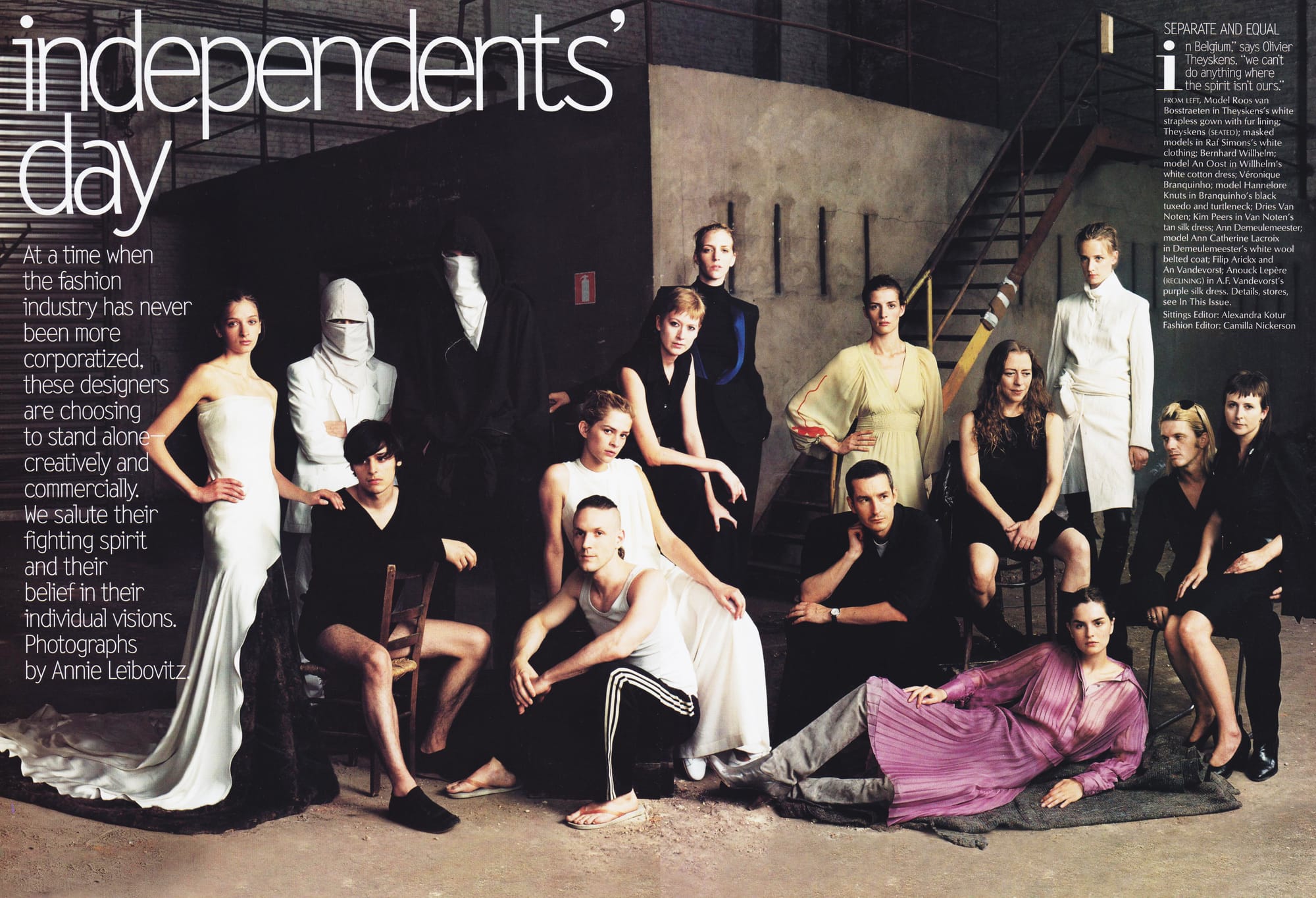
Independents Day - At a time when the fashion industry has never been more corporatized, these designers are choosing to stand alone creatively and commercially. We salute their fighting spirit and their belief in their individual visions.
Photos: Annie Leibovitz
Writer: Sally Singer
Hair: Julien D'Ys
MUA: Denise Markey for Club Monaco Cosemetics
Sittings Editor: Alexandra Kotur
Fashion Editor: Camila Nickerson
FROM LEFT, Model Roos van Bosstraeten in Theyskens's white strapless gown with fur lining: Theyskens (SEATED); masked models in Raf Simons's white clothing; Bernhard Willhelm; model An Oost in Willhelm's white cotton dress; Véronique Branquinho; model Hannelore Knuts in Branquinho's black tuxedo and turtleneck; Dries Van Noten; Kim Peers in Van Noten's tan silk dress; Ann Demeulemeester; model Ann Catherine Lacroix in Demeulemeester's white wool belted coat; Filip Arickx and An Vandevorst; Anouck Lepère (RECLINING) in A.F. Vandevorst's purple silk dress.
It's a sticky Antwerp afternoon, and An Vandevorst and Filip Arickx, the young married couple behind the label A.F. Vandevorst, have broached a sticky subject. Sipping anisette at a cafe in the city's harbor quarter, they are debating what, if anything, would induce them to sell their flourishing three-year-old company, which they wholly own. It's not, apparently, a subject they've ever debated before.
"Can I speak first?" asks An rhetorically. "Never. We have the freedom to do whatever we want, whenever." Filip is less categorical: "I wouldn't sell - but I would collaborate if it would allow me to do something that I couldn't do myself."
"But they never give only the money," An says urgently. "It's never for free." Filip shrugs and says, "If I wanted to open a store in Milan, and Gucci said, We will help you,' I would talk. Some Antwerp designers wouldn't even talk."
The question of whether or not to "collaborate" (a fashion euphemism for allowing a big corporation to control part or all of your business) is one that eventually confronts any independent designer who has succeeded in making a real name for him/herself. Just now, indie designers, like Alice in Wonderland cakes. are apparently branded with the invitation EAT ME. It has sometimes seemed, these past couple of years, that the industry has done little more than de-vour, digest, and, well, excrete itself. LVMH. for example, took a bite of John and Michael and Marc; gobbled up Fendi, Karan, Pucci, and Loewe; and regurgitated McQueen (who was swallowed by Gucci). Prada has feasted on a platter of cool, independent cupcakes: Jil Sander, Helmut Lang, Azzedine Alaia. And Gucci has, of late, been eating for two: Yves Saint Laurent, Sergio Rossi, Stella Mc-Cartney, Balenciaga.
To Tom Ford, the benefits of allowing yourself to be incorporated into a large. financially secure, and industrially well-connected supercompany are unquestionable. "You can get off the ground as an independent, but in order to compete in today's world you need a partner." Ford explains that the major conglomerates enjoy exclusive access to the best manufactories, sweet deals with retailers, niche real estate contacts, and massive marketing advantages. "If you want to stay an independent designer," he bluntly concludes, "you're going to have a product that's high-priced, low-quality, and that's not going to get into a store."
But tell that to the valiant individualists portrayed in these pages (only a sampling of a much larger group that includes such diverse but absolute talents as Giorgio Armani, Paul Smith, Vera Wang, Isabel Toledo, Clements Ribeiro, and Tuleh - not to mention Junya, Rei, and Yohii. These people spend their days and nights and weekends, and their last dollars, guilders, lire, and francs proving Ford wrong. All, without exception, have faced down the enemies of promise. All have succeeded in bringing high-quality goods to top retailers at competitive prices.
For some, it's a matter of principle. "The industrial management of fashion ultimately destroys creativity," says Roberto Cavalli, the Florentine master of chiffon tigress frocks and do-you-think-I'm-sexy printed leather jeans. "I want to stay in control of my business, to be the very heart of its creativity. Maybe I'm successful because I don't conform."
"My company taken over?" snaps Véronique Branquinho. "No way."
This commitment to aesthetic and commercial autonomy is no small feat. Make no mistake, fashion is a costly business. That knee-high granny boot you have to have this fall will have been the work of. perhaps, three leather suppliers, one hard-
ware maker, two factories, four show-rooms. A simple Ossie-ish dress? One fabric mill, one print house, one button-maker, two factories. Reversed Persian-carpet skirt with single-button, origami-constructed, ikat-print jacket by Bernhard Willhelm? Let's just say it takes a village. And an independent designer doesn't have the resources to "sample" a garment in six colors before picking just the right shade of pink. He/she can't afford to take a cut in royalties when stores put clothes on markdown a month after delivery.
"You should only set up your own company," says Hussein Chalayan, whose own has struggled to keep producing his extraordinary creations, "if you have backing or family money, or if you really have something to say. If not, it's not worth it."
The paths of nonconformity are myriad. In Belgium, for example, the go-it-alone trail was blazed in the mid-eighties, when Dries Van Noten and Ann Demeulemeester began to marry corporate and creative autonomy to wonderful effect. "When I started, there was no fashion tradition in Belgium," says Demeulemeester. "I didn't want to wait until God fell from the sky, so I did it my-self." Although only in their 40s, Van Noten and Demeulemeester have come to occupy the role of exemplars and mentors to the remarkable 20-something generation that has emerged in Antwerp and Brussels: Bernhard Willhelm, Olivier Theyskens, Véronique Branquinho, Raf Simons, and A. F. Vandevorst. The new crop has seen that it is possible to run a global business from a provincial base, and to do so without following trends at all. Dries has always done romantic Gypsy and Ann romantic punk. Thus, although Dries says that "people in Belgium have two feet on the ground," it's apparent that they're also resolute dreamers. "We can't do anything in which we don't have peace of mind, in which the spirit isn't ours.," says Theyskens.
Whereas the Belgians nearly all bank at one idiosyncratic branch of BBL in Antwerp harbor, which lends them money to produce their orders, Martin Margiela has shown it's possible to succeed without being beholden to any institution. "The garment sector is considered very high risk in France," says Maison Martin Margiela, which speaks mysteriously on behalf of its reclusive eponym. "Our company has therefore never borrowed from banks and has always operated with a zero debt." Quite a trick if you've got a turnover of nearly S16 million.
Vivienne Westwood ("I came from street fashion to become a maison") finances her corseted, bustled extravaganzas with a licensing deal in Japan. "I remember Moschino telling me before he died, 'I made a lot of money in Japan, but I had to close my eyes.'" With her track record as a cultural (Buffalo Girls were never extinct in her view) and commercial holdout, Westwood has earned the right to say, "In a world of conformity, my clothes offer a real choice. I'm proud of that."
Unlike Margiela and Westwood, who haven't spent decades constructing their brand of freedom only to sell out now. younger designers are naturally more susceptible to the opportunities presented by the conglomerates. Every week, people are being wooed for jobs; and what's on offer, more often than not, is the millionaire promise of a top job at a big house and, perhaps, most alluring of all, backing for an own-name line. Before Marc Jacobs got into bed with LVMH, his company crashed and burned repeatedly like something out of The Fast and the Furious. Today, the commercial world is at his feet, and he's able to have accessories, stores, and advertising for his Mare Jacobs and Mare lines.
Having the world at their feet holds an obvious appeal to Viktor & Rolf, who are not joking when they say, "The goal is to have a strong global presence that
consists of women's and men's accessories and perfumes our own em-pire." However, they observe, "it would be a bit a sad if nothing were possible without Prada. Gucci, and LVMH." The fate of Jil Sander also looms spectrally. She sold her name and business to Prada, only to fall out with the new proprietor within months; now the brand she had built up since the seventies, and that bears her name, has nothing to do with her. After Sander, "collaboration" looks a little less rosy than it did before.
Vandevorst and Arickx finish their cloudy drinks and bring their discussion to a close. "Sometimes, in the evenings, I ask myself, Why did I start this whole thing?'" says Arickx, who is puffing a cigarette that he and his wife are jointly smoking. "But after three years, we can really enjoy the company we started, and start suffering again." Suffering, here, means building the brand into accessories: more jewelry, more shoes, more lingerie. It turns out that they have a thriving undergarment business that Belgian manufacturers cannot handle: Every small-but-select contractor that A.F. Vandevorst works with. it seems, goes under (as it were). Suddenly the couple sees one way in which they would both be very open to partnership. "Write it in Vogue: If anyone wants to do lingerie. let them call A.F." says Arickx with a laugh.
SEPARATE AND EQUAL - In Belgium," says Olivier Theyskens, "we can't do anything where the spirit isn't ours."
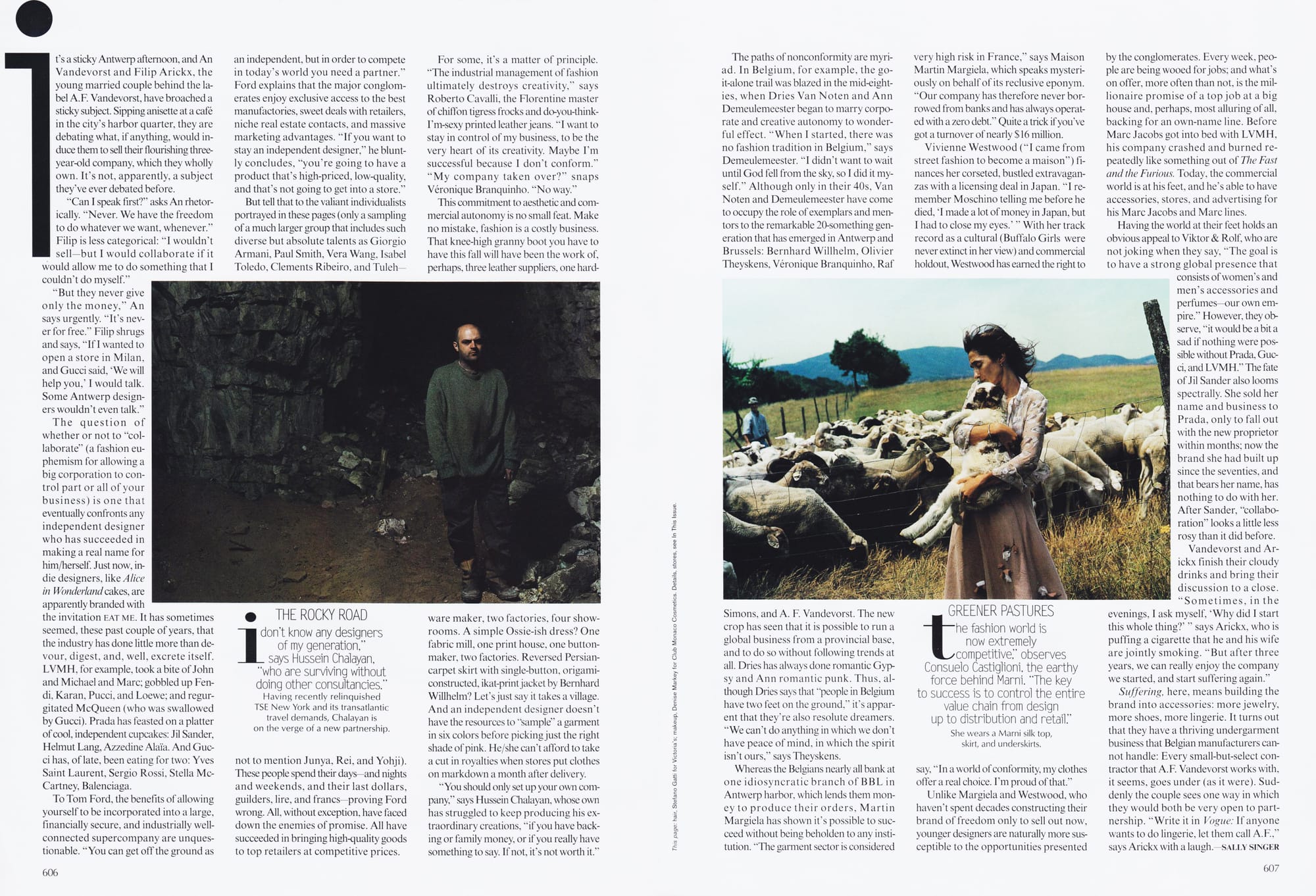
THE ROCKY ROAD - I don’t know any designers of my generation," says Hussein Chalayan "who are surviving without doing other consultancies." Having recently relinquished TSE New York and its transatlantic travel demands, Chalayan is on the verge of a new partnership.
GREENER PASTURES - "The fashion world is now extremely competitive." observes Consuelo Castiglioni. the earthy force behind Marni. "The key to success is to control the entire value chain from design up to distribution and retail." She wears a Marni silk top, skirt, and underskirts.
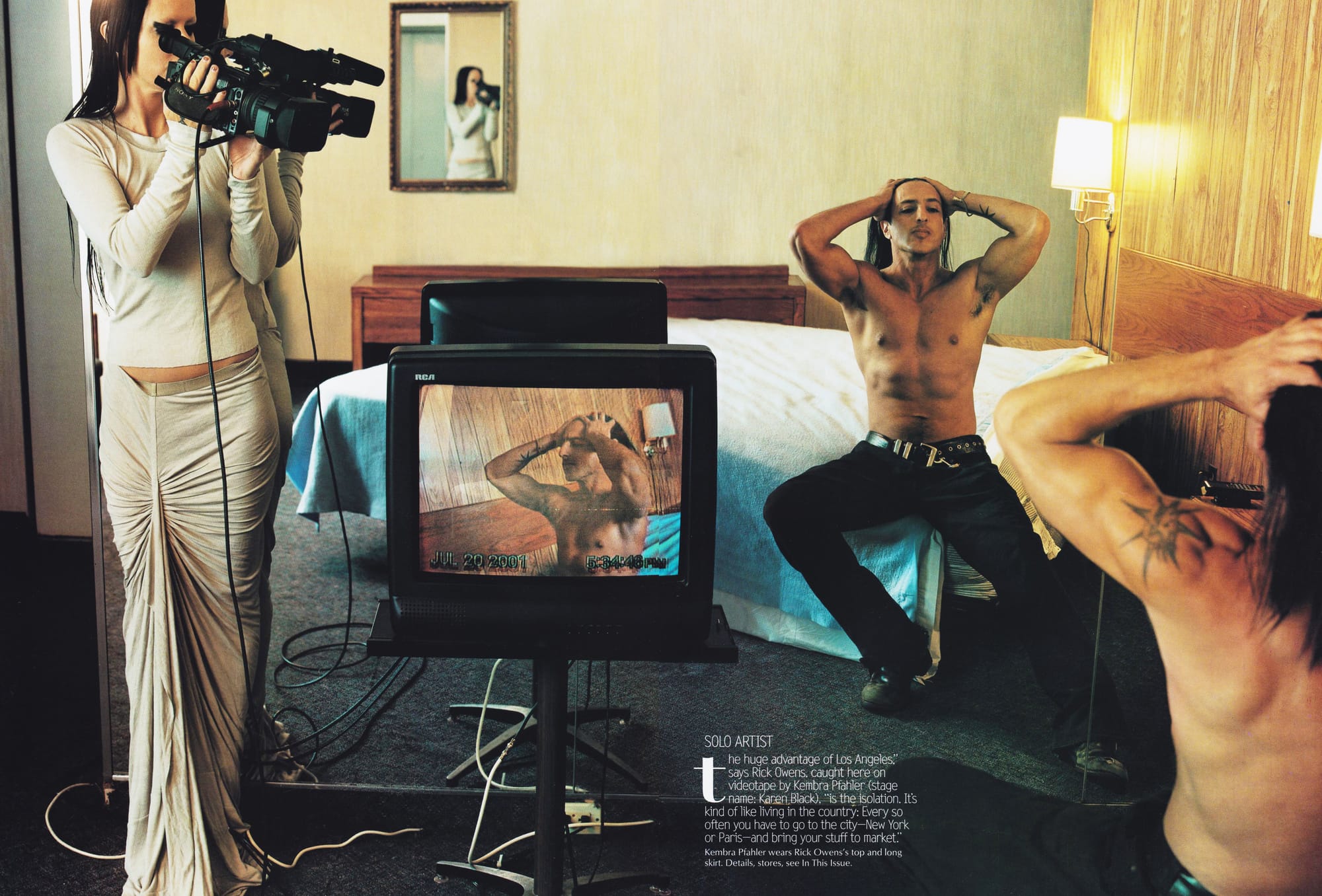
SOLO ARTIST - "The huge advantage of Los Angeles." says Rick Owens, caught here on videotape by Kembra Pfahler (stage name: Karen Black) "is the isolation. It's kind of like living in the country: Every so often you have to go to the city - New York or Paris - and bring your stuff to market." Kembra Pfahler wears Rick Owens's top and long skirt.
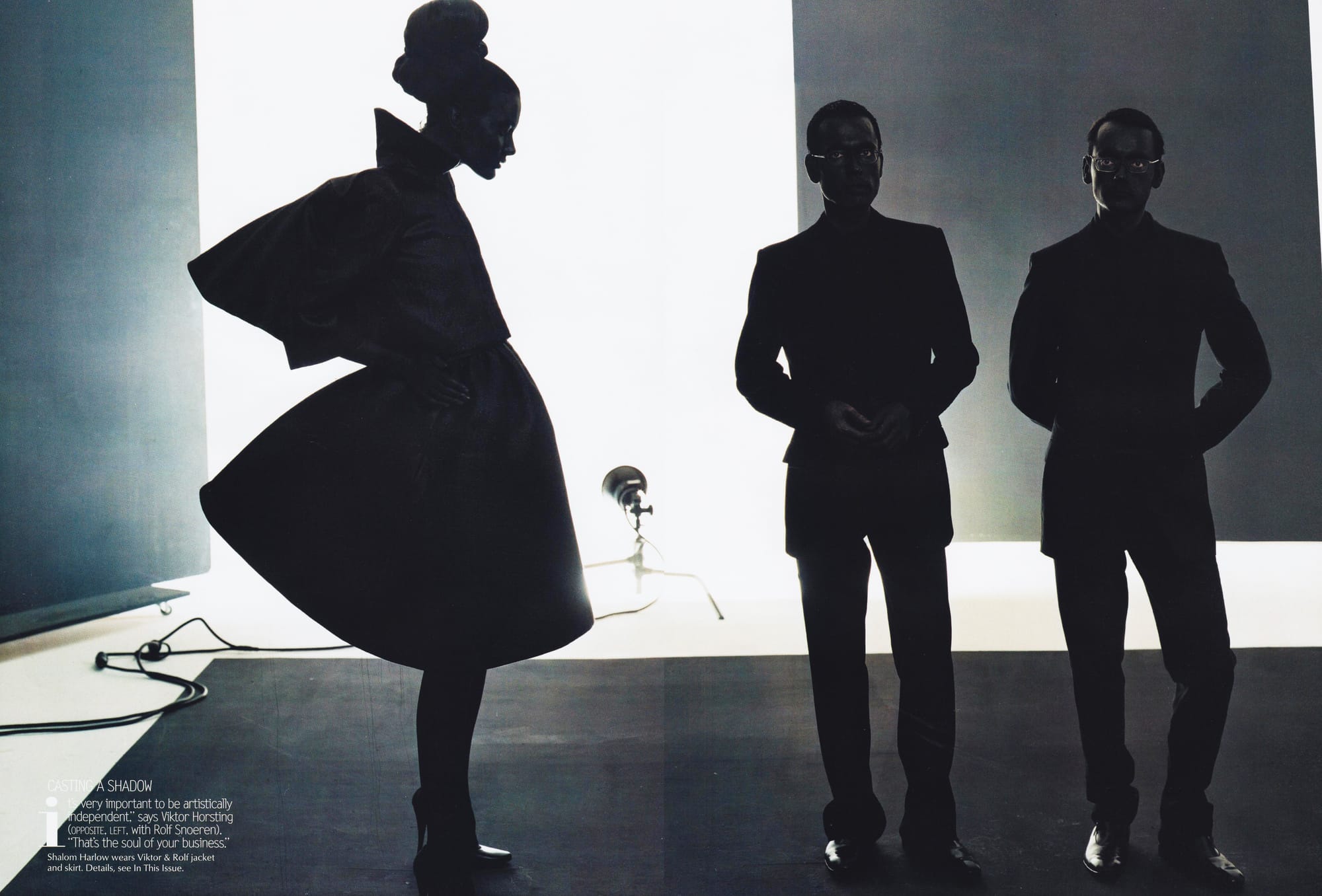
CASTING A SHADOW - "It's very important to be artistically independent," says Viktor Horsting (opposite, left, with Rolf Snoeren). "that's the soul of your business." Shalom Harlow wears Viktor & Rolf jacket and skirt.
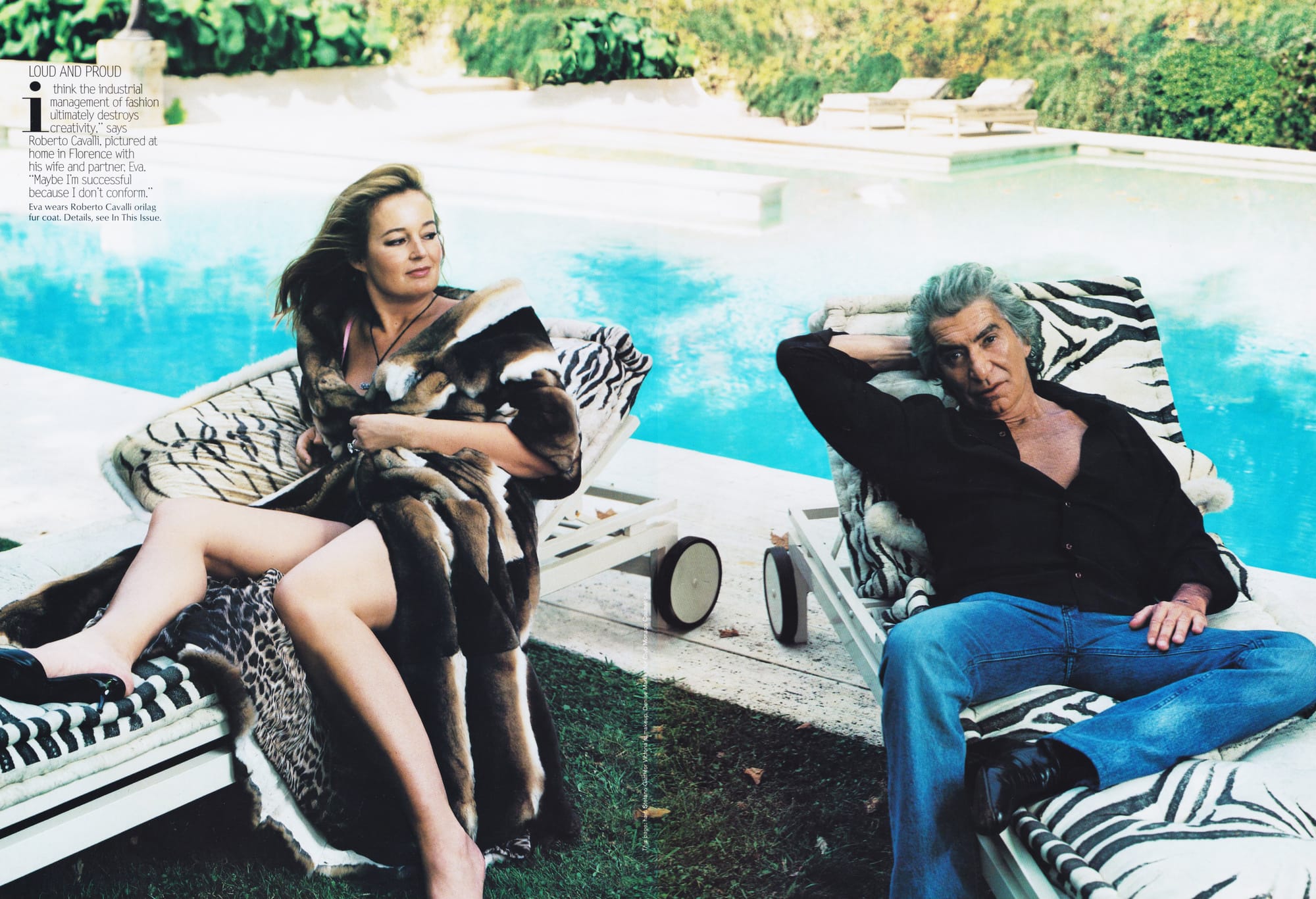
LOUD AND PROUD - "I think the industrial management of tashion ultimately destroys creativity." says Roberto Cavalhi, pictured at home in Florence with his wife and partner, Eva. "Maybe I'm successful because I don't conform." Eva wears Roberto Cavalli orilag fur coat.
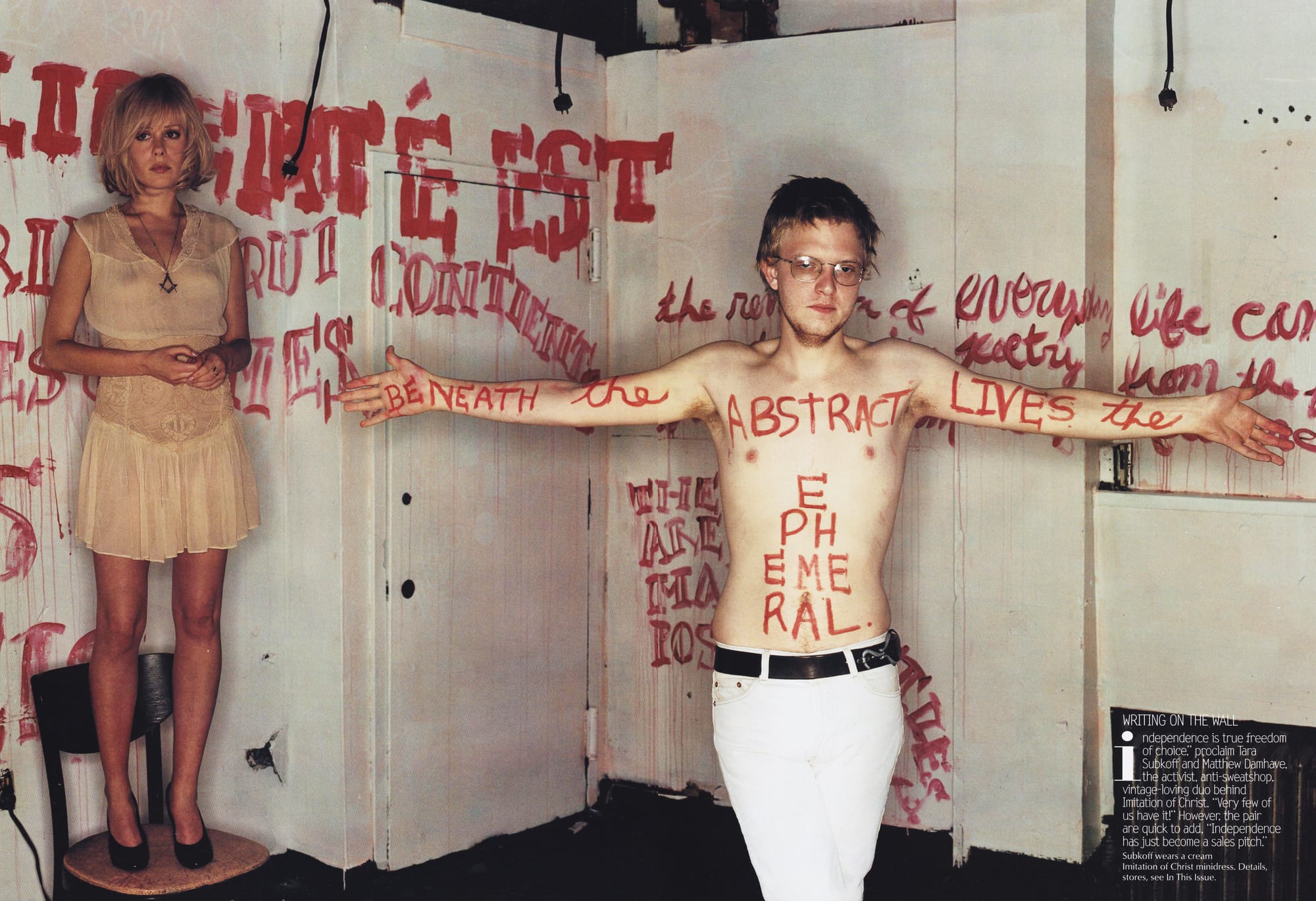
WRITING ON THE WALL - "Independence is true freedom of choice, proclaim Tara Subkoff and Matthew Damhave. The activist, anti-sweatshop, vintage-loving duo behind Imitation of Christ. "Very few of us have it!" However, the pair are quick to add, "Independence has just become a sales pitch." Subkoff wears a cream Imitation of Christ minidress.
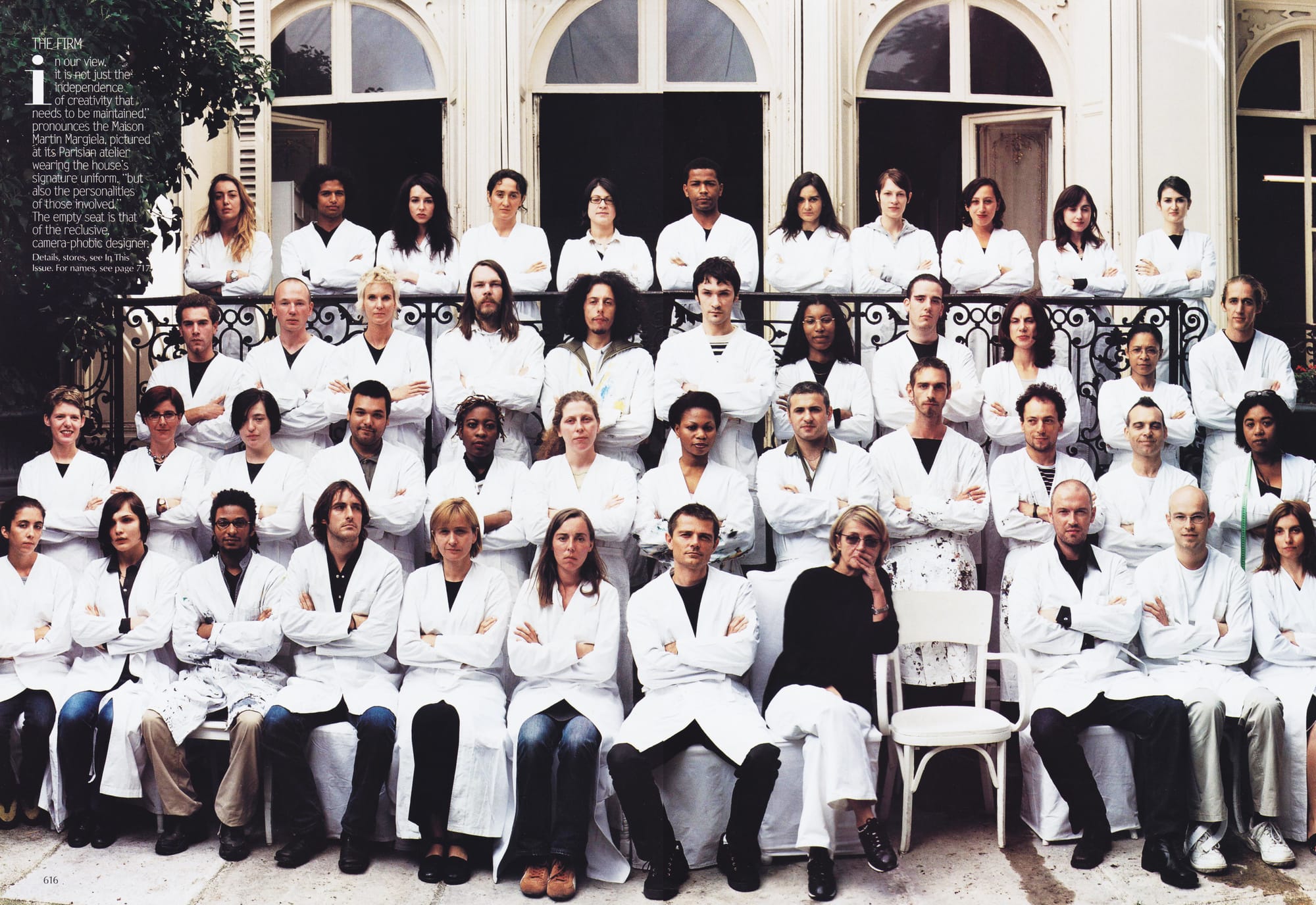
THE FIRM - In our view it is not just the independence of creativity that needs to be maintained," pronounces the Maison Martin Margiela, pictured at its Parisian atelier wearing the house's signature uniform, "but also the personalities of those involved" The empty seat is that of the reclusive, camera-phobic designer.
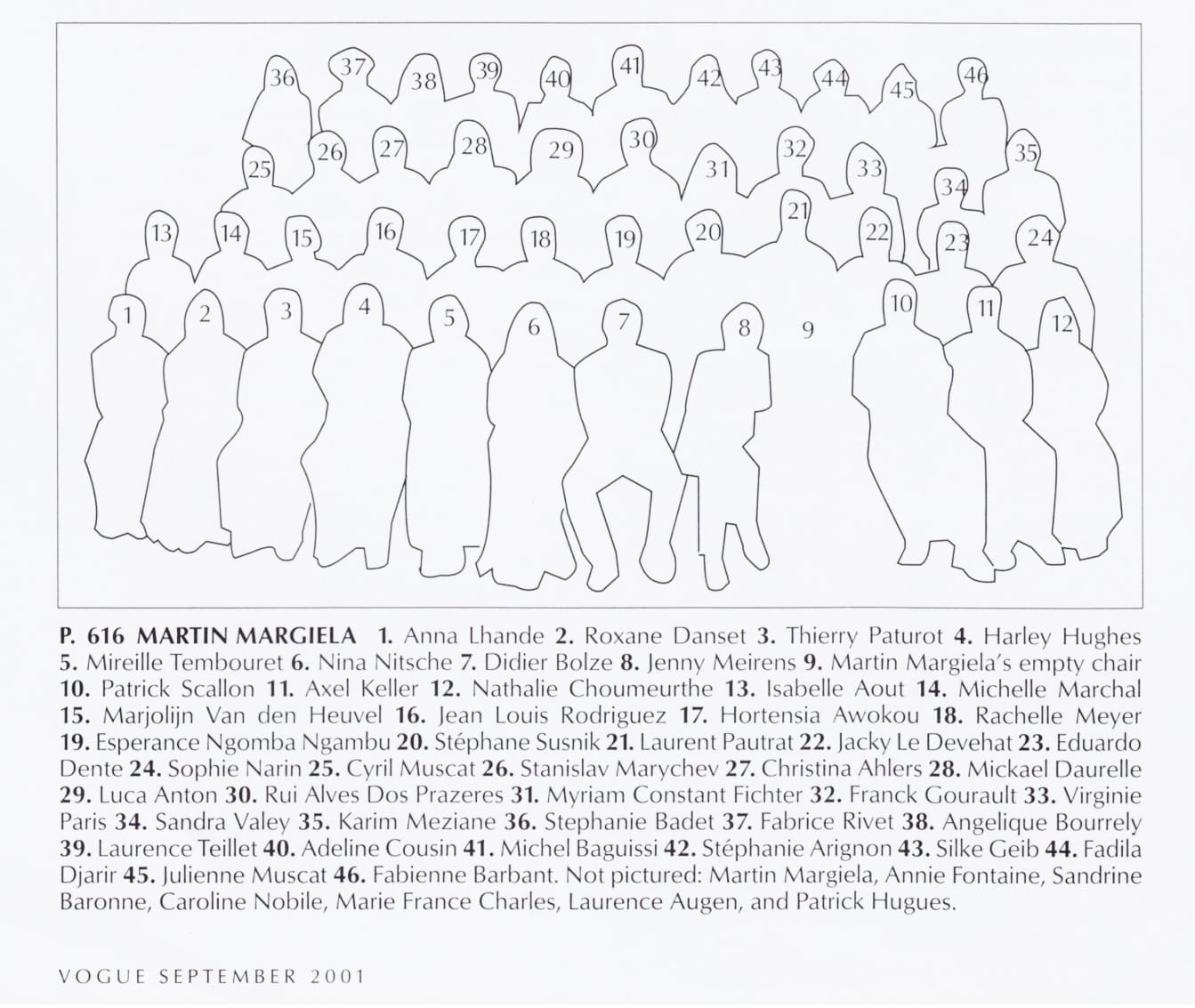
1. Anna Lhande 2. Roxane Danset 3. Thierry Paturot 4. Harley Hughes 5. Mireille Tembouret 6. Nina Nitsche 7. Didier Bolze 8. Jenny Meirens 9. Martin Margiela's empty chair 10. Patrick Scallon 11. Axel Keller 12. Nathalie Choumeurthe 13. Isabelle Aout 14. Michelle Marchal 15. Marjolijn Van den Heuvel 16. Jean Louis Rodriguez 17. Hortensia Awokou 18. Rachelle Meyer 19. Esperance Ngomba Ngambu 20. Stéphane Susnik 21. Laurent Pautrat 22. Jacky Le Devehat 23. Eduardo Dente 24. Sophie Narin 25. Cyril Muscat 26. Stanislav Marychev 27. Christina Ahlers 28. Mickael Daurelle 29. Luca Anton 30. Rui Alves Dos Prazeres 31. Myriam Constant Fichter 32. Franck Gourault 33. Virginie Paris 34. Sandra Valey 35. Karim Meziane 36. Stephanie Badet 37. Fabrice Rivet 38. Angelique Bourrely 39. Laurence Teillet 40. Adeline Cousin 41. Michel Baguissi 42. Stéphanie Arignon 43. Silke Geib 44. Fadila Djarir 45. Julienne Muscat 46. Fabienne Barbant. Not pictured: Martin Margiela, Annie Fontaine, Sandrine Baronne, Caroline Nobile, Marie France Charles, Laurence Augen, and Patrick Hugues.
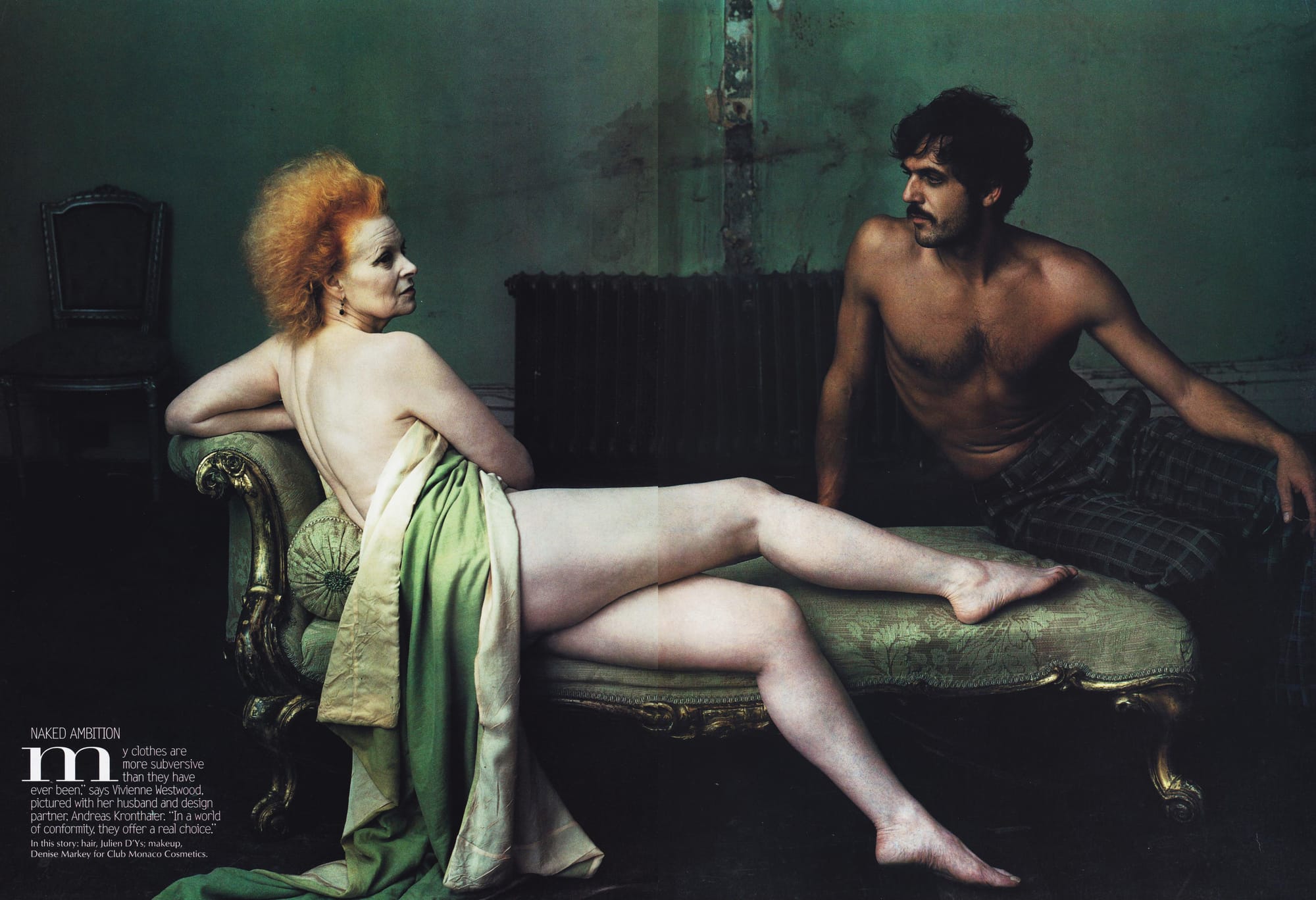
NAKED AMBITION - "My clothes are more subversive than they have ever been." says Westwood, pictured with her husband and designer partner, Andreas Kronthaler. "In a world of conformity, they offer a real choice."

Become a paid subscriber today for unlimited access!