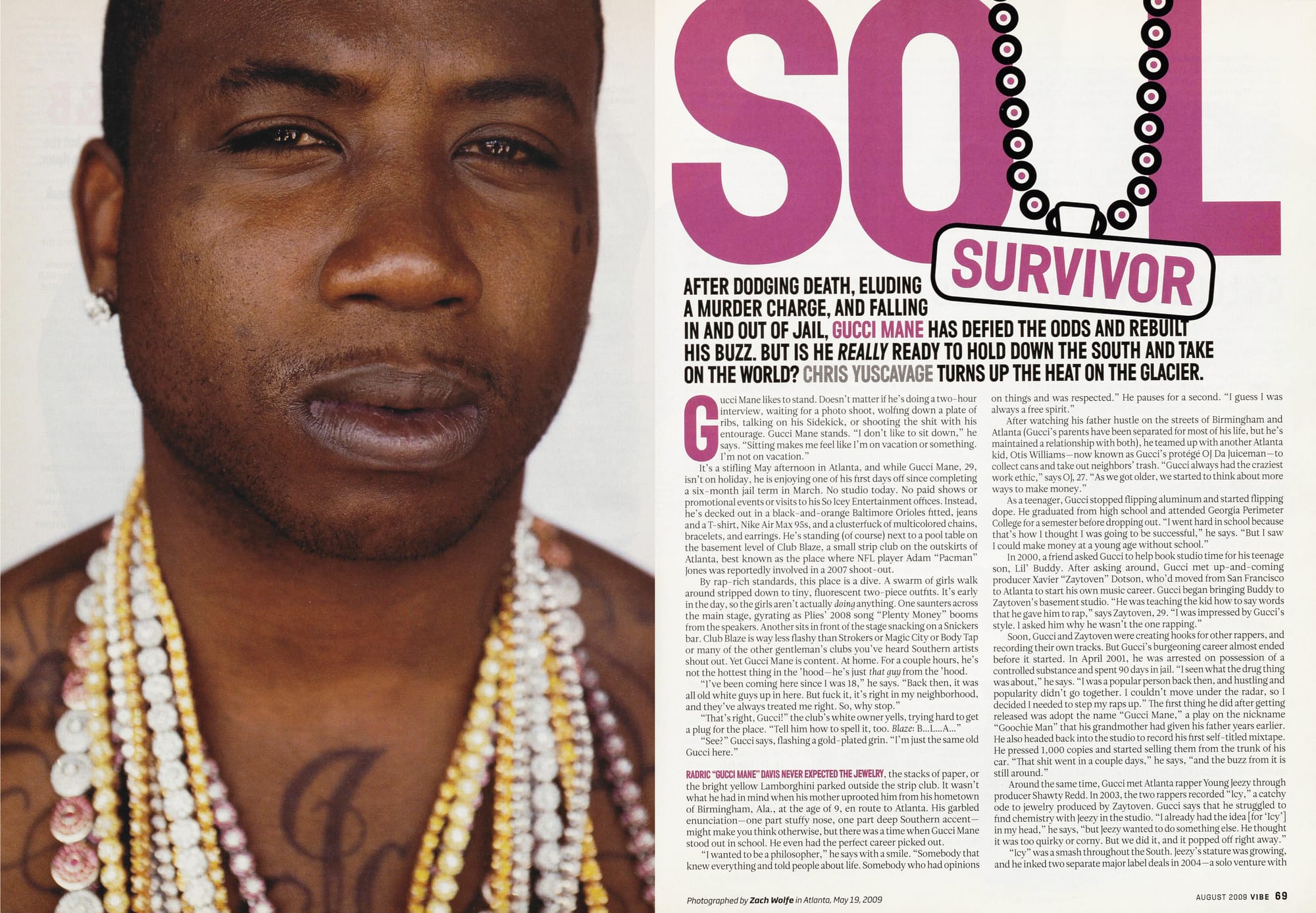
'Gucci Mane - Soul Survivor' VIBE Magazine August 2009
After dodging death, eluding a murder charge, and falling in and out of jail, Gucci Mane has defied the odds and rebuilt his buzz. But is he really ready to hold down the South and take on the world? Chris Yuscavage turns up the heat on the glacier.
Gucci Mane likes to stand. Doesn't matter if he's doing a two-hour interview, waiting for a photo shoot, wolfing down a plate of ribs, talking on his Sidekick, or shooting the shit with his entourage. Gucci Mane stands. "I don't like to sit down," he says. "Sitting makes me feel like I'm on vacation or something. I'm not on vacation.”
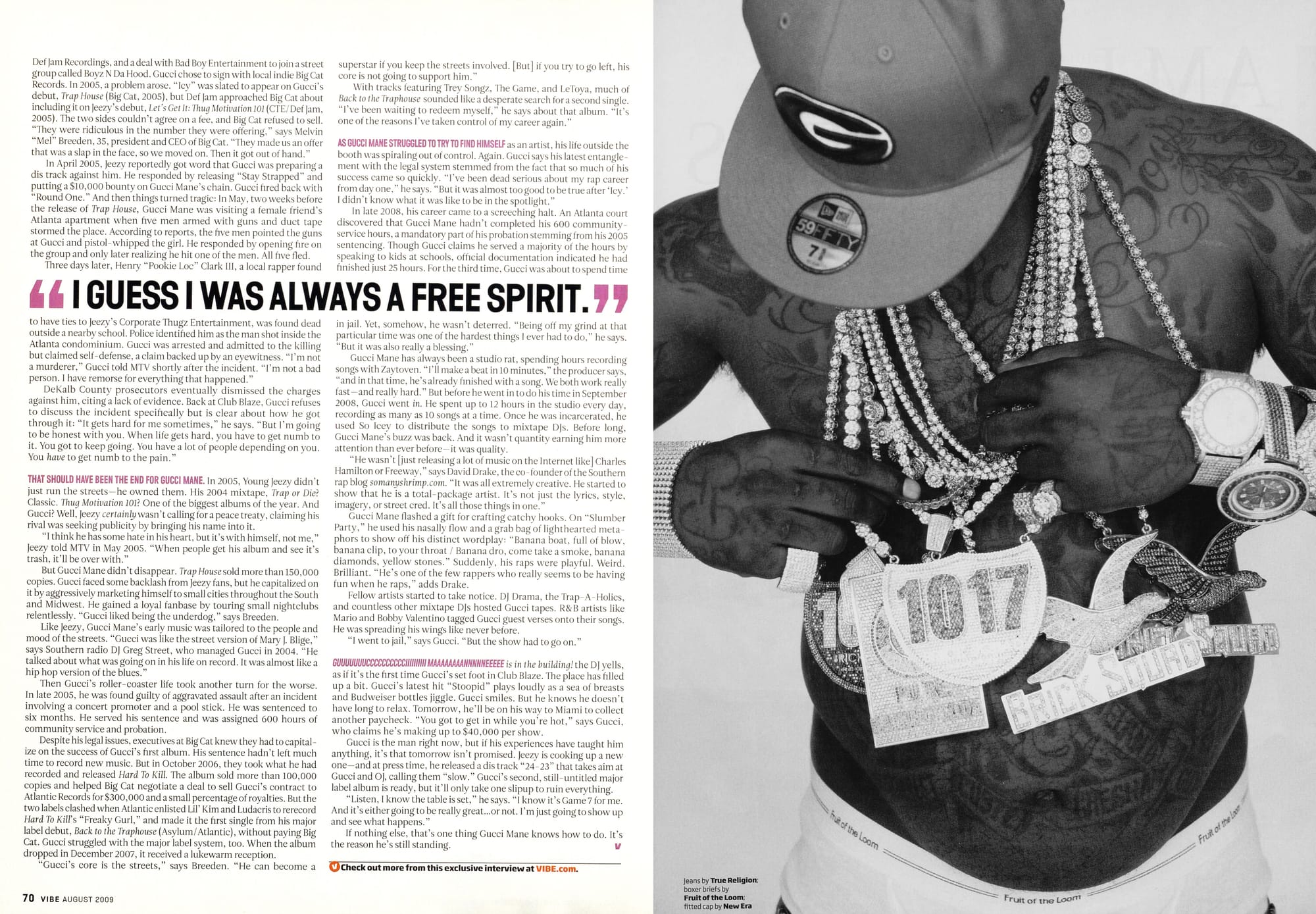
It's a stifling May afternoon in Atlanta, and while Gucci Mane, 29, isn't on holiday, he is enjoying one of his first days off since completing a six-month jail term in March. No studio today. No paid shows or promotional events or visits to his So Icey Entertainment offices. Instead, he's decked out in a black-and-orange Baltimore Orioles fitted, jeans and a T-shirt, Nike Air Max 95s, and a clusterfuck of multicolored chains, bracelets, and earrings. He's standing (of course) next to a pool table on the basement level of Club Blaze, a small strip club on the outskirts of Atlanta, best known as the place where NFL player Adam "Pacman" Jones was reportedly involved in a 2007 shoot-out.
By rap-rich standards, this place is a dive. A swarm of girls walk around stripped down to tiny, fluorescent two-piece outfits. It's early in the day, so the girls aren't actually doing anything. One saunters across the main stage, gyrating as Plies' 2008 song "Plenty Money" booms from the speakers. Another sits in front of the stage snacking on a Snickers bar. Club Blaze is way less flashy than Strokers or Magic City or Body Tap or many of the other gentleman's clubs you've heard Southern artists shout out. Yet Gucci Mane is content. At home. For a couple hours, he's not the hottest thing in the 'hood -he's just that guy from the 'hood.
"I've been coming here since I was 18," he says. "Back then, it was all old white guys up in here. But fuck it, it's right in my neighborhood, and they've always treated me right. So, why stop."
"That's right, Gucci!" the club's white owner yells, trying hard to get a plug for the place. "Tell him how to spell it, too. Blaze: B...L..A..."
"See?" Gucci says, flashing a gold-plated grin. "I’m just the same old Gucci here."
Radric "Gucci Mane" Davis never expected the jewelry, the stacks of paper, or the bright yellow Lamborghini parked outside the strip club. It wasn't what he had in mind when his mother uprooted him from his hometown of Birmingham, Ala., at the age of 9, en route to Atlanta. His garbled enunciation-one part stuffy nose, one part deep Southern accent-might make you think otherwise, but there was a time when Gucci Mane stood out in school. He even had the perfect career picked out.
"I wanted to be a philosopher," he says with a smile. "Somebody that knew everything and told people about life. Somebody who had opinions on things and was respected." He pauses for a second. "I guess I was always a free spirit.”
After watching his father hustle on the streets of Birmingham and Atlanta (Gucci's parents have been separated for most of his life, but he's maintained a relationship with both), he teamed up with another Atlanta kid, Otis Williams— now known as Gucci's protégé OJ Da Juiceman-to collect cans and take out neighbors' trash. "Gucci always had the craziest work ethic," says OJ, 27. "As we got older, we started to think about more ways to make money."
As a teenager, Gucci stopped flipping aluminum and started flipping dope. He graduated from high school and attended Georgia Perimeter College for a semester before dropping out. "I went hard in school because that's how I thought I was going to be successful," he says. "But I saw I could make money at a young age without school."
In 2000, a friend asked Gucci to help book studio time for his teenage son, Lil' Buddy. After asking around, Gucci met up-and-coming producer Xavier "Zaytoven" Dotson, who'd moved from San Francisco to Atlanta to start his own music career. Gucci began bringing Buddy to Zaytoven's basement studio. "He was teaching the kid how to say words that he gave him to rap," says Zaytoven, 29. "I was impressed by Gucci's style. I asked him why he wasn't the one rapping."
Soon, Gucci and Zaytoven were creating hooks for other rappers, and recording their own tracks. But Gucci's burgeoning career almost ended before it started. In April 2001, he was arrested on possession of a controlled substance and spent 90 days in jail. "I seen what the drug thing was about," he says. "I was a popular person back then, and hustling and popularity didn't go together. I couldn't move under the radar, so l decided I needed to step my raps up." The first thing he did after getting released was adopt the name "Gucci Mane," a play on the nickname "Goochie Man" that his grandmother had given his father years earlier.
He also headed back into the studio to record his first self-titled mixtape. He pressed 1,000 copies and started selling them from the trunk of his car.
"That shit went in a couple days," he says, "and the buzz from it is still around."
Around the same time, Gucci met Atlanta rapper Young Jeezy through producer Shawty Redd. In 2003, the two rappers recorded "Icy," a catchy ode to jewelry produced by Zaytoven. Gucci says that he struggled to find chemistry with Jeezy in the studio. "I already had the idea for 'Icy'] in my head," he says, but Jeezy wanted to do something else. He thought it was too quirky or corny. But we did it, and it popped off right away."
"Icy" was a smash throughout the South. Jeezy's stature was growing, and he inked two separate major label deals in 2004— a solo venture with Det Jam Recordings, and a deal with Bad Boy Entertainment to join a street group called Boyz N Da Hood. Gucci chose to sign with local indie Big Cat Records. In 2005, a problem arose. "Icy" was slated to appear on Gucci's debut, Trap House (Big Cat, 2005), but Def Jam approached Big Cat about including it on Jeezy's debut, Let's Get It: Thug Motivation 101 (CTE/Def Jam, 2005). The two sides couldn't agree on a fee, and Big Cat refused to sell. "They were ridiculous in the number they were offering," says Melvin "Mel" Breeden, 35, president and CEO of Big Cat. "They made us an offer that was a slap in the face, so we moved on. Then it got out of hand."
In April 2005, Jeezy reportedly got word that Gucci was preparing a dis track against him. He responded by releasing "Stay Strapped" and putting a $10,000 bounty on Gucci Mane's chain. Gucci fired back with "Round One." And then things turned tragic: In May, two weeks before the release of Trap House, Gucci Mane was visiting a female friend's Atlanta apartment when five men armed with guns and duct tape stormed the place. According to reports, the five men pointed the guns at Gucci and pistol-whipped the girl. He responded by opening fire on the group and only later realizing he hit one of the men. All five fled.
Three days later, Henry "Pookie Loc" Clark III, a local rapper found to have ties to Jeezy's Corporate Thugz Entertainment, was found dead outside a nearby school. Police identified him as the man shot inside the Atlanta condominium. Gucci was arrested and admitted to the killing but claimed self-defense, a claim backed up by an eyewitness. "I'm not a murderer," Gucci told MTV shortly after the incident. "I'm not a bad person. I have remorse for everything that happened."
DeKalb County prosecutors eventually dismissed the charges against him, citing a lack of evidence. Back at Club Blaze, Gucci refuses to discuss the incident specifically but is clear about how he got through it: "It gets hard for me sometimes," he says. "But I'm going to be honest with you. When life gets hard, you have to get numb to it. You got to keep going. You have a lot of people depending on you. You have to get numb to the pain."
That should have been the end for Gucci Mane. In 2005, Young Jeezy didn't just run the streets-he owned them. His 2004 mixtape, Trap or Die? Classic. Thug Motivation 101? One of the biggest albums of the year. And Gucci? Well, Jeezy certainly wasn't calling for a peace treaty, claiming his rival was seeking publicity by bringing his name into it.
"I think he has some hate in his heart, but it's with himself, not me," Jeezy told MTV in May 2005. "When people get his album and see it's trash, it'll be over with."
But Gucci Mane didn't disappear. Trap House sold more than 150,000 copies. Gucci faced some backlash from Jeezy fans, but he capitalized on it by aggressively marketing himself to small cities throughout the South and Midwest. He gained a loyal fanbase by touring small nightclubs relentlessly. "Gucci liked being the underdog," says Breeden.
Like Jeezy, Gucci Mane's early music was tailored to the people and mood of the streets. "Gucci was like the street version of Mary ]. Blige, says Southern radio DJ Greg Street, who managed Gucci in 2004. "He talked about what was going on in his life on record. It was almost like a hip hop version of the blues.
Then Gucci's roller-coaster life took another turn for the worse. In late 2005, he was found guilty of aggravated assault after an incident involving a concert promoter and a pool stick. He was sentenced to six months. He served his sentence and was assigned 600 hours of community service and probation.
Despite his legal issues, executives at Big Cat knew they had to capitalize on the success of Gucci's first album. His sentence hadn't left much time to record new music. But in October 2006, they took what he had recorded and released Hard To Kill. The album sold more than 100,000 copies and helped Big Cat negotiate a deal to sell Gucci's contract to Atlantic Records for $300,000 and a small percentage of royalties. But the two labels clashed when Atlantic enlisted Lil' Kim and Ludacris to rerecord Hard To Kill's "Freaky Gurl," and made it the first single from his major label debut, Back to the Traphouse (Asylum/Atlantic, without paying Big Cat. Gucci struggled with the major label system, too. When the album dropped in December 2007, it received a lukewarm reception.
"Gucci's core is the streets," says Breeden. "He can become a superstar if you keep the streets involved. [But] if you try to go left, his core is not going to support him.
With tracks featuring Trey Songz, The Game, and LeToya, much of Back to the Traphouse sounded like a desperate search for a second single. "I've been waiting to redeem myself," he says about that album. "It's one of the reasons I've taken control of my career again."
As Gucci Mane struggled to find himself as an artist, his life outside the booth was spiraling out of control. Again. Gucci says his latest entanglement with the legal system stemmed from the fact that so much of his success came so quickly. "I've been dead serious about my rap career from day one," he says. "But it was almost too good to be true after 'Icy.' I didn't know what it was like to be in the spotlight."
In late 2008, his career came to a screeching halt. An Atlanta court discovered that Gucci Mane hadn't completed his 600 community-service hours, a mandatory part of his probation stemming from his 2005 sentencing. Though Gucci claims he served a majority of the hours by speaking to kids at schools, official documentation indicated he had finished just 25 hours. For the third time, Gucci was about to spend time in jail. Yet, somehow, he wasn't deterred. "Being off my grind at that particular time was one of the hardest things I ever had to do," he says. "But it was also really a blessing."
Gucci Mane has always been a studio rat, spending hours recording songs with Zaytoven. "I'll make a beat in 10 minutes," the producer says, "and in that time, he's already finished with a song. We both work really fast —and really hard." But before he went in to do his time in September 2008, Gucci went in. He spent up to 12 hours in the studio every day, recording as many as 10 songs at a time. Once he was incarcerated, he used So Icey to distribute the songs to mixtape Djs. Before long, Gucci Mane's buzz was back. And it wasn't quantity earning him more attention than ever before-it was quality.
"He wasn't [just releasing a lot of music on the Internet like| Charles Hamilton or Freeway," says David Drake, the co-founder of the Southern rap blog somanyshrimp.com. "It was all extremely creative. He started to show that he is a total-package artist. It's not just the lyrics, style, imagery, or street cred. It's all those things in one.
Gucci Mane flashed a gift for crafting catchy hooks. On "Slumber Party," he used his nasally flow and a grab bag of lighthearted metaphors to show off his distinct wordplay: "Banana boat, full of blow, banana clip, to your throat / Banana dro, come take a smoke, banana diamonds, yellow stones." Suddenly, his raps were playful. Weird. Brilliant. "He's one of the few rappers who really seems to be having fun when he raps," adds Drake.
Fellow artists started to take notice. DJ Drama, the Trap-A-Holics, and countless other mixtape DJs hosted Gucci tapes. R&B artists like Mario and Bobby Valentino tagged Gucci guest verses onto their songs. He was spreading his wings like never before.
"I went to jail," says Gucci. "But the show had to go on."
GUUUUUUUCCCCCCCCCCIHIIIIII MAAAAAAAANNNNNEEEEE is in the building! the DJ yells, as if it's the first time Gucci's set foot in Club Blaze. The place has filled up a bit. Gucci's latest hit "Stoopid" plays loudly as a sea of breasts and Budweiser bottles jiggle. Gucci smiles. But he knows he doesn't have long to relax. Tomorrow, he'll be on his way to Miami to collect another paycheck. "You got to get in while you're hot," says Gucci, who claims he's making up to $40,000 per show.
Gucci is the man right now, but if his experiences have taught him anything, it's that tomorrow isn't promised. Jeezy is cooking up a new one-and at press time, he released a diss track "24-23" that takes aim at Gucci and Oj, calling them "slow." Gucci's second, still-untitled major label album is ready, but it'll only take one slipup to ruin everything.
"Listen, I know the table is set," he says. "I know it's Game 7 for me. And it's either going to be really great...or not. I'm just going to show up and see what happens."
If nothing else, that's one thing Gucci Mane knows how to do. It's the reason he's still standing.