
'Groove Armada' GQ February 2002
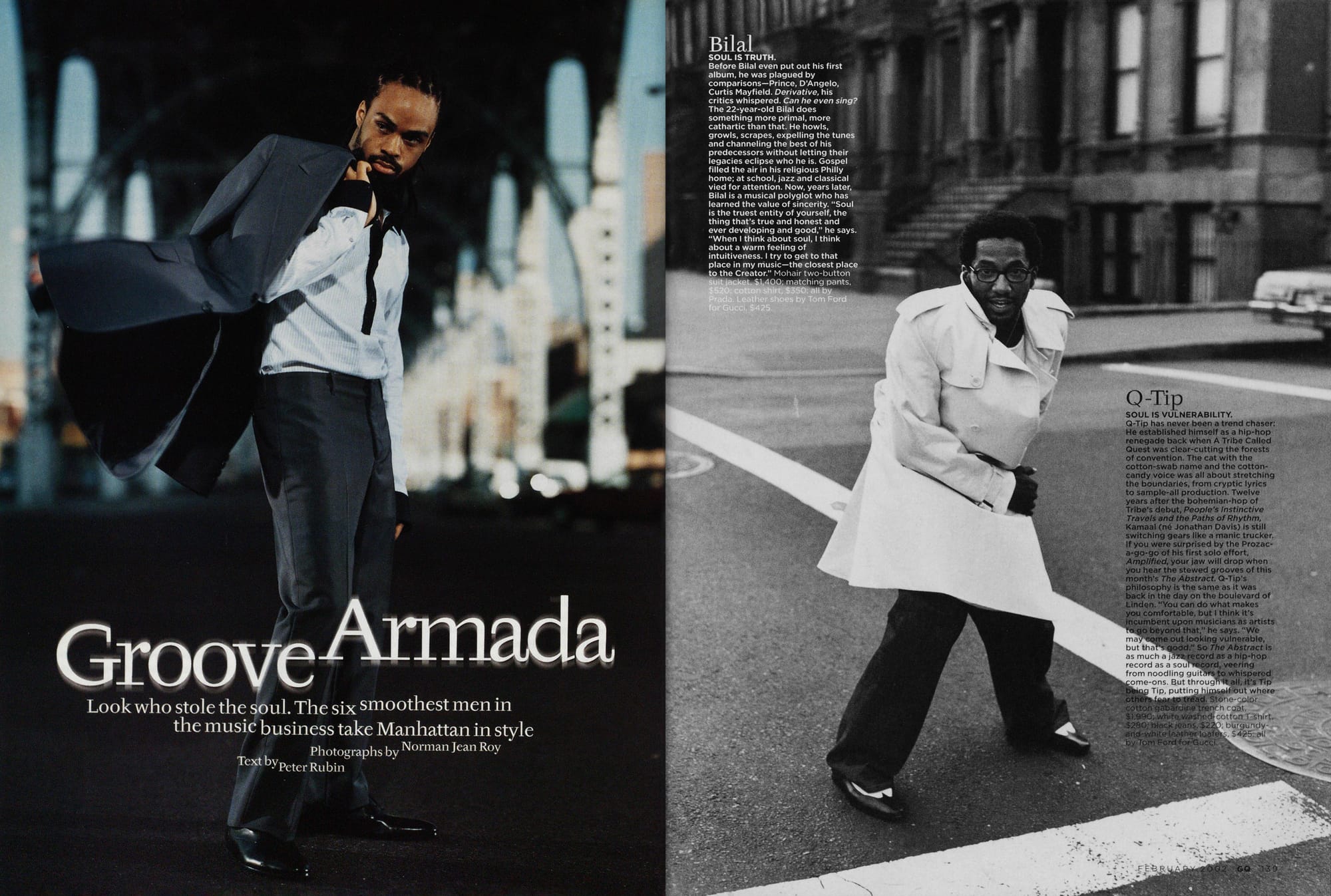
Look who stole the soul. The six smoothest men in the music business take Manhattan in style.
Photographer: Norman Jean Ray
Text: Peter Rubin
Bilal
SOUL IS TRUTH.
Before Bilal even put out his first album, he was plagued by comparisons—Prince, D’Angelo, Curtis Mayfield. Derivative, his critics whispered. Can he even sing?
The 22-year-old Bilal does something more primal, more cathartic than that. He howls, growls, scrapes, expelling the tunes and channeling the best of his predecessors without letting their legacies eclipse who he is. Gospel filled the air in his religious Philly home; at school, jazz and classical vied for attention.
Now, years later, Bilal is a musical polyglot who has learned the value of sincerity.
“Soul is the truest entity of yourself—the thing that’s true and honest and ever-developing and good,” he says.
“When I think about soul, I think about a warm feeling of intuitiveness. I try to get to that place in my music—the closest place to the Creator.”
Mohair two-button suit jacket, $1,400; matching pants, $520; cotton shirt, $350 — all by Prada. Leather shoes by Tom Ford for Gucci, $425.
Q-Tip
SOUL IS VULNERABILITY.
Q-Tip has never been a trend chaser. He established himself as a hip-hop renegade back when A Tribe Called Quest was clear-cutting the forests of convention. The cat with the cotton-swab name and the cotton-candy voice was all about stretching boundaries—from cryptic lyrics to sample-all production.
Twelve years after the bohemian hop of Tribe’s debut, People’s Instinctive Travels and the Paths of Rhythm, Kamaal (né Jonathan Davis) is still switching gears like a manic trucker.
If you were surprised by the Prozac-a-go-go of his first solo effort, Amplified, your jaw will drop when you hear the stewed grooves of this month’s The Abstract. Q-Tip’s philosophy is the same as it was back in the day on the boulevard of Linden.
“You can do what makes you comfortable, but I think it’s incumbent upon musicians, as artists, to go beyond that,” he says.
“We may come out looking vulnerable, but that’s good.”
So The Abstract is as much a jazz record as a hip-hop record as a soul record, veering from noodling guitars to whispered come-ons. But through it all, it’s Tip being Tip—putting himself out where others fear to tread.
Stone-color cotton gabardine trench coat, $1,990; white washed-cotton T-shirt, $280; black jeans, $220; burgundy-and-white leather loafers, $425 — all by Tom Ford for Gucci.
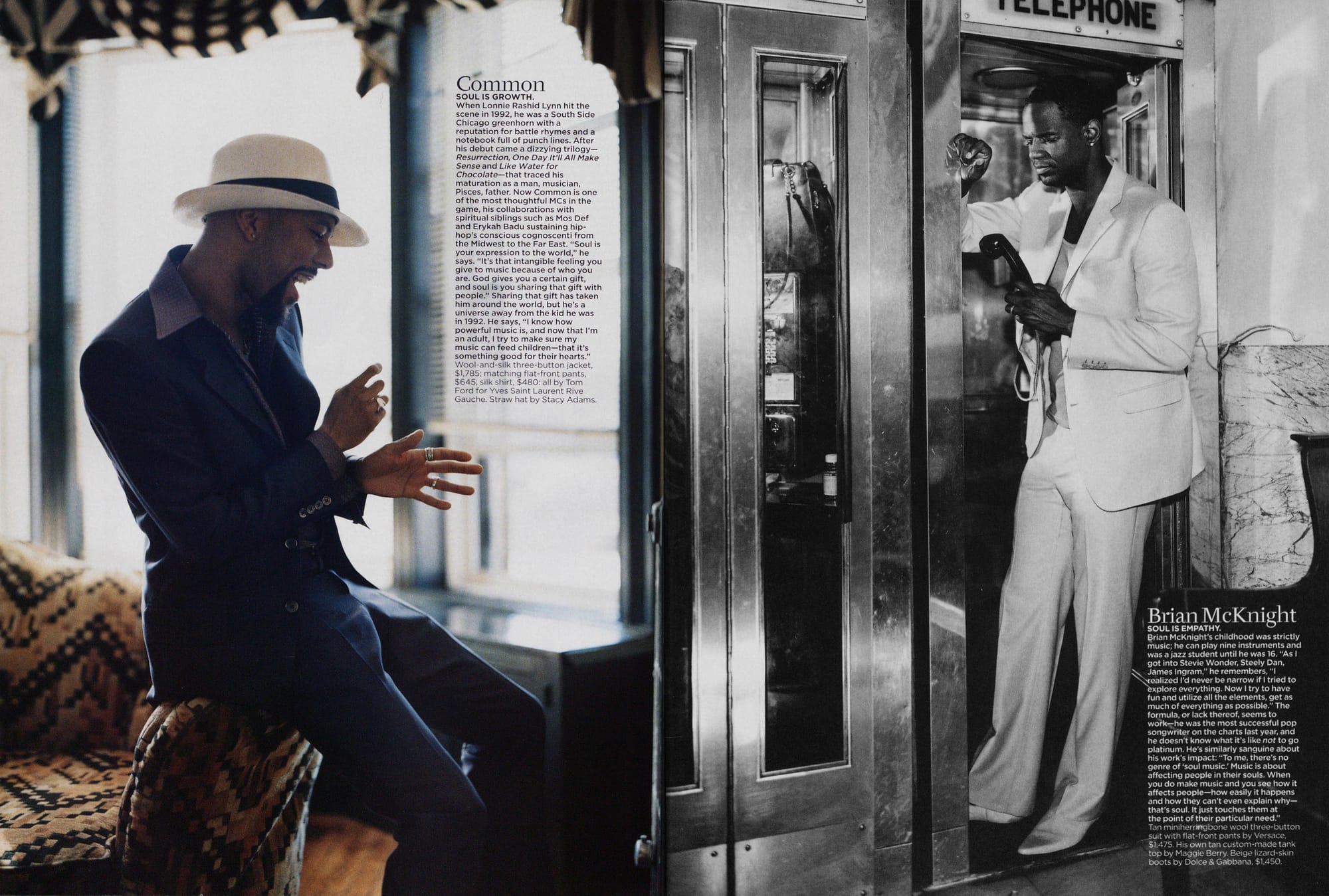
Common
SOUL IS GROWTH.
When Lonnie Rashid Lynn hit the scene in 1992, he was a South Side Chicago greenhorn with a reputation for battle rhymes and a notebook full of punch lines. After his debut came a dizzying trilogy—Resurrection, One Day It’ll All Make Sense, and Like Water for Chocolate—that traced his maturation as a man, musician, Pisces, and father.
Now Common is one of the most thoughtful MCs in the game, his collaborations with spiritual siblings such as Mos Def and Erykah Badu sustaining hip-hop’s conscious cognoscenti from the Midwest to the Far East.
“Soul is your expression to the world,” he says.
“It’s that intangible feeling you give to music because of who you are. God gives you a certain gift, and soul is you sharing that gift with people.”
Sharing that gift has taken him around the world, but he’s a universe away from the kid he was in 1992. He says:
“I know how powerful music is, and now that I’m an adult, I try to make sure my music can feed children—that it’s something good for their hearts.”
Wool-and-silk three-button jacket, $1,785; matching flat-front pants, $645; silk shirt, $480 — all by Tom Ford for Yves Saint Laurent Rive Gauche. Straw hat by Stacy Adams.
Brian McKnight
SOUL IS EMPATHY.
Brian McKnight’s childhood was strictly music; he can play nine instruments and was a jazz student until he was sixteen.
“As I got into Stevie Wonder, Steely Dan, James Ingram,” he remembers, “I realized I’d never be narrow if I tried to explore everything. Now I try to have fun and utilize all the elements—get as much of everything as possible.”
The formula—or lack thereof—seems to work. He was the most successful pop songwriter on the charts last year, and he doesn’t know what it’s like not to go platinum.
He’s similarly sanguine about his work’s impact:
“To me, there’s no genre of ‘soul music.’ Music is about affecting people in their souls. When you do make music and you see how it affects people—how easily it happens and how they can’t even explain why—that’s soul. It just touches them at the point of their particular need.”
Tan mini-herringbone wool three-button suit with flat-front pants by Versace, $1,475. Tan custom-made tank top by Maggie Berry. Beige lizard-skin boots by Dolce & Gabbana, $1,450.
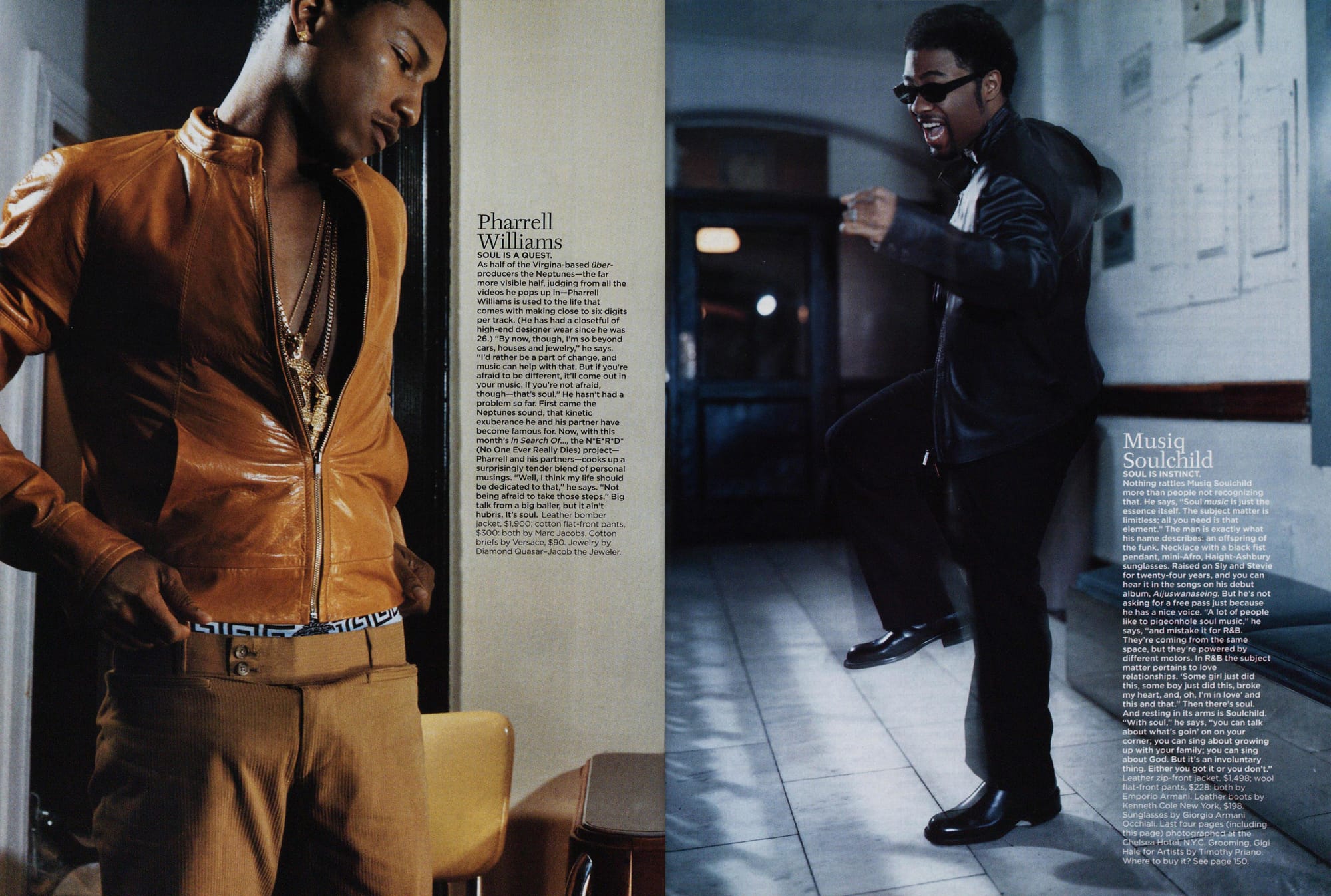
Pharrell Williams
SOUL IS A QUEST.
As half of the Virginia-based über-producers the Neptunes—the far more visible half, judging from all the videos he pops up in—Pharrell Williams is used to the life that comes with making close to six digits per track. (He’s had a closetful of high-end designer wear since he was 26.)
“By now, though, I’m so beyond cars, houses, and jewelry,” he says.
“I’d rather be a part of change, and music can help with that. But if you’re afraid to be different, it’ll come out in your music. If you’re not afraid, though—that’s soul.”
He hasn’t had a problem so far. First came the Neptunes sound—that kinetic exuberance he and his partner became famous for. Now, with this month’s In Search Of…, the NERD (No One Ever Really Dies) project, Pharrell and his partners cook up a surprisingly tender blend of personal musings.
“Well, I think my life should be dedicated to that,” he says.
“Not being afraid to take those steps.”
Big talk from a big baller, but it ain’t hubris. It’s soul.
Leather bomber jacket, $1,900; cotton flat-front pants, $300 — both by Marc Jacobs. Cotton briefs by Versace, $90. Jewelry by Diamond Quasar—Jacob the Jeweler.
Musiq Soulchild
SOUL IS INSTINCT.
Nothing rattles Musiq Soulchild more than people not recognizing that.
“Soul music is just the essence itself,” he says. “The subject matter is limitless; all you need is that element.”
The man is exactly what his name describes: an offspring of the funk. Necklace with a black fist pendant, mini-Afro, Haight-Ashbury sunglasses. Raised on Sly and Stevie for twenty-four years, you can hear it in the songs on his debut album, Aijuswanaseing.
But he’s not asking for a free pass just because he has a nice voice.
“A lot of people like to pigeonhole soul music,” he says, “and mistake it for R&B. They’re coming from the same space, but they’re powered by different motors. In R&B the subject matter pertains to love relationships—‘some girl just did this, some boy just did this, broke my heart, and oh, I’m in love,’ and this and that.”
Then there’s soul.
And resting in its arms is Soulchild.
“With soul,” he says, “you can talk about what’s goin’ on on your corner; you can sing about growing up with your family; you can sing about God. But it’s an involuntary thing. Either you got it or you don’t.”
Leather zip-front jacket, $1,498; wool flat-front pants, $228 — both by Emporio Armani. Leather boots by Kenneth Cole New York, $198. Sunglasses by Giorgio Armani Occhiali.
Last four pages (including this page) photographed at the Chelsea Hotel, NYC. Grooming by Gigi Hale for Artists by Timothy Priano. “Where to buy it?” See page 150.