'Dolly Parton Scrapbook' - Good Housekeeping February 1979
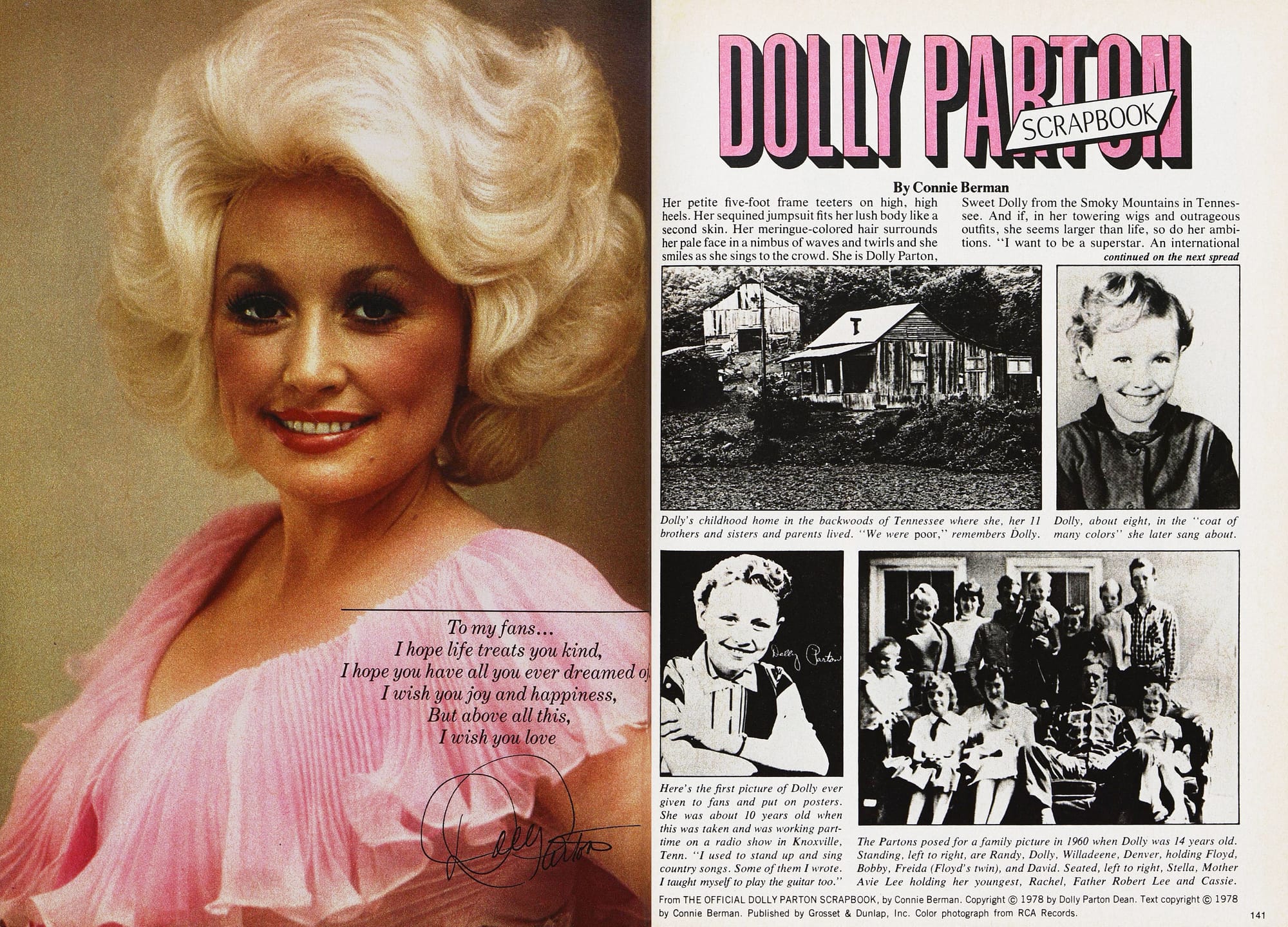
Writer: Connie Berman
Her petite five-foot frame teeters on high, high heels. Her sequined jumpsuit fits her lush body like a second skin. Her meringue-colored hair surrounds her pale face in a nimbus of waves and twirls and she smiles as she sings to the crowd. She is Dolly Parton, Sweet Dolly from the Smokey Mountains in Tennessee. And if, in her towering wigs and outrageous outfits, she seems larger than life, so do her ambitions. "I want to be a superstar. An international star. A universal star," she says.
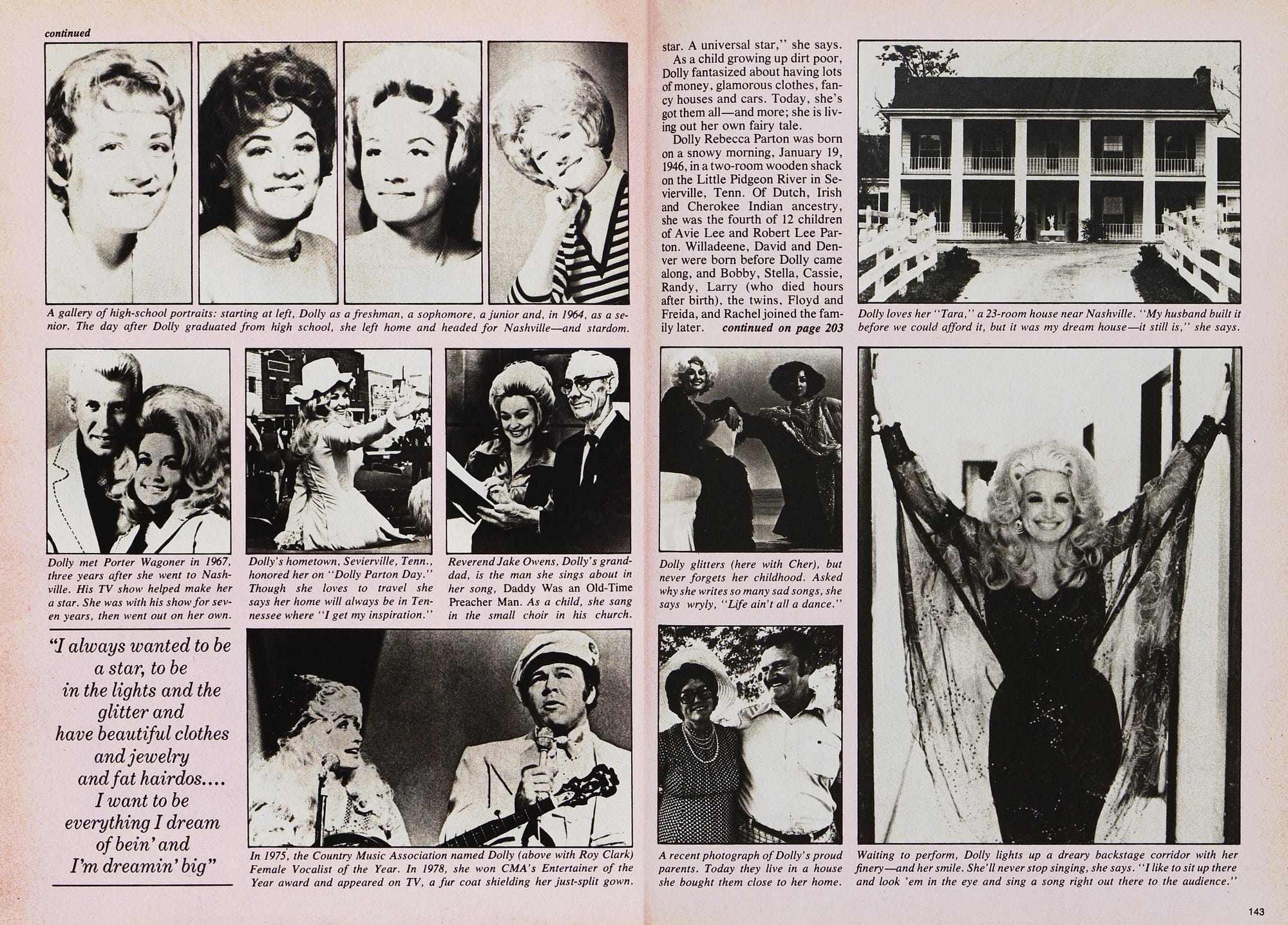
As a child growing up dirt poor, Dolly fantasized about having lots of money, glamorous clothes, fancy houses and cars. Today, she's got them all-and more; she is living out her own fairy tale.
Dolly Rebecca Parton was born on a snowy morning, January 19, 1946, in a two-room wooden shack on the Little Pidgeon River in Se-vierville, Tenn. Of Dutch, Irish and Cherokee Indian ancestry, she was the fourth of 12 children of Avie Lee and Robert Lee Parton. Willadeene, David and Denver were born before Dolly came along, and Bobby, Stella, Cassie, Randy, Larry (who died hours after birth), the twins. Floyd and Freida, and Rachel joined the family later.
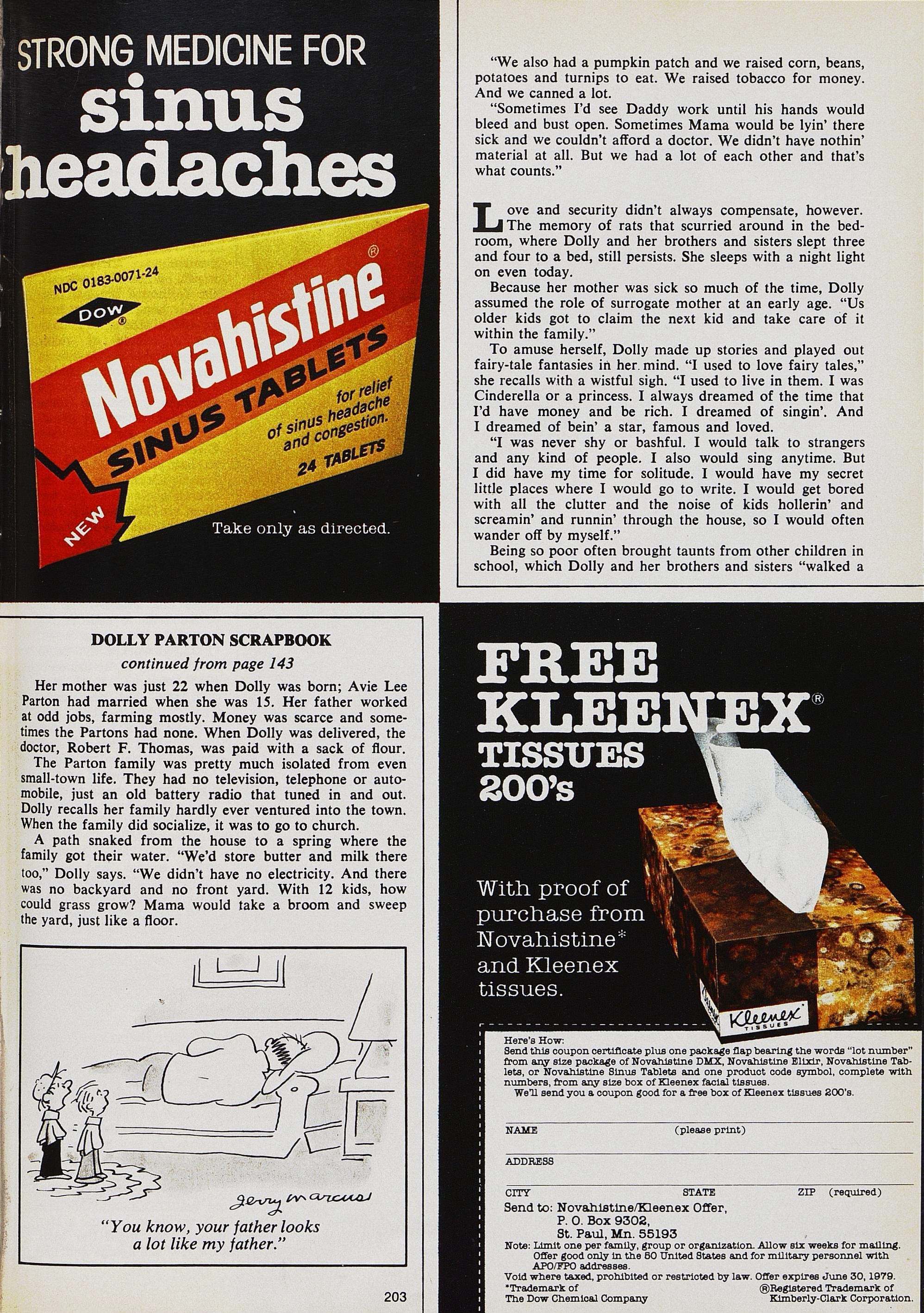
Her mother was just 22 when Dolly was born; Avie Lee Parton had married when she was 15. Her father worked at odd jobs, farming mostly. Money was scarce and sometimes the Partons had none. When Dolly was delivered, the doctor, Robert F. Thomas, was paid with a sack of flour.
The Parton family was pretty much isolated from even small-town life. They had no television, telephone or automobile, just an old battery radio that tuned in and out. Dolly recalls her family hardly ever ventured into the town. When the family did socialize, it was to go to church.
A path snaked from the house to a spring where the family got their water. "We'd store butter and milk there too," Dolly says. "We didn't have no electricity. And there was no backyard and no front yard. With 12 kids, how could grass grow? Mama would take a broom and sweep the yard, just like a floor.
"We also had a pumpkin patch and we raised corn, beans, potatoes and turnips to eat. We raised tobacco for money. And we canned a lot.”
“Sometimes I'd see Daddy work until his hands would bleed and bust open. Sometimes Mama would be lyin' there sick and we couldn't afford a doctor. We didn't have nothin' material at all. But we had a lot of each other and that's what counts."
Love and security didn't always compensate, however. The memory of rats that scurried around in the bedroom, where Dolly and her brothers and sisters slept three and four to a bed, still persists. She sleeps with a night light on even today.
Because her mother was sick so much of the time, Dolly assumed the role of surrogate mother at an early age. “Us older kids got to claim the next kid and take care of it within the family."
To amuse herself, Dolly made up stories and played out fairy-tale fantasies in her. mind. "I used to love fairy tales," she recalls with a wistful sigh. "I used to live in them. I was Cinderella or a princess. I always dreamed of the time that I'd have money and be rich. I dreamed of singin'. And I dreamed of bein' a star, famous and loved.
"I was never shy or bashful. I would talk to strangers and any kind of people. I also would sing anytime. But I did have my time for solitude. I would have my secret little places where I would go to write. I would get bored with all the clutter and the noise of kids hollerin' and screamin' and runnin' through the house, so I would often wander off by myself."
Being so poor often brought taunts from other children in school, which Dolly and her brothers and sisters "walked a long way to." In grammar school, the first through the eighth grades were all taught in one room by one teacher—with about 15 kids in the whole school.
"Sometimes you hated to go to school, because kids would tease and you were ashamed of the things you didn't have. I'd make up a story to glorify the situa-tion, like I did with the song Coat of Many Colors." (When she was eight years old, Dolly's mother made her a winter coat out of scraps. Dolly was proud of it but her schoolmates all laughed.)
But the great love of their parents carried the Parton children over most of the rough spots. "I think my mama and my daddy were the biggest influence in my life," says Dolly.
Her father was strict. "If we did some-thin' bad, he whipped us with a belt. But I was such an independent kid. I'd do anything even if I knew I would get beat to death for it."
Even as a child, Dolly was fascinated with makeup. She started wearing Merthiolate on her lips as make-believe lipstick. "It stung but it was worth the pain," she says. Her father couldn't rub it off, so she had her painted lips just as she wanted.
Dolly says that she wasn't a particularly pretty child. "I went through an ugly stage when I was about eight or nine, like every kid does. That's when your teeth are comin' in and they look like corn and you have to develop a bit."
Dolly did develop more than just a bit. "When I was 13, I looked like I was 25," she says. "From then on, I tried to improve my looks as much as I could."
Dolly was the first person in her family to graduate from high school but she "was too involved with songwriting and stuff to study." While her interest in school dwindled, Dolly focused her tremendous energies on music. When she was six, she fashioned her first guitar for herself. "I just took an old busted-up mandolin and a couple of guitar strings and I made me an instrument of some kind."
Her singing talents were honed in church, the House of Prayer, where her grand-father, the Reverend Jake Owens preached about "hell so hot you could feel the heat." Dolly joined the church choir when she was about six. This country, fundamentalist brand of religion was a significant force in shaping her character and her music.
When she was 10, Dolly's uncle Bill Owens took her to Knoxville to audition for one of the local radio shows. "I started workin' that radio show, mostly in the summertime when I could stay with my aunt and uncle. They paid me about $20 a week. When I was about 11, I guess, I made my first record. It was called Puppy Love. Then when I was in high school, I made another record for Mercury called It May Not Kill Me But It's Sure Gonna Hurt."
One day, Uncle Bill borrowed a car and drove Dolly to Nashville, some 200 miles away, so that she could sing at the Grand Ole Opry. "Everybody said I couldn't sing. But finally I talked to a singer named Jimmie C. Newman who let me have one of his spots. I sang If You Want To Be My Baby, and the audience clapped and clapped.
"I kept thinkin' about Mama and Daddy and my brothers and sisters back home, all of them listenin' to me on the radio and that made me excited."
That appearance on the Grand Ole Opry helped Dolly nourish her dreams of stardom. At her high school graduation, June 1964, each member of the departing senior class announced his or her plans for post-graduation life. Dolly declared matter-of-factly that she was going to Nashville to become a star in country music. That night she went home, packed a few belongings and her songs in a cardboard suitcase fastened with a string and, early the next morn-ing, Saturday, she was on the bus to Nashville. She never turned back.
As soon as Dolly arrived, she headed for the area called South Nashville, where her Uncle Bill had moved with his wife and young child. Since both parents worked, Dolly was to baby-sit their little boy in return for food and shelter.
Just a few hours after she arrived in the city, she met the most important man in her life. "I was walkin' down the street, just lookin' at everything, when I saw this handsome man drive by in a white car. So I waved to him. When you're from the country, you wave to people. It's not flirtin, it's just bein friendly.”
“This guy waved back and then hollered at me. Then he came over to talk to me.”
"I said, ‘I can't go out with you; I don't even know you' But I told him that he could come over to Uncle Bill's house and sit with me while I was baby-sittin' my nephew. The man's name was Carl Dean and it was love at first sight.
"Every day that week, Carl would come up to the house in the afternoons. We would sit outside on the porch and talk. I didn't go in the house with him because that wouldn't have been right. When my aunt got a day off, Carl and I went out on a real date. He took me to his parents' house and I was introduced to them. We knew we were just so right for each other. I guess you could say he was my first real boyfriend."
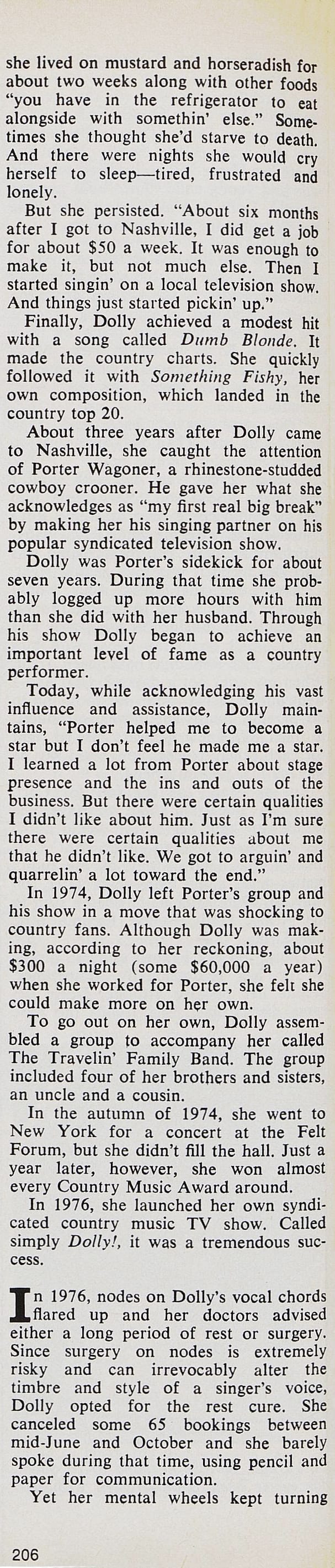
But as deeply as she felt for Carl, Dolly was uncertain about marriage. She wasn't sure that her career would allow her to have children-ever. But Carl insisted that Dolly's way of life didn't matter and, about two years later, on May 30, 1966, after he finished a stint in the Army, Dolly Parton became Mrs. Carl Dean.
Things did not happen quite so quickly for her professionally. Sometimes, despite her positive attitude, Dolly became discouraged. She recalls the time she lived on mustard and horseradish for about two weeks along with other foods "you’d have in the refrigerator to eat alongside with somethin' else." Sometimes she thought she'd starve to death. And there were nights she would cry herself to sleep—tired, frustrated and lonely.
But she persisted. "About six months after I got to Nashville, I did get a job for about $50 a week. It was enough to make it, but not much else. Then I started singin' on a local television show. And things just started pickin' up."
Finally, Dolly achieved a modest hit with a song called Dumb Blonde. It made the country charts. She quickly followed it with Something Fishy, her own composition, which landed in the country top 20.
About three years after Dolly came to Nashville, she caught the attention of Porter Wagoner, a rhinestone-studded cowboy crooner. He gave her what she acknowledges as "my first real big break" by making her his singing partner on his popular syndicated television show.
Dolly was Porter's sidekick for about seven years. During that time she probably logged up more hours with him than she did with her husband. Through his show Dolly began to achieve an important level of fame as a country performer.
Today, while acknowledging his vast influence and assistance, Dolly main-tains, "Porter helped me to become a star but I don't feel he made me a star.
I learned a lot from Porter about stage presence and the ins and outs of the business. But there were certain qualities I didn't like about him. Just as I'm sure there were certain qualities about me that he didn't like. We got to arguin' and quarrelin' a lot toward the end."
In 1974, Dolly left Porter's group and his show in a move that was shocking to country fans. Although Dolly was making, according to her reckoning, about $300 a night (some $60,000 a year) when she worked for Porter, she felt she could make more on her own.
To go out on her own, Dolly assembled a group to accompany her called The Travelin' Family Band. The group included four of her brothers and sisters, an uncle and a cousin.
In the autumn of 1974, she went to New York for a concert at the Felt Forum, but she didn't fill the hall. Just a year later, however, she won almost every Country Music Award around. In 1976, she launched her own syndicated country music TV show. Called simply Dolly!, it was a tremendous success.
In 1976, nodes on Dolly's vocal chords flared up and her doctors advised either a long period of rest or surgery. Since surgery on nodes is extremely risky and can irrevocably alter the timbre and style of a singer's voice, Dolly opted for the rest cure. She canceled some 65 bookings between mid-June and October and she barely spoke during that time, using pencil and paper for communication.
Yet her mental wheels kept turning rapidly. Now that she was 30, she figured some changes had to be made in her career. When these changes were announced early in 1977, Dolly was bitterly criticized.
She replaced her Travelin' Family Band with a new group called Gypsy Fever and said that she was going to cross over and sing pop and rock. Furthermore she broke with her old Nashville managers and hired a top Hollywood firm instead.
Attacks from some old-guard country fans against these innovations were fierce. "Crucified" is the word Dolly uses about their reactions. But she defends herself, "I did not fire my band.
My band was made up of my family and I did not fire my family. They knew I was goin' to make some changes and they were glad about it actually."
Success and acclaim greeted Dolly's crossover. By mid-1977, she'd had more success in the first few months than "in all the years that I'd been killin' myself."
In addition to her sell-out performances in the U.S., she also entertained in Europe and sang for Queen Elizabeth at a Royal Jubilee TV special in London. Later Dolly was introduced to the Queen and Prince Philip.
There's a paradox in the way Dolly presents herself as a performer-that high-pitched girlish soprano swells out from a voluptuous woman clad in red-hot-mama clothes. Though some people have derided her stage get-ups, she claims they're just a show-business gimmick. "My gaudy appearance has nothing to do with the kind of person I am," she says. "I like lookin' as if I came out of a fairy tale. It's like I'm playin' out a fantasy that I had when I was a child, playin' with colors and flashy clothes. If people think I'm a dumb blonde because of the way I look, then they're dumber than they think I am."
Dolly’s secure enough that she can poke fun at herself. For instance, she claims that if she took up jogging, "I would give myself two black eyes for a couple of good reasons!" And there's a long-running Dolly Parton gag that when she burned her bra, it took the fire department days to put out the blaze. Rumor is that Dolly started that joke herself.
But, joking aside, Dolly has never disclosed her measurements and doesn't plan to. All she says is that when she eats a lot, she is 80-80-80.
People who know Dolly claim that she's one of the nicest women they've ever met. Linda Ronstadt, a good friend of hers, remarked, "I've never met anyone so free of neurosis as Dolly. She's just kind of a Southern magnolia blossom that floats on the breeze."
Dolly believes that part of the reason she is able to stay on the right track is her faith in God. Though she doesn't go to church anymore, Dolly calls herself a religious person. She also calls herself a "vanilla sinner," a phrase she invented which means, she says, that she's a combination of both bad and good.
"I believe that all good things come from God. I think that if my work has touched people at all, it's because of God. I pray every day. I do believe and I have been saved and baptized. I know I've got help whenever everybody else might seem not to be there for me. I always know that God is there. I never make a decision about business or anything without talkin' to God about it and usually when I do, I feel after I pray that I've got my answer."
Dolly is a passionate believer in will-dreaming yourself to be anything you want to be. There's an almost religious quality about her positive thinking. "You can think yourself rich or you can think yourself poor," she says. "You can think yourself havin’ a horrible marriage or you can make it work. If you're sick you can think yourself well. I grew up where faith was what carried us through. So I thought, I want myself to be happy. I like myself. I'm all I've got. So why can't I have the best for myself?'"
This urge to believe, Dolly claims, is what got her out of that poor wooden shack where she was born and made her into a very successful singer. Today she has an assortment of invest-ments, tax shelters and busi-nesses, including the popular Dolly doll, that amount to well over a million dollars.
"But I don't spend much money on myself because I never have time to shop," she says. "Usually I like for other people to have things, like my family."
Besides being good to her family, Dolly is also very close with her band. She doesn’t pull any star stuff. “I love those people, I travel with them. I don’t stay in separate hotels or anything, We need each other to survive."
Dolly and her band travel as much as 150,000 miles and 300 days a year in her custom made bus. The bus is worth about $150,000. It is equipped with a full recording studio, color TV, a CB radio, a kitchen, two bathrooms and 11 beds. Dolly has her own tiny bedroom with a sofa and a bed that unfolds and takes up almost the entire room. Her room has three closets-one for her stage clothes-and cabinets for her wigs. She usually takes along 25 to 30 wigs for a month-long tour.
If she's on the road longer than that, Dolly packs extra wigs in luggage compartments, specially designed for her wigs, underneath the passenger area. Dolly has been wearing those curli-cued, platinum wigs for about five years. Before that she used to tease her own hair.
"When I was about 15, everybody was teasin' up their hair and I always liked to see how high and puffy I could make it. I used to love to bleach and tease my hair and have this big-haired image. I like the way it looks on me. I'm only five feet tall so I wear a lotta hair to offset that. My real hair is blonde and baby-fine. I bleach it so it stays blonde."
Though her public life seems open, Dolly's private life, specifically her marriage to Carl Dean, puzzles many observers. Dolly and Carl, who is four years her senior, have been married for over 12 years. He is a retiring, reserved man and he has never given an interview. He works in the farm around the 23-room Tara-like mansion he built for Dolly in Nashville and he also runs his own asphalt paving company. Dolly says, "He don't want people to stare and point at him and say, ‘There's Dolly Parton's husband.'”
"Still, we are together more than most people think," maintains Dolly. "More than those stories which say that we only see each other about six weeks a year. We are together as much as we need to be. Carl is very independent. He reminds me a lot of my daddy-and I respect my daddy a lot."
Dolly calls her husband "Daddy." He in turn calls her "the old woman," or "crazy woman." Dolly says that if he did use her proper name her feelings would be hurt.
She says that Carl is like her little boy, her brother and her daddy all rolled into one person. "He gives me everything," she says breathlessly. "Love, understanding, kindness, thoughtfulness. And he gives me roots. Carl never gets involved with Dolly's career. There used to be talk that he had never even seen her perform, but, that was just a joke," says Dolly. "Actually, he didn't used to like my singin' all that much, but he likes it a lot better now."
Dolly and Carl have no children and she doubts that she'll ever have any. "I raised enough of my brothers and sisters," she says. "The last of them just got married several months ago. I feel like I've been raisin' babies all my life. This is the first time in all our twelve years of marriage that Carl and I've been really alone. It's like we're on a second honeymoon. Besides, I don't think it's fair to be on the road all the time like I am and have kids of my own.
When they are home in Nashville together, Dolly and Carl enjoy a simple life. "Like I'll cook the things he likes," says Dolly, “I’m a real good cook because I'm a good eater and a big eater. All the things I like are fattening. I cook like my mother and don't go by a recipe. I seem to know what tastes good."
Dolly's mother and father now live in a house she bought for them not far away from hers and there's also a roomy mobile home camped near "Tara" where Dolly's folks stay when they visit her. During holidays such as Thanksgiving and Christmas, Partons and other relatives gather from far and wide for old-fashioned family dinners.
A 200-acre farm surrounds Dolly's house. There's a stable of horses, 25 Hereford cows, peacocks which strut on the lawn, and dogs. Every room in the house has a large closet. The closet in Dolly's bedroom is about the size of a small room. She keeps her clothes throughout the house: her skirts, dresses and jeans upstairs, her winter coats and costumes (about 3,000 glittery rhine-stone-covered work outfits, as she calls them) downstairs.
Dolly is especially fond of the kitchen. It's double-sized and equipped with both modern appliances and an old wood-burning stove, like the one her mother used. In another sentimental gesture, the fireplace in the den has a facing of pine logs Dolly salvaged from the cabin
where she was born on Little Pidgeon River. "It's my foundation, having this house and Carl," she says. "These are my roots."
Carl, along with Dolly's uncle, built the house "board by board." She confides that Carl wanted to build it himself because it was kind of a tribute to his love for her. No matter what anyone else thinks of her unusual marriage, Dolly glows when she talks about her man and their relationship. "We don't have any problems at all," she says. "Everything with Carl is as good as it could be."
Whether she's home or on the road, Dolly is always writing songs. She has written literally thousands of them, of which about 500 have been published. It is as a songwriter that Dolly has received the most critical applause. Though she recently signed a movie contract with 20th Century-Fox, her goals now go beyond music or movies. She would like to write children's books—"I could be the new Mother Goose”—and is currently working on a book of poems and short stories about mountain life.
"There are so many sides of me that don't show yet," she says. "I want to be famous for a lot of things." Dolly has said she'd like to live forever to accomplish all her dreams. She wants
to be able to go anywhere and have people recognize her as Dolly Parton, the star.
"I don't know what it is that I was meant to be but I know it will be something phenomenal when it does happen. ... I want to leave somethin' good and important behind me," she says. With her boundless ambition and talents, it seems likely that this dream, too, will come true.