
'Divine Inspiration' Vogue US June 2000
Vogue Point Of View - Where does fashion come from? Seven designers talk with Plum Sykes about the origins of their fall collections.
Writer: Plum Sykes
Photography: Michael Thompson
Fashion Editor: Tonne Goodman
Hair: Serge Normant
MUA: Sharon Dowsett for M.A.C. Cosmetics.
Donna Karan is having a "red experience." She's also having a scarf moment. For the privilege, she's flown all the way to Bhutan, which is not exactly the most convenient place in the world. "I did Vietnam in a day, Cambodia in a day, Nepal in three days, India in three days," Donna says, her voice crackling down a very remote cellular. Her trip has included private jets, out-of-this-world temples, tea-drinking with Bhutanese princes, meetings with monks, and a monumental amount of shopping.
All of this for a red coat. A very beautiful, perfectly urban, undeniably heavenly red coat, but a red coat nevertheless. How you get from the Far Eastern experience to Donna Karan's fall show dominated by every shade of red, from paprika to lipstick-is a matter of processing. Bhutanese traditional garb which consists of a dress-ing-gown-like garment, worn, loose at the waist, by adults and children alike-started Karan pondering. "I thought about the Bhutanese 'uniform, which is really so modern," she says. "And then I thought about our own uniform back home." Karan also found herself obsessed with the red scarflike garment worn by Bhutanese monks, by the way it drapes and folds so regally. (So much does she adore it, she has "not taken off my own red scarf since. It's a part of me," she says.) To put it simply, Bhutanese robe plus red scarf equals Manhattan wrap coat.
This is a season dominated by clothes rich with sartorial references. Yohji Yamamoto researched ethnic Eskimo garments to inspire amazingly raw but elegant black satin cocktail dresses. Jean Paul Gaultier's collection was the epitome of Parisian chic, but its breathtaking silhouette was based on a frankly hideous eighties bat-wing sweater that he had found in the grottiest French flea market. Whether we are talking about Alexander McQueen, who studied the seams of nineteenth-century jackets, or other designers universal and ongoing love affair with Yves Saint Laurent, this is a season when fashion is what inspired fashion.
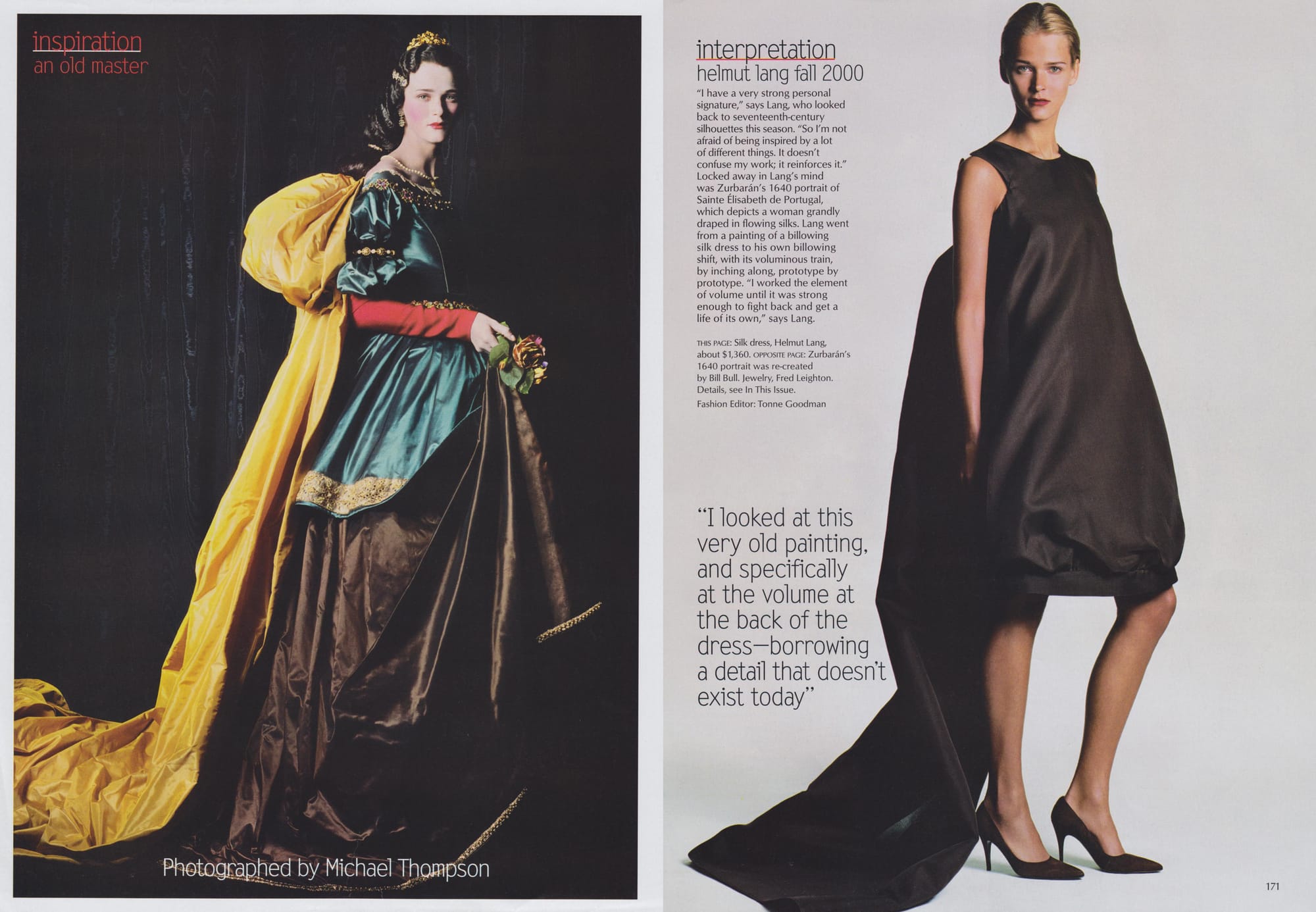
Inspiration: An old master
Interpreation: Helmut Lang Fall 2000
"I have a very strong personal signature," says Lang, who looked back to seventeenth-century silhouettes this season. "So I'm not afraid of being inspired by a lot of different things. It doesn't confuse my work; it reinforces it." Locked away in Lang's mind was Zurbarán's 1640 portrait of Sainte Elisabeth de Portugal, which depicts a woman grandly draped in flowing silks. Lang went from a painting of a billowing silk dress to his own billowing shift, with its voluminous train, by inching along, prototype by prototype. "I worked the element of volume until it was strong enough to fight back and get a life of its own," says Lang.
THIS PAGE: Silk dress, Helmut Lang, about $1,360.
OPPOSITE PAGE: Zurbarán's 1640 portrait was recreated by Bill Bull. Jewelry, Fred Leighton.
"I looked at this very old painting, and specifically at the volume at the back of the dress - borrowing a detail that doesn't exist today."
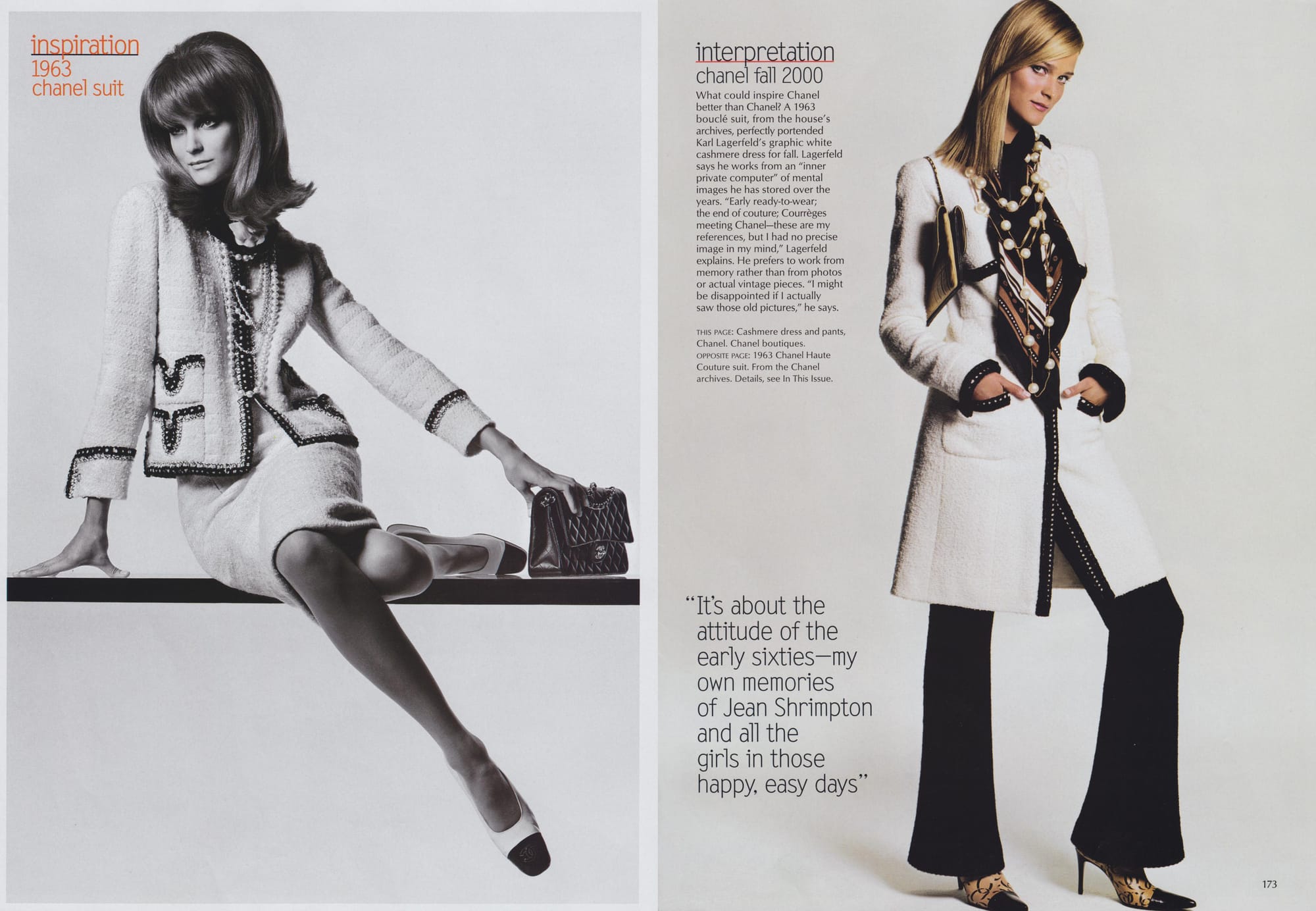
Inspiration: 1963 Channel suit
Interpretation: Chanel Fall 2000
What could inspire Chanel better than Chanel? A 1963 boucle suit, from the house's archives, perfectly portended Karl Lagerfeld's graphic white cashmere dress for fall. Lagerfeld says he works from an "inner private computer" of mental images he has stored over the years. "Early ready-to-wear; the end of couture; Courrèges meeting Chanel-these are my references, but I had no precise image in my mind," Lagerfeld explains. He prefers to work from memory rather than from photos or actual vintage pieces. "I might be disappointed if I actually saw those old pictures," he says.
THIS PAGE: Cashmere dress and pants, Chanel. Chanel boutiques.
OPPOSITE PAGE: 1963 Chanel Haute Couture suit. From the Chanel archives. Details, see In This Issue.
"It's about the attitude of the early sixties-my own memories of Jean Shrimpton and all the girls in those happy, easy days."
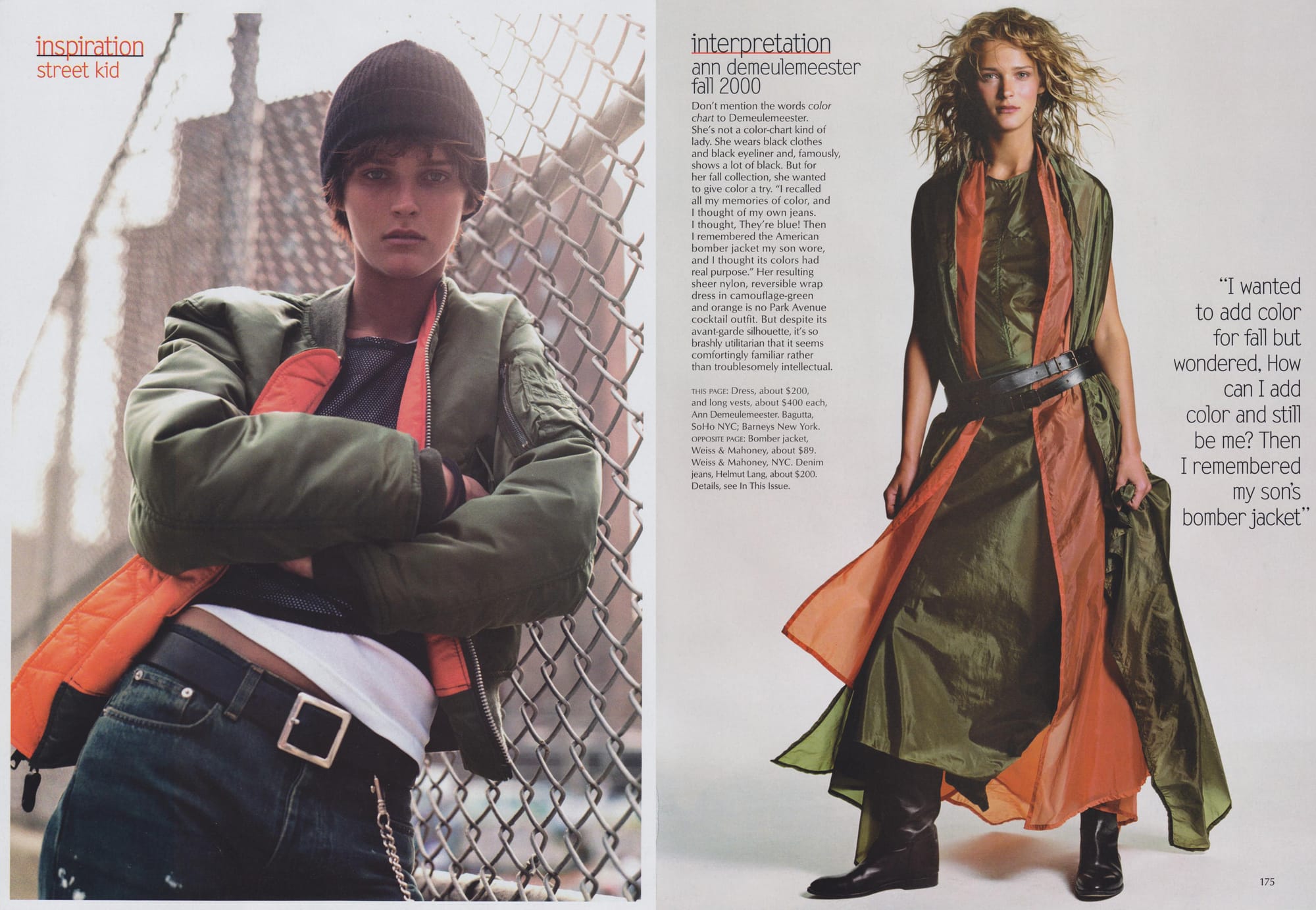
Inspiration: Street kid
Interpretation: Ann Demeulemeester Fall 2000
Don't mention the words color chart to Demeulemeester. She's not a color-chart kind of lady. She wears black clothes and black eyeliner and, famously, shows a lot of black. But for her fall collection, she wanted to give color a try. "I recalled all my memories of color, and I thought of my own jeans. I thought, They're blue! Then I remembered the American bomber jacket my son wore, and I thought its colors had real purpose." Her resulting sheer nylon, reversible wrap dress in camouflage-green and orange is no Park Avenue cocktail outfit. But despite its avant-garde silhouette, it's so brashly utilitarian that it seems comfortingly familiar rather than troublesomely intellectual.
THIS PAGE: Dress, about $200, and long vests, about $400 each, Ann Demeulemeester. Bagutta, SoHo NYC; Barneys New York.
OPPOSITE PAGE: Bomber jacket, Weiss & Mahoney, about $89.
Weiss & Mahoney, NYC. Denim jeans, Helmut Lang, about $200.
"I wanted to add color for fall but wondered, How can I add color and still be me? Then I remembered my son's bomber jacket."
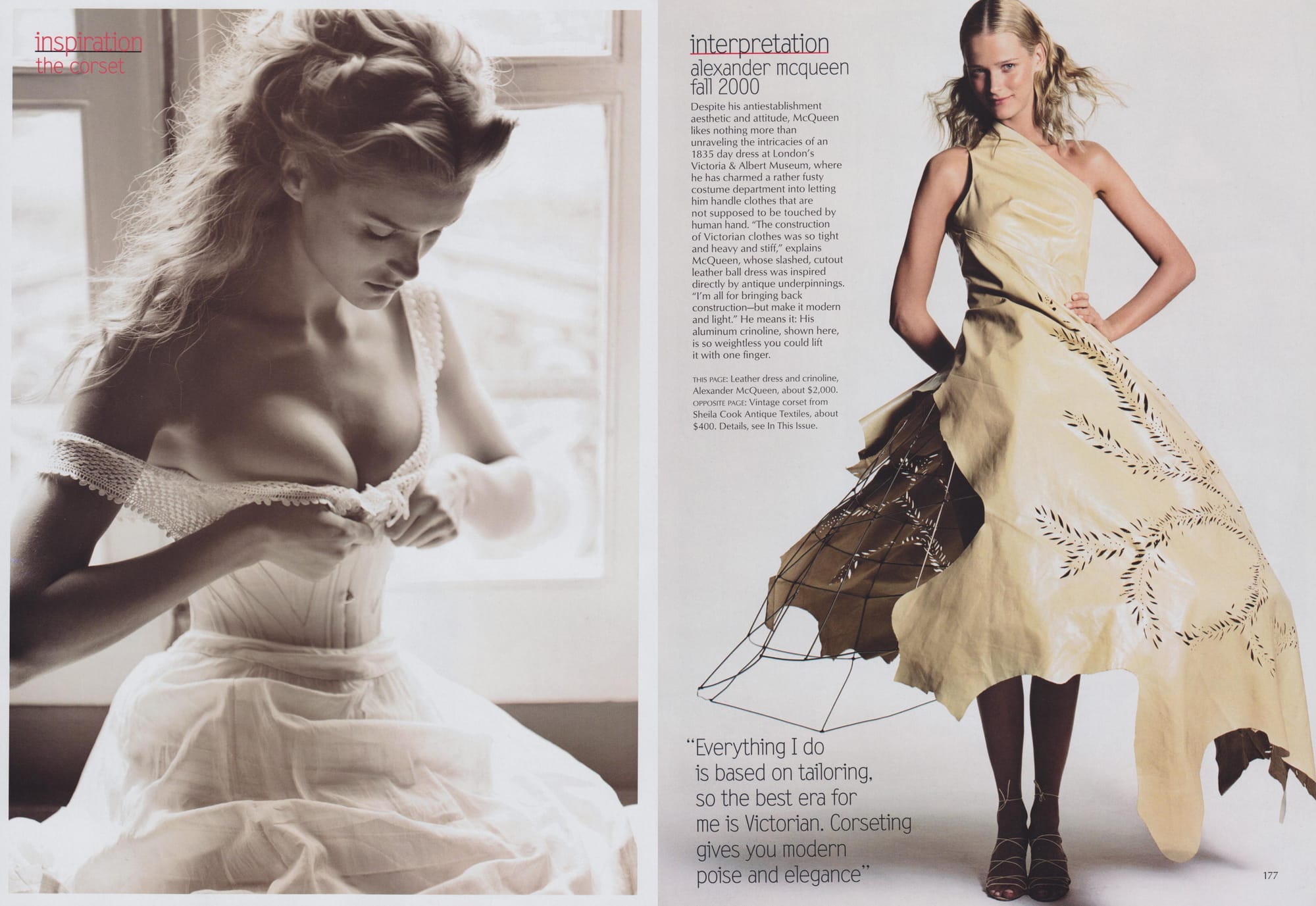
Inspiration: The corset
Interpretation: Alexander McQueen Fall 2000
Despite his antiestablishment aesthetic and attitude, McQueen likes nothing more than unraveling the intricacies of an 1835 day dress at London's Victoria & Albert Museum, where he has charmed a rather fusty costume department into letting him handle clothes that are not supposed to be touched by human hand. "The construction of Victorian clothes was so tight and heavy and stiff," explains McQueen, whose slashed, cutout leather ball dress was inspired directly by antique underpinnings. "I'm all for bringing back construction - but make it modern and light." He means it: His aluminum crinoline, shown here, is so weightless you could lift it with one finger.
THIS PAGE: Leather dress and crinoline, Alexander McQueen, about $2,000.
OPPOSITE PAGE: Vintage corset from Sheila Cook Antique Textiles, about $400.
"Everything I do is based on tailoring, so the best era for
me is Victorian. Corseting gives you modern poise and elegance."
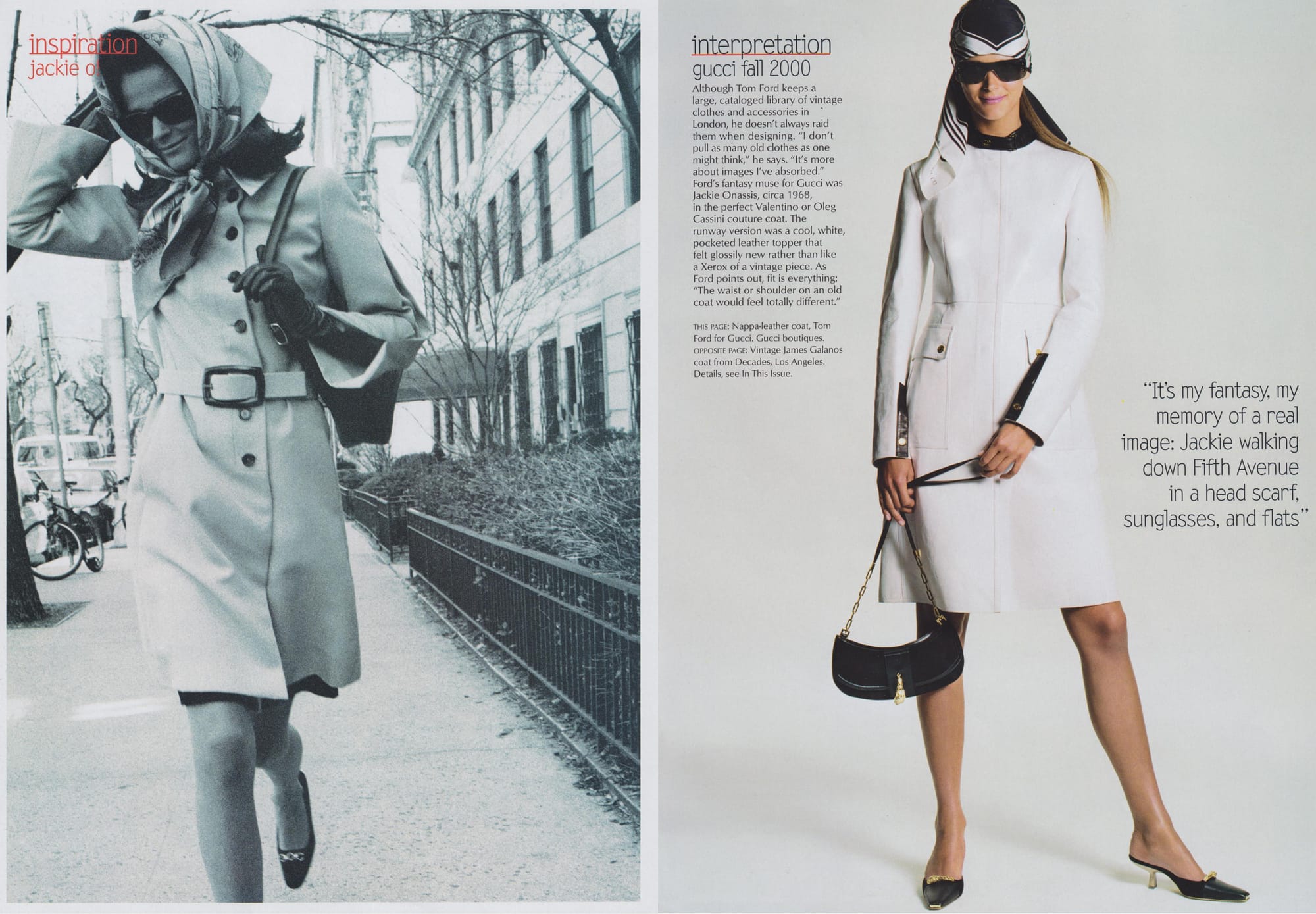
Inspiration: Jackie O!
Interpretation: Gucci Fall 2000
Although Tom Ford keeps a large, cataloged library of vintage clothes and accessories in London, he doesn't always raid them when designing. "I don't pull as many old clothes as one might think," he says. "It's more about images I've absorbed." Ford's fantasy muse for Gucci was Jackie Onassis, circa 1968, in the perfect Valentino or Oleg Cassini couture coat. The runway version was a cool, white, pocketed leather topper that felt glossily new rather than like a Xerox of a vintage piece. As Ford points out, fit is everything: "The waist or shoulder on an old coat would feel totally different."
THIS PAGE: Nappa-leather coat, Tom Ford for Gucci. Gucci boutiques.
OPPOSITE PAGE: Vintage James Galanos coat from Decades, Los Angeles.
"It's my fantasy, my memory of a real image: Jackie walking down Fifth Avenue in a head scarf, sunglasses, and flats."
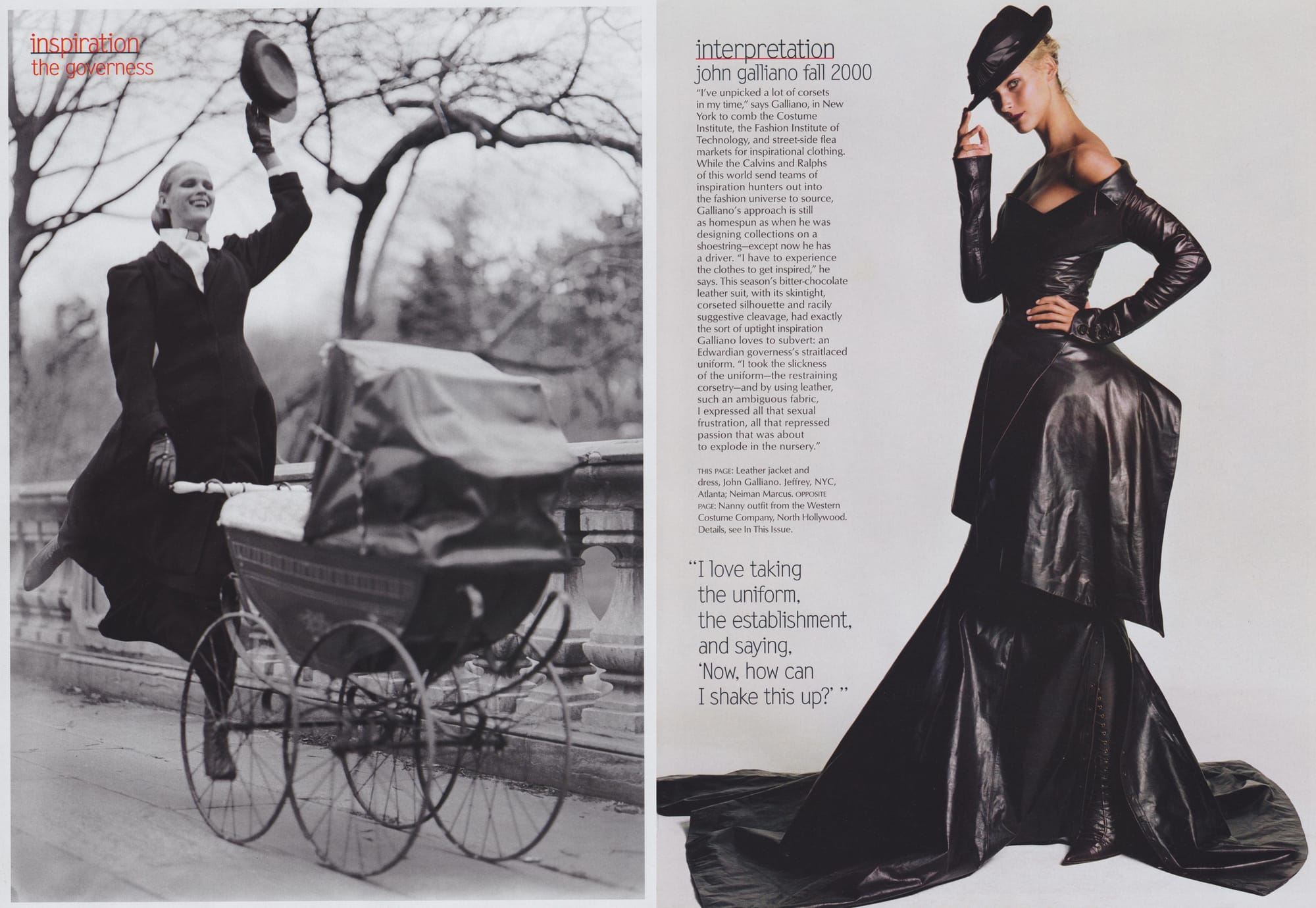
Inspiration: The governess
Interpretation: John Galliano Fall 2000
"I've unpicked a lot of corsets in my time," says Galliano, in New York to comb the Costume Institute, the Fashion Institute of Technology, and street-side flea markets for inspirational clothing. While the Calvins and Ralphs of this world send teams of inspiration hunters out into the fashion universe to source, Galliano's approach is still as homespun as when he was designing collections on a shoestring - except now he has a driver. "I have to experience the clothes to get inspired," he says. This season's bitter chocolate leather suit, with its skintight, corseted silhouette and racily suggestive cleavage, had exactly the sort of uptight inspiration Galliano loves to subvert: an Edwardian governess's straitlaced uniform. "I took the slickness of the uniform-the restraining corsetry-and by using leather, such an ambiguous fabric, I expressed all that sexual frustration, all that repressed passion that was about to explode in the nursery."
THIS PAGE: Leather jacket and dress, John Galliano. Jeffrey, NYC, Atlanta; Neiman Marcus.
OPPOSITE PAGE: Nanny outfit from the Western Costume Company, North Hollywood.
"I love taking the uniform, the establishment, and saying, 'Now, how can I shake this up?'"
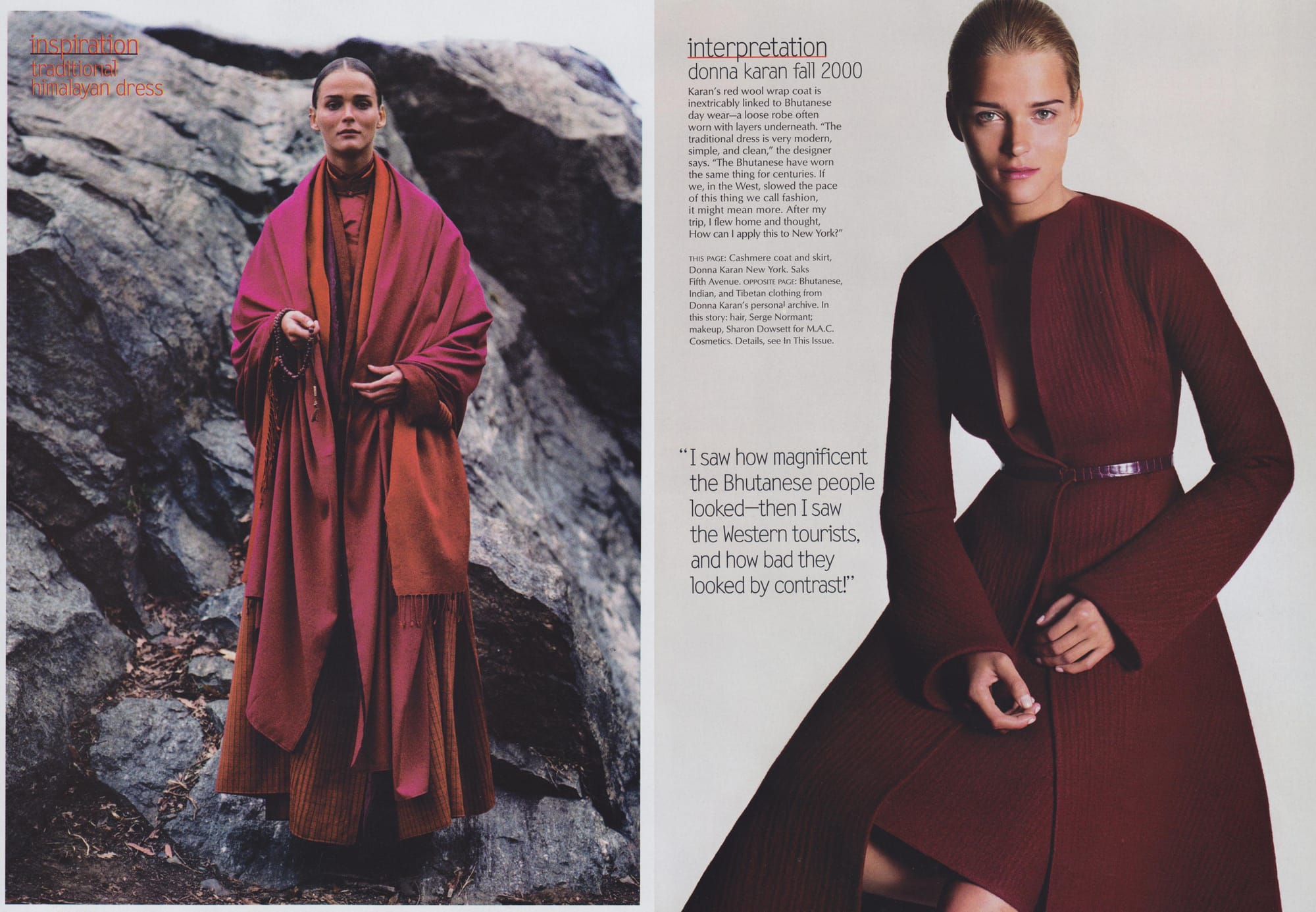
Inspiration: Traditional Himalayan dress
Interpretation: Donna Karan Fall 2000
Karan's red wool wrap coat is inextricably linked to Bhutanese day wear-a loose robe often worn with layers underneath. "The traditional dress is very modern, simple, and clean," the designer says. "The Bhutanese have worn the same thing for centuries. If we, in the West, slowed the pace of this thing we call fashion, it might mean more. After my trip, I flew home and thought, How can I apply this to New York?"
THIS PAGE: Cashmere coat and skirt, Donna Karan New York. Saks
Fifth Avenue.
OPPOSITE PAGE: Bhutanese, Indian, and Tibetan clothing from Donna Karan's personal archive.
"I saw how magnificent the Bhutanese people looked-then I saw the Western tourists, and how bad they looked by contrast!"

Become a paid subscriber today for unlimited access!