
'Another World of Style... Rei Kawakubo' - Vogue US August 1987
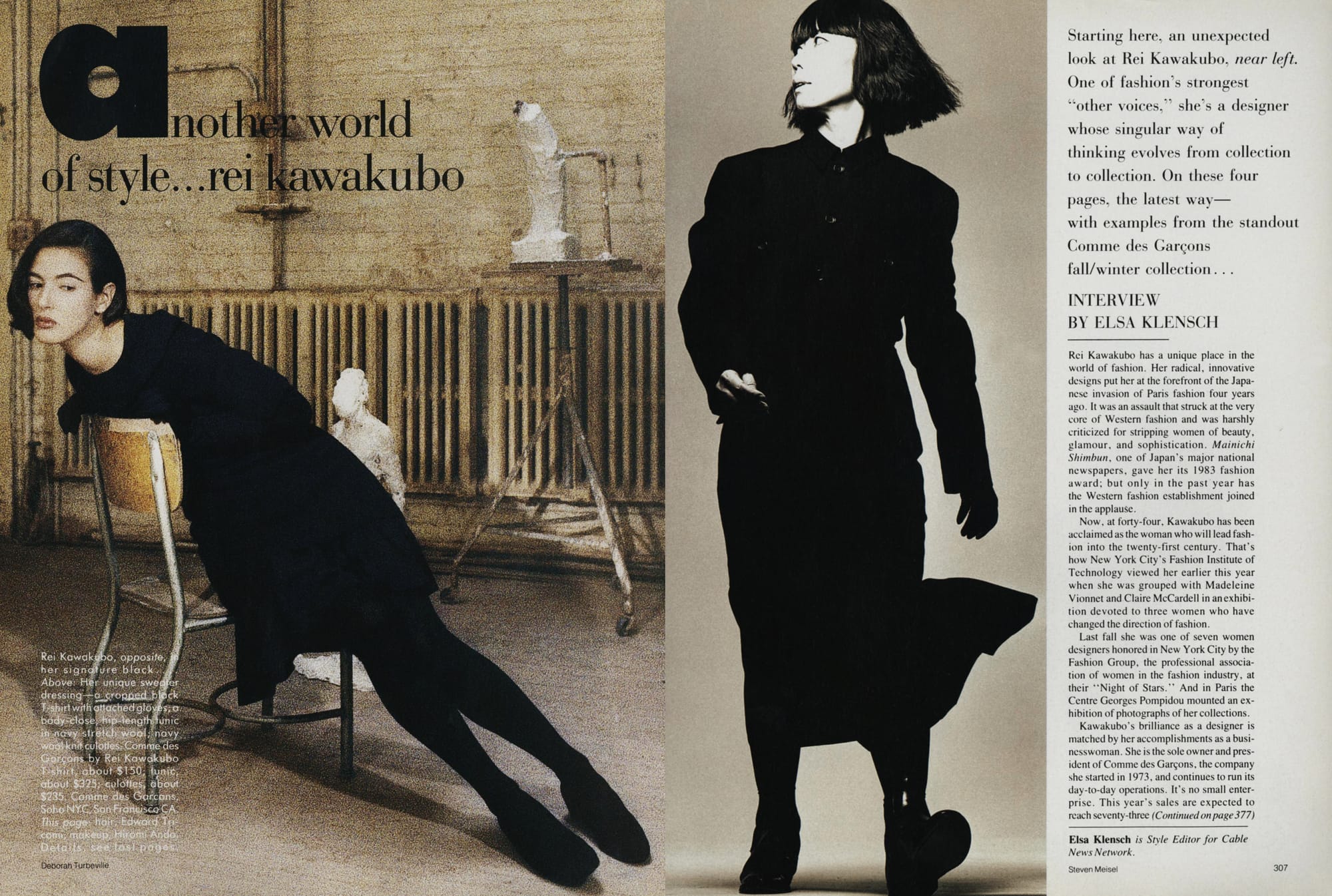
Starting here, an unexpected look at Rei Kawakubo, near left. One of fashion’s strongest “other voices,” she’s a designer whose singular way of thinking evolves from collection to collection. On these four pages, the latest way — with examples from the standout Comme des Garçons fall/winter collection.
Interview by Elsa Klensch
Photographs by Steven Meisel
Rei Kawakubo has a unique place in the world of fashion. Her radical, innovative designs put her at the forefront of the Japanese invasion of Paris fashion four years ago. It was an assault that struck at the very core of Western fashion and was harshly criticized for stripping women of beauty, glamour, and sophistication.
Mainichi Shimbun, one of Japan’s major national newspapers, gave her its 1983 fashion award; but only in the past year has the Western fashion establishment joined in the applause.
Now, at forty-four, Kawakubo has been acclaimed as the woman who will lead fashion into the twenty-first century. That’s how New York City’s Fashion Institute of Technology viewed her earlier this year when she was grouped with Madeleine Vionnet and Claire McCardell in an exhibition devoted to three women who have changed the direction of fashion.
Last fall she was one of seven women designers honored in New York City by the Fashion Group, the professional association of women in the fashion industry, at their “Night of Stars.” And in Paris the Centre Georges Pompidou mounted an exhibition of photographs of her collections.
Kawakubo’s brilliance as a designer is matched by her accomplishments as a businesswoman. She is the sole owner and president of Comme des Garçons, the company she started in 1973, and continues to run its day-to-day operations. It’s no small enterprise. This year’s sales are expected to reach seventy-three million dollars. The company has 254 outlets in Japan and fifteen in the U.S., and fifty-four in other countries around the world, including its own boutiques in Paris and New York City.
Rei Kawakubo is extremely shy and dislikes discussing her private life — particularly her relationship with designer Yohji Yamamoto. But as a businesswoman she is sharp and decisive, constantly planning the expansion of her company and the welfare of her three hundred employees. Here, she talks about the creative and business sides of her life.
Elsa Klensch: Which is more important to you, being the designer or the president?
Rei Kawakubo: Designing is more important, but I have never felt any conflict.
EK: Do you consult many people before making a decision, or do you know intuitively what’s right?
RK: Basically it’s intuitive, but that doesn’t mean that after I’ve made a decision I don’t ask others what they think.
EK: A woman who heads a company she created must be nearly unique in Japan.
RK: I’m not unique in that respect. Several Japanese women have done that. The one unique thing is that I’ve been a successful designer even though I did not have formal training in design.
EK: Do you see a pattern in the way women around the world are dressing? Is it more casual, say, or more dressy?
RK: The biggest change I see is that more and more women are dressing to suit their lifestyles. There’s no longer a uniform way to dress. Women are dressing more freely.
EK: How do you describe the extraordinary evolution in the shape of your clothes?
RK: When I started showing in Paris I used a lot of fabric, a lot of wrapping. Now my clothes have become slimmer, in the Western sense. My spring collection was the most body-conscious I’ve done. Fall is slightly looser. I’m at the stage where I find it challenging to do interesting shapes in the simplest way.
EK: When you began designing, most of the collections were in black, natural, or indigo. Now you put new colors in each collection.
RK: I’ve always preferred black and dark blues. I use other colors in each collection, but I never know why I choose the particular ones.
EK: Are fabrics the most important part of the collection?
RK: I don’t have a set pattern. Sometimes there’s a certain shape that I have in my mind and then I go for shape first. But usually it’s simultaneous — I think of a certain shape and I think of a certain fabric.
EK: When did you first become interested in fashion?
RK: When I was about twenty-four. I’d been working in the advertising department of a textile company, and I was asked to style the print ads and TV commercials. I liked the work so much that after two years I decided to leave the firm and work as a freelance stylist.
EK: Later, when you decided to become a designer, was it because you couldn’t find clothes you thought were right for your work?
RK: It wasn’t so much that I couldn’t find the kinds of clothes I wanted. I was frustrated by the way we chose the clothes.
EK: When and how did you get started?
RK: In about 1969 I rented a room that was part of a Tokyo graphics design studio and set up with two assistants.
EK: What sort of clothes did you produce?
RK: Clothes I felt were modern and new. But they were commercial as well; I was in business, and I had to support myself.
EK: How did you decide on the name Comme des Garçons?
RK: I don’t remember exactly. I know I wanted something long, something with a ring to it. One of the people working with me said, “How about ‘Comme des Garçons’?” And I thought, “Why not?”
EK: Your own name has a ring to it.
RK: I didn’t think of myself as a designer. It was a business, a group of people working together. I wanted a name that would represent the whole group.
EK: In 1981 you began showing in Paris?
RK: By 1980 both the men’s and women’s collections were doing well and I wanted to expand into the international market. Paris was the place to show. I did a very small collection and showed it with six models in a room at the Hotel Inter-Continental.
EK: What was the reaction?
RK: I was very happy with it. Marie Claire, the French magazine, came to see it and several high-fashion specialty stores bought from me. The next season I came back to show in a hotel again, but after that I joined the Fédération Française de la Couture and showed with the French designers in the tents at the Louvre.
EK: Like many other famous women designers — Sonia Rykiel, for instance — you wear only black. Is that because it’s easy?
RK: I’d put it the other way around — black’s easy because I like black.
EK: How do you select your clothes for each season?
RK: As the president of the company as well as the designer I have to promote my own clothes. I go through the collection each season and pick out the three or four outfits that suit me.
EK: What sort of look do you like to project?
RK: I’m not in the entertainment business, so I’ve never really thought about it. I am what I am. I’ve never thought about building an image.
EK: Has your long friendship with Yohji Yamamoto affected the way you design?
RK: We don’t influence each other because we rarely talk about our designs.
EK: What gives you the most pleasure out of designing?
RK: It’s not pleasurable too often, I wish it were; but maybe it’s the moment when I see the first sample — seeing the fabric and the shape together and knowing it works. Those moments are great, but each collection is like passing an examination.
EK: What’s your ultimate aim as a designer?
RK: I’d like to keep right on as I have been doing, earning my living with my designs.
EK: And what’s your ultimate aim as a businesswoman?
RK: I’m not materialistic. I want to maintain my staff. I realize I’m an important person to my staff. I also hope that I can always be, as a businesswoman, excited by my designs. And that my staff, too, can remain excited.
EK: What personality traits have contributed most to your success?
RK: It’s not personality. It’s hard work. When Estée Lauder accepted her achievement award at the Fashion Group last fall she said she didn’t get where she got by chance. She worked.
It’s the same with me. I worked hard every day. That’s all it is — a lot of hard work.
Elsa Klensch is Style Editor for Cable News Network.
Hair: Edward Tricomi
Makeup: Hiromi Ando
Image Captions:
Opposite: Rei Kawakubo, in her signature black.
Above: Her unique way of dressing — a cropped black shirt with attached glove sleeves, a body-close, hip-length tunic in navy stretch wool, and navy wool knit culottes. Comme des Garçons by Rei Kawakubo. Shirt, about $150; tunic, about $295; culottes, about $285.Comme des Garçons, Soho, NYC; San Francisco, CA.
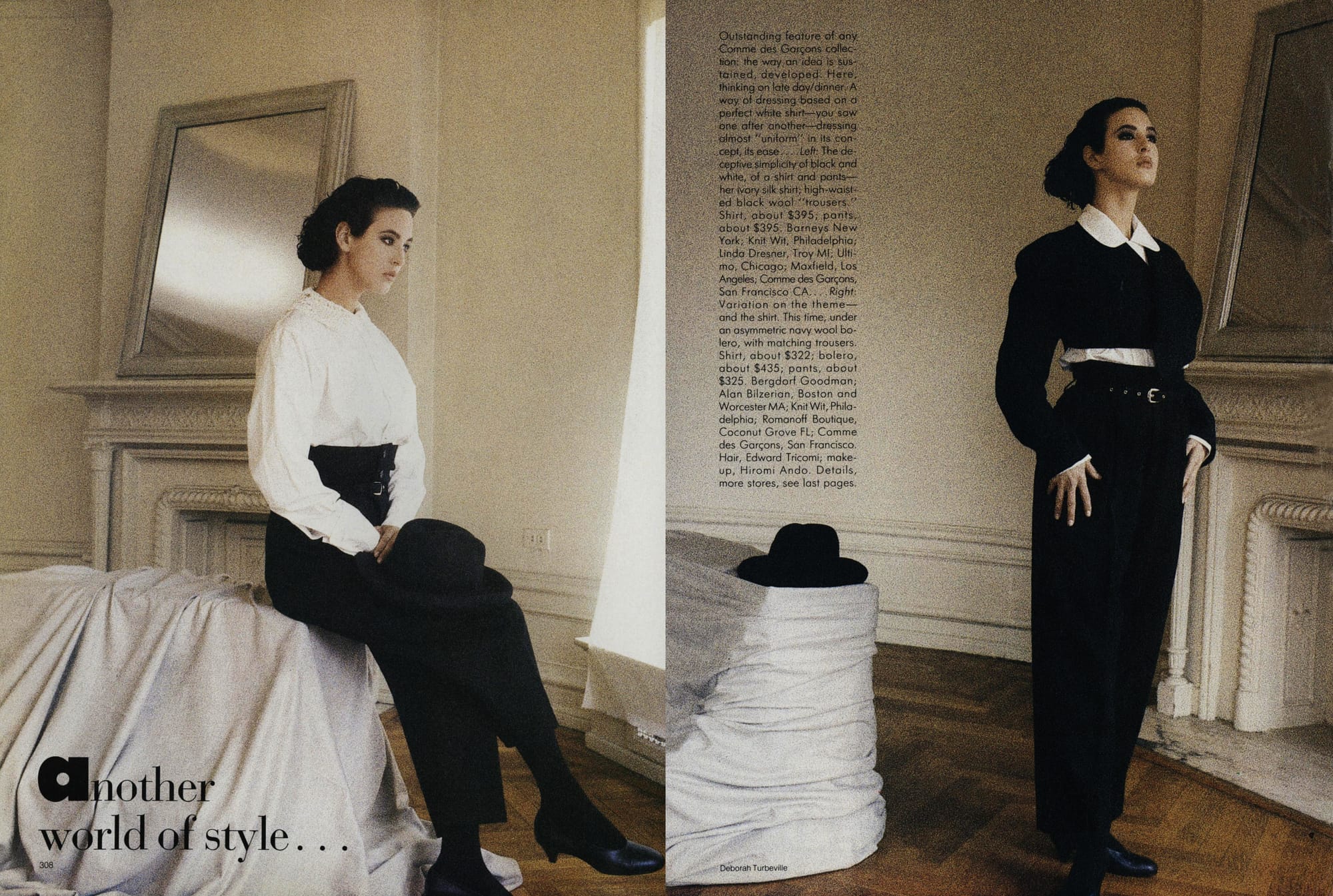
An outstanding feature of any Comme des Garçons collection is the way an idea is sustained and developed. Here, thinking for late day and dinner: a way of dressing based on the perfect white shirt — you see one after another — dressing almost “uniform” in its concept, its ease.
Left: The deceptive simplicity of black and white, of a shirt and pants — her ivory silk shirt with high-waisted black wool trousers. Shirt, about $395; pants, about $395. Available at: Barneys New York; Knit Wit, Philadelphia; Linda Dresner, Troy, MI; Ultimo, Chicago; Maxfield, Los Angeles; Comme des Garçons, San Francisco, CA. Right: A variation on the theme — and the shirt. This time under an asymmetric navy wool bolero with matching trousers. Shirt, about $322; bolero, about $435; pants, about $325. Available at: Bergdorf Goodman; Alan Bilzerian, Boston and Worcester, MA; Knit Wit, Philadelphia; Romanoff Boutique, Coconut Grove, FL; Comme des Garçons, San Francisco.