'Time Bomb' 15 Years of Hip Hop - VIBE Magazine December 1994
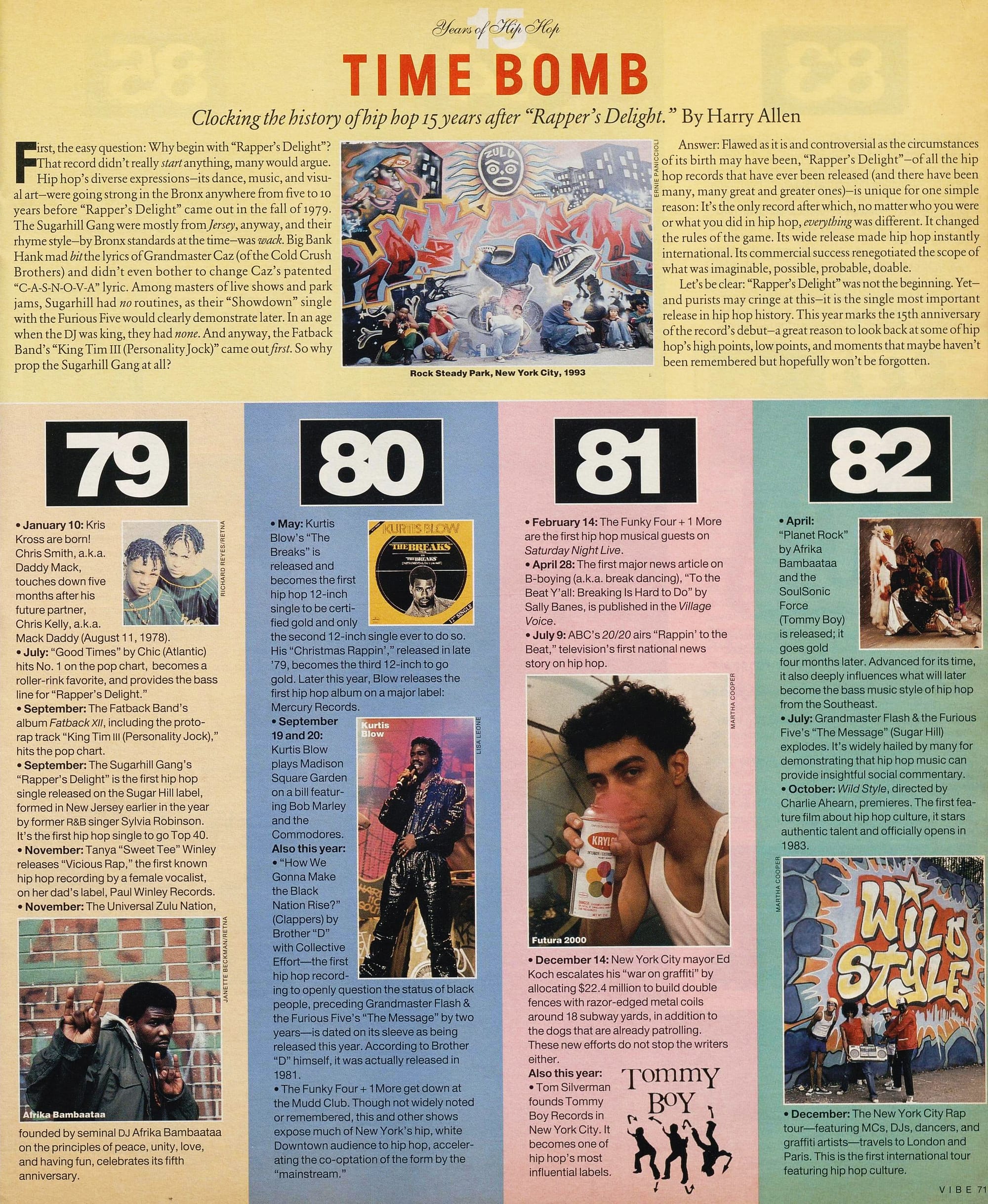
‘Time Bomb’ - Clocking the history of hip hop 15 years after "Rapper's Delight."
Writer: Harry Allen
First, the easy question: Why begin with "Rapper's Delight"? That record didn’t really start anything, many would argue. Hip hop's diverse expressions—its dance, music, and visual art—were going strong in the Bronx anywhere from five to 10 years before "Rapper's Delight" came out in the fall of 1979. The Sugarhill Gang were mostly from Jersey, anyway, and their rhyme style—by Bronx standards at the time—was wack. Big Bank Hank mad bit the lyrics of Grandmaster Caz (of the Cold Crush Brothers) and didn't even bother to change Caz's patented "C-A-S-N-O-V-A" lyric. Among masters of live shows and park jams, Sugarhill had no routines, as their "Showdown" single with the Furious Five would clearly demonstrate later. In an age when the DJ was king, they had none. And anyway, the Fatback Band's "King Tim III (Personality Jock)" came out first. So why prop the Sugarhill Gang at all?
Answer: Flawed as it is and controversial as the circumstances of its birth may have been, "Rapper's Delight"—of all the hip hop records that have ever been released (and there have been many, many great and greater ones)—is unique for one simple reason: It's the only record after which, no matter who you were or what you did in hip hop, everything was different. It changed the rules of the game. Its wide release made hip hop instantly international. Its commercial success renegotiated the scope of what was imaginable, possible, probable, doable.
Let's be clear: "Rapper's Delight" was not the beginning. Yet—and purists may cringe at this—it is the single most important release in hip hop history. This year marks the 15th anniversary of the record's debut—a great reason to look back at some of hip hop's high points, low points, and moments that maybe haven't been remembered but hopefully won't be forgotten.
1979:
• January 10: Kris Kross are born! Chris Smith, a.k.a. Daddy Mack, touches down five months after his future partner, Chris Kelly, a.k.a. Mack Daddy (August 11, 1978).
• July: "Good Times" by Chic (Atlantic) hits No. 1 on the pop chart, becomes a roller-rink favorite, and provides the bass line for "Rapper's Delight."
• September: The Fatback Band's album Fatback XII, including the proto-rap track "King Tim III (Personality Jock)," hits the pop chart.
• September: The Sugarhill Gang's "Rapper's Delight" is the first hip hop single released on the Sugar Hill label, formed in New Jersey earlier in the year by former R&B singer Sylvia Robinson. It's the first hip hop single to go Top 40.
• November: Tanya "Sweet Tee" Winley releases "Vicious Rap," the first known hip hop recording by a female vocalist, on her dad's label, Paul Winley Records.
• November: The Universal Zulu Nation, founded by seminal DJ Afrika Bambaataa on the principles of peace, unity, love, and having fun, celebrates its fifth anniversary.
1980:
May: Kurtis Blow's "The Breaks" is released and becomes the first hip hop 12-inch single to be certified gold and only the second 12-inch single ever to do so. His "Christmas Rappin", released in late 79, becomes the third 12-inch to go gold. Later this year, Blow releases the first hip hop album on a major label: Mercury Records.
• September 19 and 20: Kurtis Blow plays Madison Square Garden on a bill featuring Bob Marley and the Commodores.
Also this year:
• How We Gonna Make the Black Nation Rise? (Clappers) by Brother "D" with Collective Effort—the first hip hop recording to openly question the status of black people, preceding Grandmaster Flash & the Furious Five's "The Message" by two years—is dated on its sleeve as being released this year. According to Brother "D" himself, it was actually released in 1981.
• The Funky Four + 1 More get down at the Mudd Club. Though not widely noted or remembered, this and other shows expose much of New York's hip, white Downtown audience to hip hop, accelerating the co-optation of the form by the "mainstream."
1981:
• February 14: The Funky Four + 1 More are the first hip hop musical guests on Saturday Night Live.
• April 28: The first major news article on B-boying (a.k.a. break dancing), "To the Beat Y'all: Breaking Is Hard to Do" by Sally Banes, is published in the Village Voice.
• July 9: ABC's 20/20 airs "Rappin' to the Beat," television's first national news story on hip hop.
• December 14: New York City mayor Ed Koch escalates his "war on graffiti" by allocating $22.4 million to build double fences with razor-edged metal coils around 18 subway yards, in addition to the dogs that are already patrolling. These new efforts do not stop the writers either.
Also this year:
• Tom Silverman founds Tommy Boy Records in New York City. It becomes one of hip hop's most influential labels.
1982:
April: "Planet Rock" by Afrika Bambaataa and the SoulSonic Force (Tommy Boy) is released; it goes gold four months later. Advanced for its time, it also deeply influences what will later become the bass music style of hip hop from the Southeast.
• July: Grandmaster Flash & the Furious Five's The Message (Sugar Hill) explodes. It's widely hailed by many for demonstrating that hip hop music can provide insightful social commentary.
• October: "Wild Style", directed by Charlie Ahearn, premieres. The first feature film about hip hop culture, it stars authentic talent and officially opens in 1983.
• December: The New York City Rap tour—featuring MCs, DJs, dancers, and graffiti artists—travels to London and Paris. This is the first international tour featuring hip hop culture.
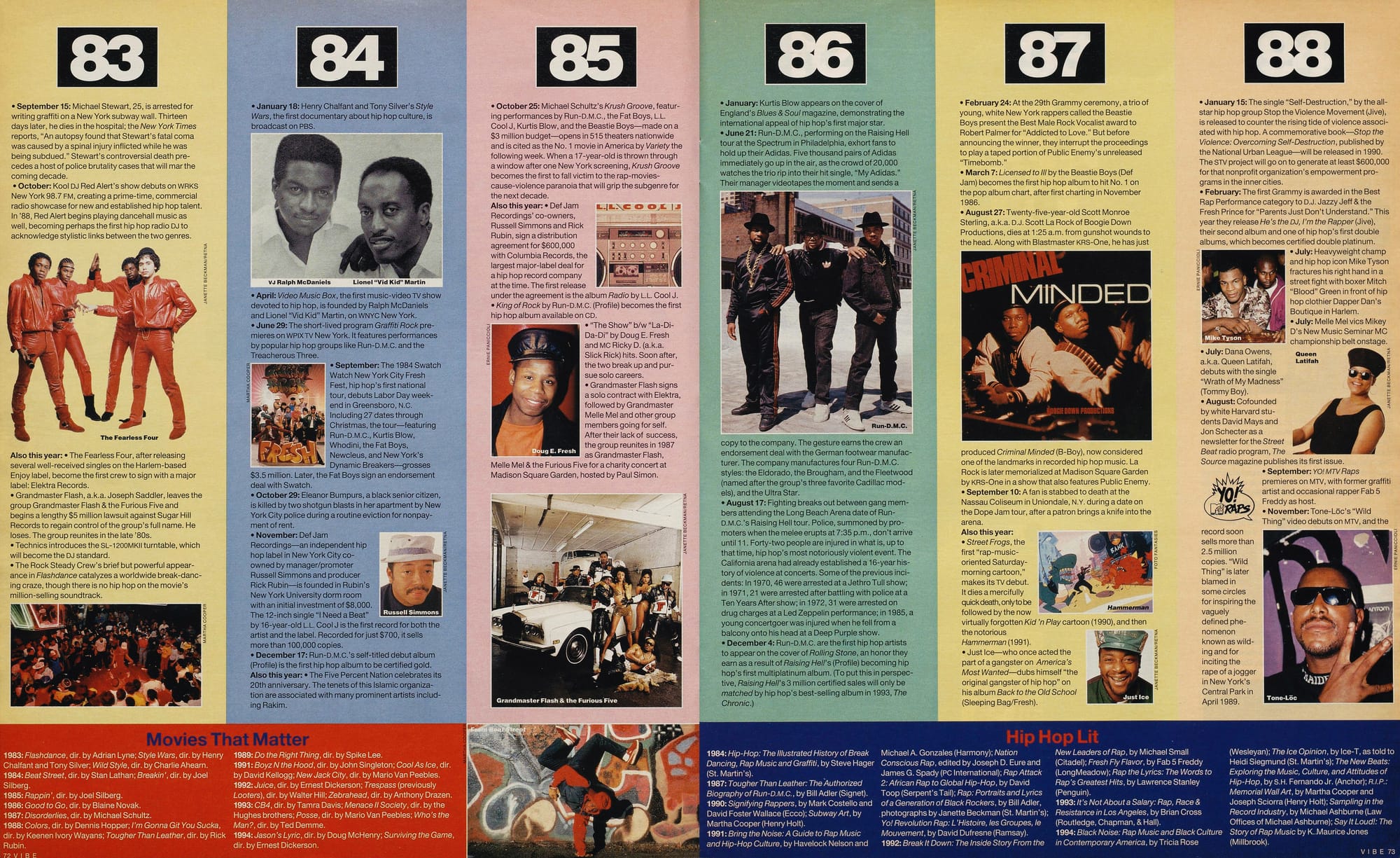
1983:
• September 15: Michael Stewart, 25, is arrested for writing graffiti on a New York subway wall. Thirteen days later, he dies in the hospital; the New York Times reports, "An autopsy found that Stewart's fatal coma was caused by a spinal injury inflicted while he was being subdued.” Stewart’s controversial death precedes a host of police brutality cases that will mar the coming decade.
• October: Kool DJ Red Alert's show debuts on WRKS New York 98.7 FM, creating a prime-time, commercial radio showcase for new and established hip hop talent. In '88, Red Alert begins playing dancehall music as well, becoming perhaps the first hip hop radio DJ to acknowledge stylistic links between the two genres.
Also this year:
• The Fearless Four, after releasing several well-received singles on the Harlem-based Enjoy label, became the first crew to sign with a major label: Elektra Records.
• Grandmaster Flash, a.k.a. Joseph Saddler, leaves the group Grandmaster Flash & the Furious Five and begins a lengthy $5 million lawsuit against Sugar Hill Records to regain control of the group's full name. He loses. The group reunites in the late '80s.
• Technics introduces the SL-1200MKII turntable, which will become the DJ standard.
• The Rock Steady Crew's brief but powerful appearance in Flashdance catalyzes a worldwide break-dancing craze, though there is no hip hop on the movie's million-selling soundtrack.
1984:
• January 18: Henry Chalfant and Tony Silver's "Style Wars", the first documentary about hip hop culture, is broadcast on PBS.
• April: Video Music Box, the first music-video TV show devoted to hip hop, is founded by Ralph McDaniels and Lionel "Vid Kid" Martin, on WNYC New York.
• June 29: The short-lived program Graffiti Rock premieres on WPIX TV New York. It features performances by popular hip hop groups like Run-D.M.C. and the Treacherous Three.
• September: The 1984 Swatch Watch New York City Fresh Fest, hip hop's first national tour, debuts Labor Day weekend in Greensboro, N.C. Including 27 dates through Christmas, the tour—featuring Run-D.M.C., Kurtis Blow, Whodini, the Fat Boys, Newcleus, and New York's Dynamic Breakers—grosses $3.5 million. Later, the Fat Boys sign an endorsement deal with Swatch.
• October 29: Eleanor Bumpurs, a black senior citizen, is killed by two shotgun blasts in her apartment by New York City police during a routine eviction for nonpayment of rent.
• November: Def Jam Recordings—an independent hip hop label in New York City co-owned by manager/promoter Russell Simmons and producer Rick Rubin—is founded in Rubin's New York University dorm room with an initial investment of $8,000. The 12-inch single "I Need a Beat" by 16-year-old L.L. Cool J is the first record for both the artist and the label. Recorded for just $700, it sells more than 100,000 copies.
• December 17: Run-D.M.C.'s self-titled debut album (Profile) is the first hip hop album to be certified gold.
Also this year:
• The Five Percent Nation celebrates its 20th anniversary. The tenets of this Islamic organization are associated with many prominent artists including Rakim.
1985:
• October 25: Michael Schultz's Krush Groove, featuring performances by Run-D.M.C., the Fat Boys, L.L. Cool J, Kurtis Blow, and the Beastie Boys—made on a $3 million budget—opens in 515 theaters nationwide and is cited as the No. 1 movie in America by Variety the following week. When a 17-year-old is thrown through a window after one New York screening, Krush Groove becomes the first to fall victim to the rap-movies-cause-violence paranoia that will grip the subgenre for the next decade.
Also this year:
• Def Jam Recordings' co-owners, Russell Simmons and Rick Rubin, sign a distribution agreement for $600,000 with Columbia Records, the largest major-label deal for a hip hop record company at the time. The first release under the agreement is the album Radio by L.L. Cool J.
• King of Rock by Run-D.M.C. (Profile) becomes the first hip hop album available on CD.
• "The Show" b/w "La-Di-Da-Di" by Doug E. Fresh and MC Ricky D. (a.k.a. Slick Rick) hits. Soon after, the two break up and pursue solo careers.
• Grandmaster Flash signs a solo contract with Elektra, followed by Grandmaster Melle Mel and other group members going for self. After their lack of success, the group reunites in 1987 as Grandmaster Flash, Melle Mel & the Furious Five for a charity concert at Madison Square Garden, hosted by Paul Simon.
1986:
• January: Kurtis Blow appears on the cover of England's Blues & Soul magazine, demonstrating the international appeal of hip hop's first major star.
• June 21: Run-D.M.C., performing on the Raising Hell tour at the Spectrum in Philadelphia, exhort fans to hold up their Adidas. Five thousand pairs of Adidas immediately go up in the air, as the crowd of 20,000 watches the trio rip into their hit single, "My Adidas." Their manager videotapes the moment and sends a copy to the company. The gesture earns the crew an endorsement deal with the German footwear manufacturer. The company manufactures four Run-D.M.C. styles: the Eldorado, the Brougham, and the Fleetwood (named after the group's three favorite Cadillac models), and the Ultra Star.
• August 17: Fighting breaks out between gang members attending the Long Beach Arena date of Run-D.M.C.'s Raising Hell tour. Police, summoned by promoters when the melee erupts at 7:35 p.m., don't arrive until 11. Forty-two people are injured in what is, up to that time, hip hop's most notoriously violent event. The California arena had already established a 16-year history of violence at concerts. Some of the previous incidents: In 1970, 46 were arrested at a Jethro Tull show; in 1971, 21 were arrested after battling with police at a Ten Years After show; in 1972, 31 were arrested on drug charges at a Led Zeppelin performance; in 1985, a young concertgoer was injured when he fell from a balcony onto his head at a Deep Purple show.
• December 4: Run-D.M.C. are the first hip hop artists to appear on the cover of Rolling Stone, an honor they earn as a result of Raising Hell's (Profile) becoming hip hop's first multiplatinum album. (To put this in perspective, Raising Hell's 3 million certified sales will only be matched by hip hop's best-selling album in 1993, The Chronic.)
1987:
• February 24: At the 29th Grammy ceremony, a trio of young, white New York rappers called the Beastie Boys present the Best Male Rock Vocalist award to Robert Palmer for "Addicted to Love." But before announcing the winner, they interrupt the proceedings to play a taped portion of Public Enemy's unreleased "Timebomb."
• March 7: Licensed to Ill by the Beastie Boys (Def Jam) becomes the first hip hop album to hit No. 1 on the pop album chart, after first charting in November 1986.
• August 27: Twenty-five-year-old Scott Monroe Sterling, a.k.a. D.J. Scott La Rock of Boogie Down Productions, dies at 1:25 a.m. from gunshot wounds to the head. Along with Blastmaster KRS-One, he has just produced Criminal Minded (B-Boy), now considered one of the landmarks in recorded hip hop music. La Rock is later memorialized at Madison Square Garden by KRS-One in a show that also features Public Enemy.
• September 10: A fan is stabbed to death at the Nassau Coliseum in Uniondale, N.Y. during a date on the Dope Jam tour, after a patron brings a knife into the arena.
Also this year:
• Street Frogs, the first "rap-music-oriented Saturday-morning cartoon," makes its TV debut. It dies a mercifully quick death, only to be followed by the now virtually forgotten Kid 'n Play cartoon (1990), and then the notorious Hammerman (1991).
• Just Ice—who once acted the part of a gangster on America's Most Wanted—dubs himself "the original gangster of hip hop" on his album Back to the Old School Just Ice (Sleeping Bag/Fresh).
1988:
• January 15: The single "Self-Destruction," by the all-star hip hop group Stop the Violence Movement (Jive), is released to counter the rising tide of violence associated with hip hop. A commemorative book—Stop the Violence: Overcoming Self-Destruction, published by the National Urban League will be released in 1990. The STV project will go on to generate at least $600,000 for that nonprofit organization's empowerment programs in the inner cities.
• February: The first Grammy is awarded in the Best Rap Performance category to D.J. Jazzy Jeff & the Fresh Prince for "Parents Just Don't Understand." This year they release He's the DJ, I'm the Rapper (Jive), their second album and one of hip hop's first double albums, which becomes certified double platinum.
• July: Heavyweight champ and hip hop icon Mike Tyson fractures his right hand in a street fight with boxer Mitch "Blood" Green in front of hip hop clothier Dapper Dan's Boutique in Harlem.
• July: Melle Mel vics Mikey D's New Music Seminar MC championship belt onstage.
• July: Dana Owens, a.k.a. Queen Latifah, debuts with the single "Wrath of My Madness" (Tommy Boy).
• August: Cofounded by white Harvard students David Mays and Jon Schecter as a newsletter for the Street Beat radio program, The Source magazine publishes its first issue.
• September: YO! MTV Raps premieres on MTV, with former graffiti artist and occasional rapper Fab 5 Freddy as host.
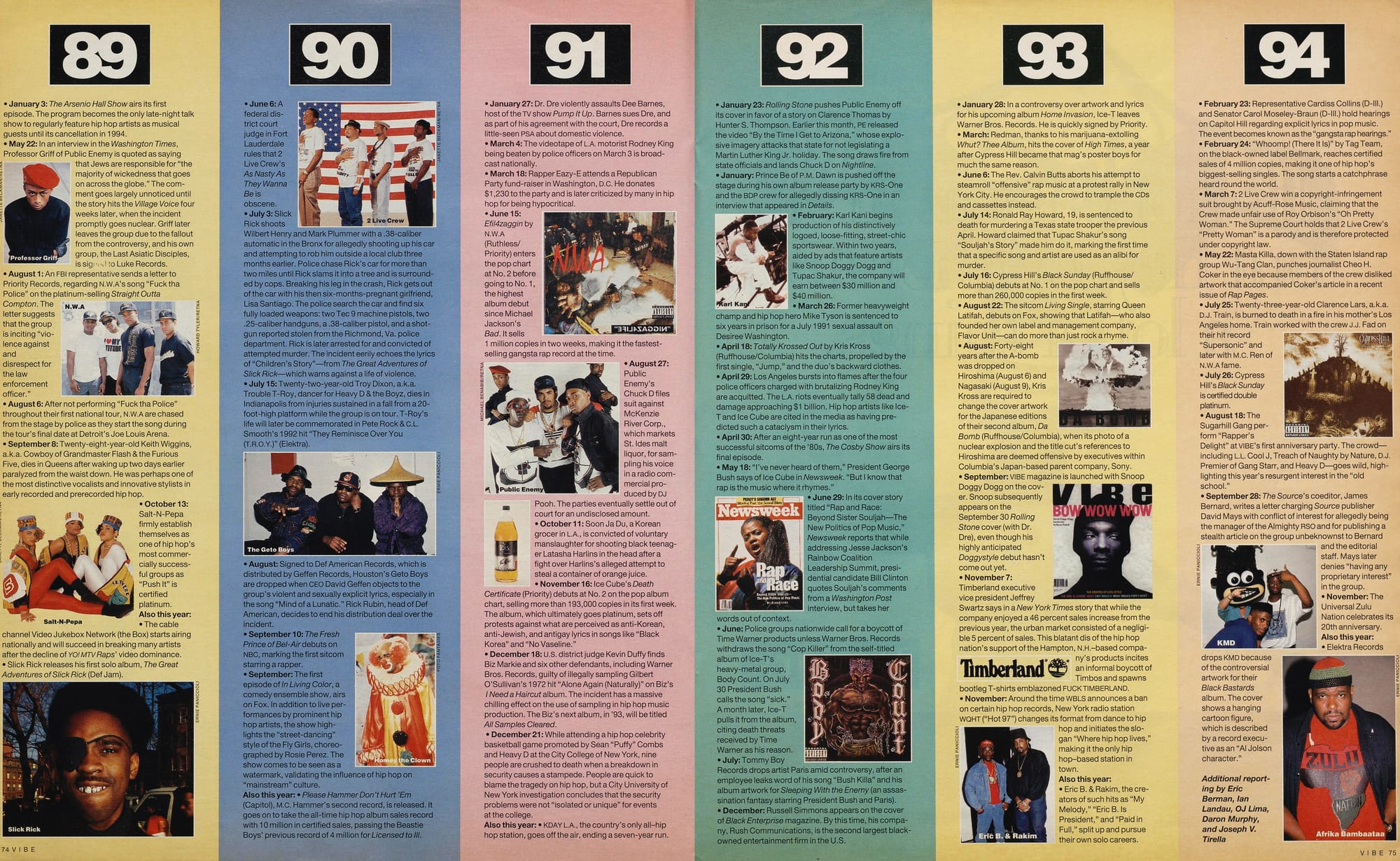
1989:
• January 3: The Arsenio Hall Show airs its first episode. The program becomes the only late-night talk show to regularly feature hip hop artists as musical guests until its cancellation in 1994.
• May 22: In an interview in the Washington Times, Professor Griff of Public Enemy is quoted as saying that Jews are responsible for "the majority of wickedness that goes on across the globe." The comment goes largely unnoticed until the story hits the Village Voice four weeks later, when the incident promptly goes nuclear. Griff later leaves the group due to the fallout from the controversy, and his own group, the Last Asiatic Disciples, signed to Luke Records.
• August 1: An FBI representative sends a letter to Priority Records, regarding N.W.A's song "Fuck tha Police" on the platinum-selling Straight Outta Compton. The letter suggests that the group is inciting "violence against and disrespect for the law enforcement officer."
• August 6: After not performing "Fuck tha Police" throughout their first national tour, N.W.A are chased from the stage by police as they start the song during the tour's final date at Detroit's Joe Louis Arena.
• September 8: Twenty-eight-year-old Keith Wiggins, a.k.a. Cowboy of Grandmaster Flash & the Furious Five, dies in Queens after waking up two days earlier paralyzed from the waist down. He was perhaps one of the most distinctive vocalists and innovative stylists in early recorded and prerecorded hip hop.
• October 13: Salt-N-Pepa firmly establish themselves as one of hip hop's most commercially successful groups as "Push It" is certified platinum.
Also this year:
• The cable channel Video Jukebox Network (the Box) starts airing nationally and will succeed in breaking many artists after the decline of YO! MTV Raps' video dominance.
• Slick Rick releases his first solo album, The Great Adventures of Slick Rick (Def Jam).
1990:
• June 6: A federal district court judge in Fort Lauderdale rules that 2 Live Crew's As Nasty As They Wanna Be is obscene.
• July 3: Slick Rick shoots Wilbert Henry and Mark Plummer with a .38-caliber automatic in the Bronx for allegedly shooting up his car and attempting to rob him outside a local club three months earlier. Police chase Rick's car for more than two miles until Rick slams it into a tree and is surrounded by cops. Breaking his leg in the crash, Rick gets out of the car with his then six-months-pregnant girlfriend, Lisa Santiago. The police search the car and find six fully loaded weapons: two Tec 9 machine pistols, two .25-caliber handguns, a .38-caliber pistol, and a shotgun reported stolen from the Richmond, Va. police department. Rick is later arrested for and convicted of attempted murder. The incident eerily echoes the lyrics of "Children's Story"—from The Great Adventures of Slick Rick—which warns against a life of violence.
• July 15: Twenty-two-year-old Troy Dixon, a.k.a. Trouble T-Roy, dancer for Heavy D & the Boyz, dies in Indianapolis from injuries sustained in a fall from a 20-foot-high platform while the group is on tour. T-Roy's life will later be commemorated in Pete Rock & C.L. Smooth's 1992 hit "They Reminisce Over You (T.R.O.Y.)" (Elektra).
• August: Signed to Def American Records, which is distributed by Geffen Records, Houston's Geto Boys are dropped when CEO David Geffen objects to the group's violent and sexually explicit lyrics, especially in the song "Mind of a Lunatic." Rick Rubin, head of Def American, decides to end his distribution deal over the incident.
• September 10: The Fresh Prince of Bel-Air debuts on NBC, marking the first sitcom starring a rapper.
• September: The first episode of In Living Color, a comedy ensemble show, airs on Fox. In addition to live performances by prominent hip hop artists, the show highlights the "street-dancing" style of the Fly Girls, choreographed by Rosie Perez. The show comes to be seen as a watermark, validating the influence of hip hop on "mainstream" culture.
Also this year:
• Please Hammer Don't Hurt 'Em (Capitol), M.C. Hammer's second record, is released. It goes on to take the all-time hip hop album sales record with 10 million in certified sales, passing the Beastie Boys' previous record of 4 million for Licensed to III.
1991:
• January 27: Dr. Dre violently assaults Dee Barnes, host of the TV show Pump It Up. Barnes sues Dre, and as part of his agreement with the court, Dre records a little-seen PSA about domestic violence.
• March 4: The videotape of L.A. motorist Rodney King being beaten by police officers on March 3 is broadcast nationally.
• March 18: Rapper Eazy-E attends a Republican Party fund-raiser in Washington, D.C. He donates $1,230 to the party and is later criticized by many in hip hop for being hypocritical.
• June 15: Efil4zaggin by N.W.A (Ruthless/ Priority) enters the pop chart at No. 2 before going to No. 1, the highest album debut since Michael Jackson’s Bad. It sells 1 million copies in two weeks, making it the fastest-selling gangsta rap record at the time.
• August 27: Public Enemy's Chuck D files suit against McKenzie River Corp., which markets St. Ides malt liquor, for sampling his voice in a radio commercial produced by DJ Pooh. The parties eventually settle out of court for an undisclosed amount.
• October 11: Soon Ja Du, a Korean grocer in L.A., is convicted of voluntary manslaughter for shooting black teenager Latasha Harlins in the head after a fight over Harlins's alleged attempt to steal a container of orange juice.
• November 16: Ice Cube's Death Certificate (Priority) debuts at No. 2 on the pop album chart, selling more than 193,000 copies in its first week. The album, which ultimately goes platinum, sets off protests against what are perceived as anti-Korean, anti-Jewish, and anti-gay lyrics in songs like "Black Korea" and "No Vaseline."
• December 18: U.S. district judge Kevin Duffy finds Biz Markie and six other defendants, including Warner Bros. Records, guilty of illegally sampling Gilbert O'Sullivan's 1972 hit "Alone Again (Naturally)" on Biz's / Need a Haircut album. The incident has a massive chilling effect on the use of sampling in hip hop music production. The Biz's next album, in '93, will be titled All Samples Cleared.
• December 21: While attending a hip hop celebrity basketball game promoted by Sean "Puffy" Combs and Heavy D at the City College of New York, nine people are crushed to death when a breakdown in security causes a stampede. People are quick to blame the tragedy on hip hop, but a City University of New York investigation concludes that the security problems were not "isolated or unique" for events at the college.
Also this year:
• KDAY L.A., the country's only all-hip hop station, goes off the air, ending a seven-year run.
1992:
• January 23: Rolling Stone pushes Public Enemy off its cover in favor of a story on Clarence Thomas by Hunter S. Thompson. Earlier this month, PE released the video "By the Time I Get to Arizona," whose explosive imagery attacks that state for not legislating a Martin Luther King Jr. holiday. The song draws fire from state officials and lands Chuck D on Nightline.
• January: Prince Be of P.M. Dawn is pushed off the stage during his own album release party by KRS-One and the BDP crew for allegedly dissing KRS-One in an interview that appeared in Details.
• February: Karl Kani begins production of his distinctively logoed, loose-fitting, street-chic sportswear. Within two years, aided by ads that feature artists like Snoop Doggy Dogg and Tupac Shakur, the company will earn between $30 million and $40 million.
• March 26: Former heavyweight champ and hip hop hero Mike Tyson is sentenced to six years in prison for a July 1991 sexual assault on Desiree Washington.
• April 18: Totally Krossed Out by Kris Kross (Ruffhouse/Columbia) hits the charts, propelled by the first single, "Jump," and the duo's backward clothes.
• April 29: Los Angeles bursts into flames after the four police officers charged with brutalizing Rodney King are acquitted. The L.A. riots eventually tally 58 dead and damage approaching $1 billion. Hip hop artists like Ice-T and Ice Cube are cited in the media as having predicted such a cataclysm in their lyrics.
• April 30: After an eight-year run as one of the most successful sitcoms of the '80s, The Cosby Show airs its final episode.
• May 18: "I've never heard of them," President George Bush says of Ice Cube in Newsweek. "But I know that rap is the music where it rhymes."
• June 29: In its cover story titled "Rap and Race: Beyond Sister Souljah - The New Politics of Pop Music," Newsweek reports that while addressing Jesse Jackson's Rainbow Coalition Leadership Summit, presidential candidate Bill Clinton quotes Souljah's comments from a Washington Post interview, but takes her words out of context.
• June: Police groups nationwide call for a boycott of Time Warner products unless Warner Bros. Records withdraws the song "Cop Killer" from the self-titled album of Ice-T's heavy-metal group, Body Count. On July 30 President Bush calls the song "sick." A month later, Ice-T pulls it from the album, citing death threats received by Time Warner as his reason.
• July: Tommy Boy Records drops artist Paris amid controversy, after an employee leaks word of his song "Bush Killa" and his album artwork for Sleeping With the Enemy (an assassination fantasy starring President Bush and Paris.)
• December: Russell Simmons appears on the cover of Black Enterprise magazine. By this time, his company, Rush Communications, is the second largest black-owned entertainment firm in the U.S.
1993:
• January 28: In a controversy over artwork and lyrics for his upcoming album Home Invasion, Ice-T leaves Warner Bros. Records. He is quickly signed by Priority.
• March: Redman, thanks to his marijuana-extolling Whut? Thee Album, hits the cover of High Times, a year after Cypress Hill became that mag's poster boys for much the same reason.
• June 6: The Rev. Calvin Butts aborts his attempt to steamroll "offensive" rap music at a protest rally in New York City. He encourages the crowd to trample the CDs and cassettes instead.
• July 14: Ronald Ray Howard, 19, is sentenced to death for murdering a Texas state trooper the previous April. Howard claimed that Tupac Shakur's song "Souljah's Story" made him do it, marking the first time that a specific song and artist are used as an alibi for murder.
• July 16: Cypress Hill's Black Sunday (Ruffhouse/ Columbia) debuts at No. 1 on the pop chart and sells more than 260,000 copies in the first week.
• August 22: The sitcom Living Single, starring Queen Latifah, debuts on Fox, showing that Latifah—who also founded her own label and management company, Flavor Unit—can do more than just rock a rhyme.
• August: Forty-eight years after the A-bomb was dropped on Hiroshima (August 6) and Nagasaki (August 9), Kris Kross are required to change the cover artwork for the Japanese editions of their second album, Da Bomb (Ruffhouse/Columbia), when its photo of a nuclear explosion and the title cut's references to Hiroshima are deemed offensive by executives within Columbia's Japan-based parent company, Sony.
• September: VIBE magazine is launched with Snoop Doggy Dogg on the cover. Snoop subsequently appears on the September 30 Rolling Stone cover (with Dr. Dre), even though his highly anticipated Doggystyle debut hasn't come out.
• November 7: Timberland executive vice president Jeffrey Swartz says in a New York Times story that while the company enjoyed a 46 percent sales increase from the previous year, the urban market consisted of a negligible 5 percent of sales. This blatant dis of the hip hop nation's support of the Hampton, N.H.-based company’s products incites an informal boycott of Timbos and spawns bootleg T-Shirt’s emblazoned “Fuck Timberland”.
• November: Around the time WBLS announces a ban on certain hip hop records, New York radio station WQHT ("Hot 97") changes its format from dance to hip hop and initiates the slogan "Where hip hop lives," making it the only hip hop-based station in town.
Also this year:
• Eric B. & Rakim, the creators of such hits as "My Melody," "Eric B. Is President," and "Paid in Full," split up and pursue their own solo careers.
1994:
• February 23: Representative Cardiss Collins (D-III.) and Senator Carol Moseley-Braun (D-III.) hold hearings on Capitol Hill regarding explicit lyrics in pop music. The event becomes known as the "gangsta rap hearings."
• February 24: "Whoomp! (There It Is)" by Tag Team, on the black-owned label Bellmark, reaches certified sales of 4 million copies, making it one of hip hop's biggest-selling singles. The song starts a catchphrase heard round the world.
• March 7: 2 Live Crew win a copyright-infringement suit brought by Acuff-Rose Music, claiming that the Crew made unfair use of Roy Orbison's "Oh Pretty Woman." The Supreme Court holds that 2 Live Crew's "Pretty Woman" is a parody and is therefore protected under copyright law.
• May 22: Masta Killa, down with the Staten Island rap group Wu-Tang Clan, punches journalist Cheo H. Coker in the eye because members of the crew disliked artwork that accompanied Coker's article in a recent issue of Rap Pages.
• July 25: Twenty-three-year-old Clarence Lars, a.k.a. D.J. Train, is burned to death in a fire in his mother's Los Angeles home. Train worked with the crew J.J. Fad on their hit record "Supersonic" and later with M.C. Ren of N.W.A fame.
• July 26: Cypress Hill's Black Sunday is certified double platinum.
• August 18: The Sugarhill Gang perform "Rapper's Delight" at VIBE's first anniversary party. The crowd—including L.L. Cool J, Treach of Naughty by Nature, D.J. Premier of Gang Starr, and Heavy D—goes wild, highlighting this year's resurgent interest in the "old school."
• September 28: The Source's coeditor, James Bernard, writes a letter charging Source publisher David Mays with conflict of interest for allegedly being the manager of the Almighty RSO and for publishing a stealth article on the group unbeknownst to Bernard and the editorial staff. Mays later denies "having any proprietary interest" in the group.
• November: The Universal Zulu Nation celebrates its 20th anniversary.
Also this year:
• Elektra Records drops KMD because of the controversial artwork for their Black Bastards album. The cover shows a hanging cartoon figure, which is described by a record executive as an "Al Jolson character."
Additional reporting by Eric Berman, lan Landau, OJ Lima, Daron Murphy, and Joseph V. Tirella
Movies That Matter:
1983: Flashdance, dir. by Adrian Lyne; Style Wars, dir. by Henry Chalfant and Tony Silver; Wild Style, dir. by Charlie Ahearn.
1984: Beat Street, dir. by Stan Lathan; Breakin', dir. by Joel Silberg.
1985: Rappin', dir. by Joel Silberg.
1986: Good to Go, dir. by Blaine Novak.
1987: Disorderlies, dir. by Michael Schultz.
1988: Colors, dir. by Dennis Hopper; I'm Gonna Git You Sucka, dir. by Keenen Ivory Wayans; Tougher Than Leather, dir. by Rick Rubin.
1989: Do the Right Thing, dir. by Spike Lee.
1991: Boyz N the Hood, dir. by John Singleton; Cool As Ice, dir. by David Kellogg; New Jack City, dir. by Mario Van Peebles.
1992: Juice, dir. by Ernest Dickerson; Trespass (previously Looters), dir. by Walter Hill; Zebrahead, dir. by Anthony Drazen.
1993: CB4, dir. by Tamra Davis; Menace // Society, dir. by the Hughes brothers; Posse, dir. by Mario Van Peebles; Who's the Man?, dir. by Ted Demme.
1994: Jason's Lyric, dir. by Doug McHenry; Surviving the Game, dir. by Ernest Dickerson.
Hip Hop Lit:
1984: Hip-Hop: The Illustrated History of Break Dancing, Rap Music and Graffiti, by Steve Hager (St. Martin's).
1987: Tougher Than Leather: The Authorized Biography of Run-D.M.C., by Bill Adler (Signet).
1990: Signifying Rappers, by Mark Costello and David Foster Wallace (Ecco); Subway Art, by Martha Cooper (Henry Holt).
1991: Bring the Noise: A Guide to Rap Music and Hip-Hop Culture, by Havelock Nelson and Michael A. Gonzales (Harmony); Nation Conscious Rap, edited by Joseph D. Eure and James G. Spady (PC International); Rap Attack 2: African Rap to Global Hip-Hop, by David Toop (Serpent's Tail); Rap: Portraits and Lyrics of a Generation of Black Rockers, by Bill Adler, . photographs by Janette Beckman (St. Martin's); Yo! Revolution Rap: L'Histoire, les Groupes, le Mouvement, by David Dufresne (Ramsay).
1992: Break It Down: The Inside Story From the New Leaders of Rap, by Michael Small (Citadel); Fresh Fly Flavor, by Fab 5 Freddy (LongMeadow); Rap the Lyrics: The Words to Rap's Greatest Hits, by Lawrence Stanley (Penguin).
1993: It's Not About a Salary: Rap, Race & Resistance in Los Angeles, by Brian Cross (Routledge, Chapman, & Hall).
1994: Black Noise: Rap Music and Black Culture in Contemporarv America, by Tricia Rose (Wesleyan); The Ice Opinion, by Ice-T, as told to Heidi Siegmund (St. Martin's); The New Beats: Exploring the Music, Culture, and Attitudes of Hip-Hop, by S.H. Fernando Jr. (Anchor); R.I.P.: Memorial Wall Art, by Martha Cooper and Joseph Sciorra (Henry Holt); Sampling in the Record Industry, by Michael Ashburne (Law Offices of Michael Ashburne); Say It Loud!: The Story of Rap Music by K.Maurice Jones (Millbrook).